## Bar Chart: Comparison of Base Prompt and Iteration 3 Performance
### Overview
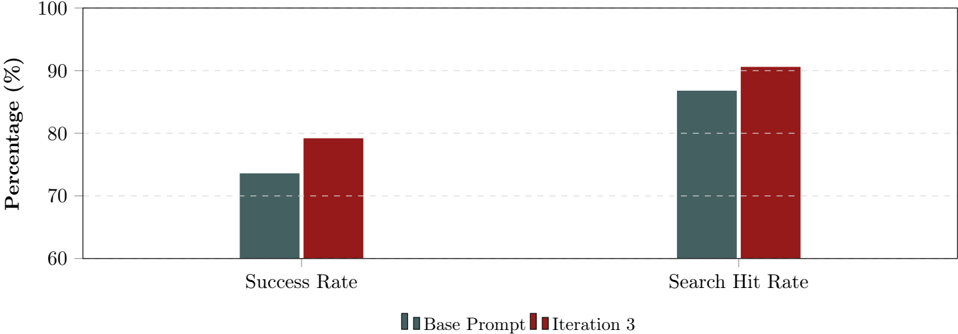
This grouped bar chart compares the performance of two prompt strategies, "Base Prompt" and "Iteration 3," across two metrics: "Success Rate" and "Search Hit Rate." The chart shows the percentage achieved for each metric by both prompt types.
### Components/Axes
* **Y-axis:** Labeled "Percentage (%)". The scale ranges from 60 to 100, with major grid lines at 10-percentage-point intervals (60, 70, 80, 90, 100).
* **X-axis:** Represents two distinct categories of performance metrics:
* **Success Rate**
* **Search Hit Rate**
* **Legend:** Located at the bottom center of the chart, it defines the two data series:
* **Base Prompt:** Represented by a dark teal/grey bar.
* **Iteration 3:** Represented by a dark red/maroon bar.
### Detailed Analysis
The chart presents the following approximate data points for each metric and prompt type:
* **Success Rate:**
* **Base Prompt (Teal):** The bar reaches approximately **73-74%**.
* **Iteration 3 (Red):** The bar reaches approximately **79-80%**.
* **Trend:** Iteration 3 shows a clear improvement over the Base Prompt for the Success Rate.
* **Search Hit Rate:**
* **Base Prompt (Teal):** The bar reaches approximately **86-87%**.
* **Iteration 3 (Red):** The bar reaches approximately **90-91%**.
* **Trend:** Iteration 3 also shows an improvement over the Base Prompt for the Search Hit Rate, though the absolute increase is slightly smaller than for the Success Rate.
### Key Observations
* **Consistent Improvement:** For both "Success Rate" and "Search Hit Rate," the "Iteration 3" prompt outperforms the "Base Prompt."
* **Higher Overall Search Hit Rate:** Both prompt types achieve higher percentages for the "Search Hit Rate" (above 85%) compared to the "Success Rate" (below 80%).
* **Magnitude of Improvement:** The improvement from the Base Prompt to Iteration 3 is approximately 6 percentage points for the Success Rate and approximately 4 percentage points for the Search Hit Rate.
### Interpretation
The data demonstrates that the iterative process (leading to "Iteration 3") has successfully improved the performance of the prompt. This improvement is evident in both the overall success of the task ("Success Rate") and the ability to find relevant information ("Search Hit Rate"). The fact that the Search Hit Rate is consistently higher than the Success Rate suggests that while the system is good at finding relevant information, it is slightly less effective at successfully completing the overall task based on that information. The iterative refinement has helped to close this gap and improve performance across the board.