## Bar Charts: Resolved by Turn (GPT 4, Full) and Resolved by Turn (Claude 3 Opus, Full)
### Overview
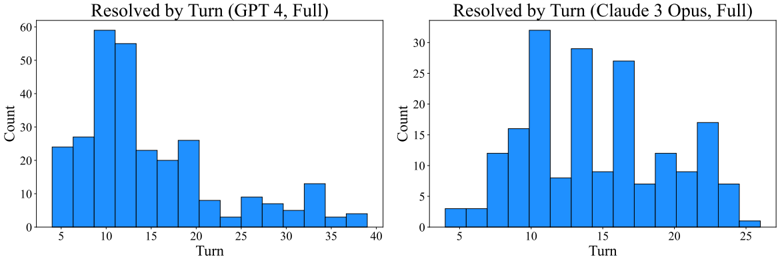
The image contains two side-by-side bar charts comparing the distribution of task resolutions across turns for two AI models: GPT 4 and Claude 3 Opus. Both charts use "Turn" as the x-axis and "Count" as the y-axis, with distinct ranges and distributions for each model.
---
### Components/Axes
#### Left Chart (GPT 4, Full)
- **Title**: "Resolved by Turn (GPT 4, Full)"
- **X-axis (Turn)**: Discrete intervals from 5 to 40 (inclusive), labeled in increments of 5.
- **Y-axis (Count)**: Continuous scale from 0 to 60, labeled in increments of 10.
- **Bars**: Blue, with heights corresponding to resolution counts per turn.
- **Key Data Points**:
- Turn 10: ~60 (peak)
- Turn 11: ~55
- Turn 15: ~20
- Turn 20: ~25
- Turn 30: ~5
- Turn 35: ~3
- Turn 40: ~2
#### Right Chart (Claude 3 Opus, Full)
- **Title**: "Resolved by Turn (Claude 3 Opus, Full)"
- **X-axis (Turn)**: Discrete intervals from 5 to 25 (inclusive), labeled in increments of 5.
- **Y-axis (Count)**: Continuous scale from 0 to 30, labeled in increments of 5.
- **Bars**: Blue, with heights corresponding to resolution counts per turn.
- **Key Data Points**:
- Turn 10: ~30 (peak)
- Turn 14: ~28
- Turn 18: ~25
- Turn 20: ~12
- Turn 22: ~18
- Turn 24: ~15
- Turn 25: ~2
---
### Detailed Analysis
#### Left Chart (GPT 4, Full)
- **Trend**:
- Sharp peak at Turn 10 (~60 resolutions), followed by a rapid decline.
- Secondary peak at Turn 20 (~25 resolutions).
- Counts drop below 10 after Turn 25, with minimal activity by Turn 40.
- **Distribution**:
- High concentration of resolutions in early turns (5–15), with a long tail extending to Turn 40.
#### Right Chart (Claude 3 Opus, Full)
- **Trend**:
- Peak at Turn 10 (~30 resolutions), followed by a secondary peak at Turn 14 (~28 resolutions).
- Gradual decline after Turn 18, with a resurgence at Turn 22 (~18 resolutions).
- Counts remain above 5 until Turn 25.
- **Distribution**:
- More evenly distributed across turns compared to GPT 4, with resolutions spread from Turn 5 to 25.
---
### Key Observations
1. **GPT 4 Dominance in Early Turns**:
- GPT 4 resolves significantly more tasks by Turn 10 (~60 vs. ~30 for Claude 3 Opus).
- Resolutions drop sharply after Turn 11, suggesting rapid initial progress but limited sustained performance.
2. **Claude 3 Opus’ Gradual Resolution**:
- Resolutions are more evenly distributed, with no single turn exceeding 30.
- Secondary peaks at Turns 14 and 22 indicate prolonged task resolution over time.
3. **X-axis Range Discrepancy**:
- GPT 4’s x-axis extends to Turn 40, while Claude 3 Opus stops at Turn 25. This may reflect differences in task complexity or game length.
4. **Y-axis Scaling**:
- GPT 4’s y-axis scales to 60, while Claude 3 Opus’ scales to 30, emphasizing GPT 4’s higher resolution capacity.
---
### Interpretation
- **Efficiency vs. Consistency**:
- GPT 4 demonstrates higher efficiency in resolving tasks early (Turn 10 peak), but its performance declines rapidly. This suggests a "burst" approach, excelling in initial problem-solving but struggling with sustained effort.
- Claude 3 Opus shows more consistent resolution across turns, with no single turn dominating. This implies a steadier, more methodical approach to task resolution.
- **Turn Range Implications**:
- The extended x-axis for GPT 4 (up to Turn 40) may indicate it handles longer or more complex tasks, whereas Claude 3 Opus’ shorter range (up to Turn 25) suggests shorter or simpler scenarios.
- **Practical Implications**:
- GPT 4 might be better suited for tasks requiring rapid initial solutions (e.g., debugging, quick decision-making).
- Claude 3 Opus could be preferable for tasks demanding prolonged engagement and incremental progress (e.g., strategic planning, iterative development).
- **Anomalies**:
- GPT 4’s sharp decline after Turn 10 contrasts with Claude 3 Opus’ gradual resolution, highlighting divergent problem-solving strategies.
- The resurgence in Claude 3 Opus’ resolutions at Turn 22 (~18) suggests a late-stage effort spike, possibly indicating adaptive behavior.
---
### Conclusion
The charts reveal distinct performance profiles between GPT 4 and Claude 3 Opus. GPT 4 excels in early-stage task resolution but falters in sustained effort, while Claude 3 Opus maintains steadier performance over time. These differences underscore the importance of model selection based on task requirements: speed vs. consistency.