## Concept: MUSE as a Musically Inspired Esolang
### Overview
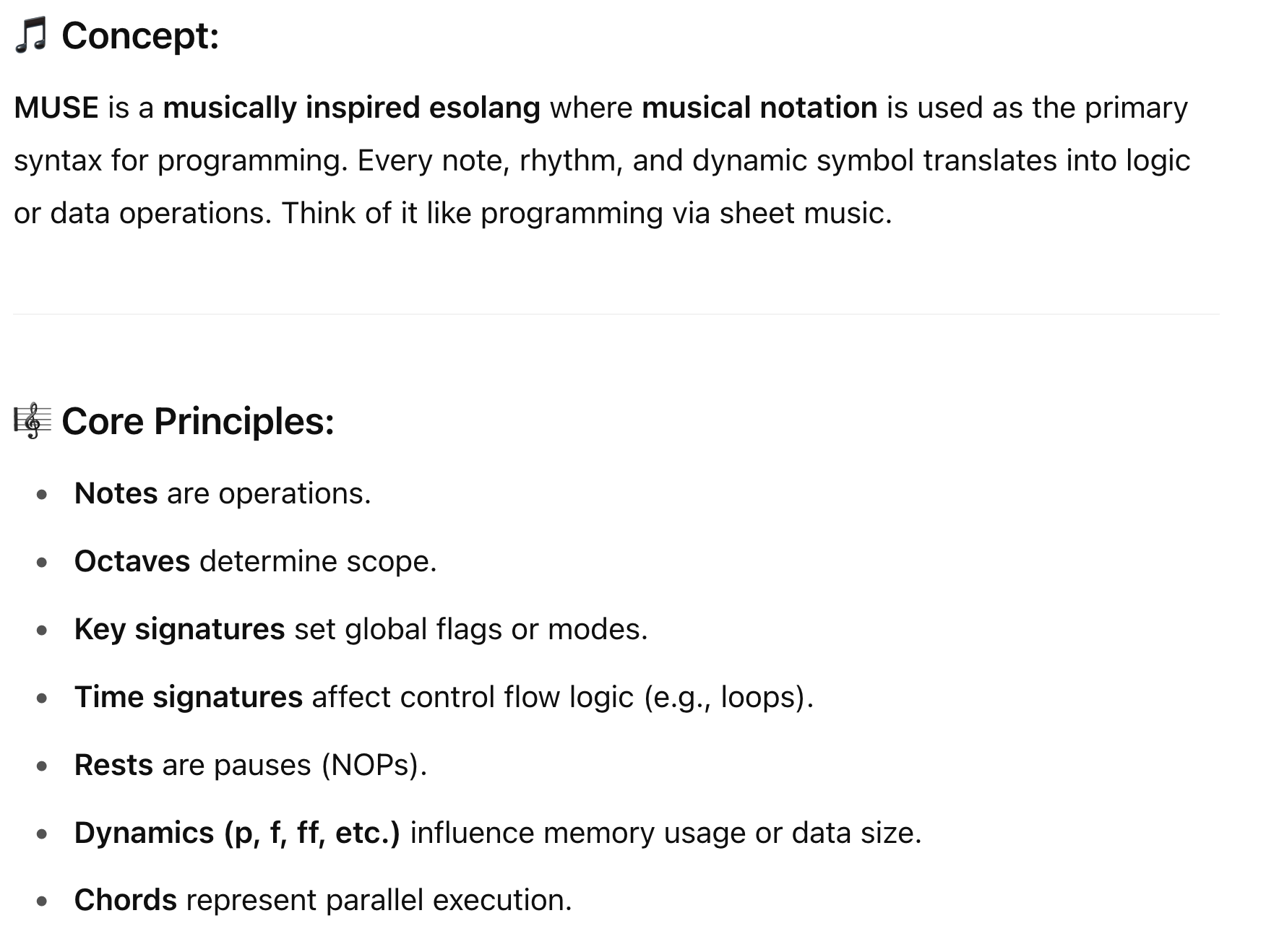
The image describes **MUSE**, a programming language (esolang) inspired by musical notation. It posits that musical elements (notes, rhythms, dynamics) are mapped to programming logic and data operations, enabling code to be written "via sheet music."
### Components/Axes
- **Concept Section**:
- Title: "Concept:" with a musical note icon.
- Text: "MUSE is a **musically inspired esolang** where **musical notation** is used as the primary syntax for programming. Every note, rhythm, and dynamic symbol translates into logic or data operations. Think of it like programming via sheet music."
- **Core Principles Section**:
- Title: "Core Principles:" with a musical staff icon.
- Bullet points (7 total):
1. **Notes** are operations.
2. **Octaves** determine scope.
3. **Key signatures** set global flags or modes.
4. **Time signatures** affect control flow logic (e.g., loops).
5. **Rests** are pauses (NOPs).
6. **Dynamics** (p, f, ff, etc.) influence memory usage or data size.
7. **Chords** represent parallel execution.
### Detailed Analysis
- **Musical Terminology Mapped to Programming Concepts**:
- Notes → Operations (e.g., function calls, arithmetic).
- Octaves → Scope (e.g., variable visibility, block-level access).
- Key Signatures → Global flags/modes (e.g., program state, configuration).
- Time Signatures → Control flow (e.g., loop iterations, timing logic).
- Rests → NOPs (no operation, pauses in execution).
- Dynamics → Memory/data size (e.g., "p" = low memory usage, "ff" = high data size).
- Chords → Parallel execution (e.g., concurrent processes, multithreading).
### Key Observations
- The framework explicitly ties musical notation to programming constructs, creating a direct analogy between sheet music and code.
- No numerical data, trends, or visualizations are present; the image focuses on conceptual mapping.
### Interpretation
MUSE proposes a novel programming paradigm where musical syntax replaces traditional code structure. For example:
- A **note** (e.g., "C4") could represent a specific operation (e.g., `add(2, 3)`).
- An **octave** (e.g., "C5") might define a scope (e.g., a function or loop block).
- A **chord** (e.g., "C-E-G") could trigger parallel tasks (e.g., `parallel_execute(task1, task2)`).
This approach suggests that rhythm and dynamics could govern program flow and resource allocation, while key signatures enforce global consistency. The language’s design emphasizes intuitive, creative coding through musical patterns, though practical implementation details (e.g., syntax rules, execution models) are not provided in the image.
---
**Note**: The image contains no numerical data, charts, or diagrams. All information is textual and conceptual.