## Text Description: MUSE Esolang Concept and Core Principles
### Overview
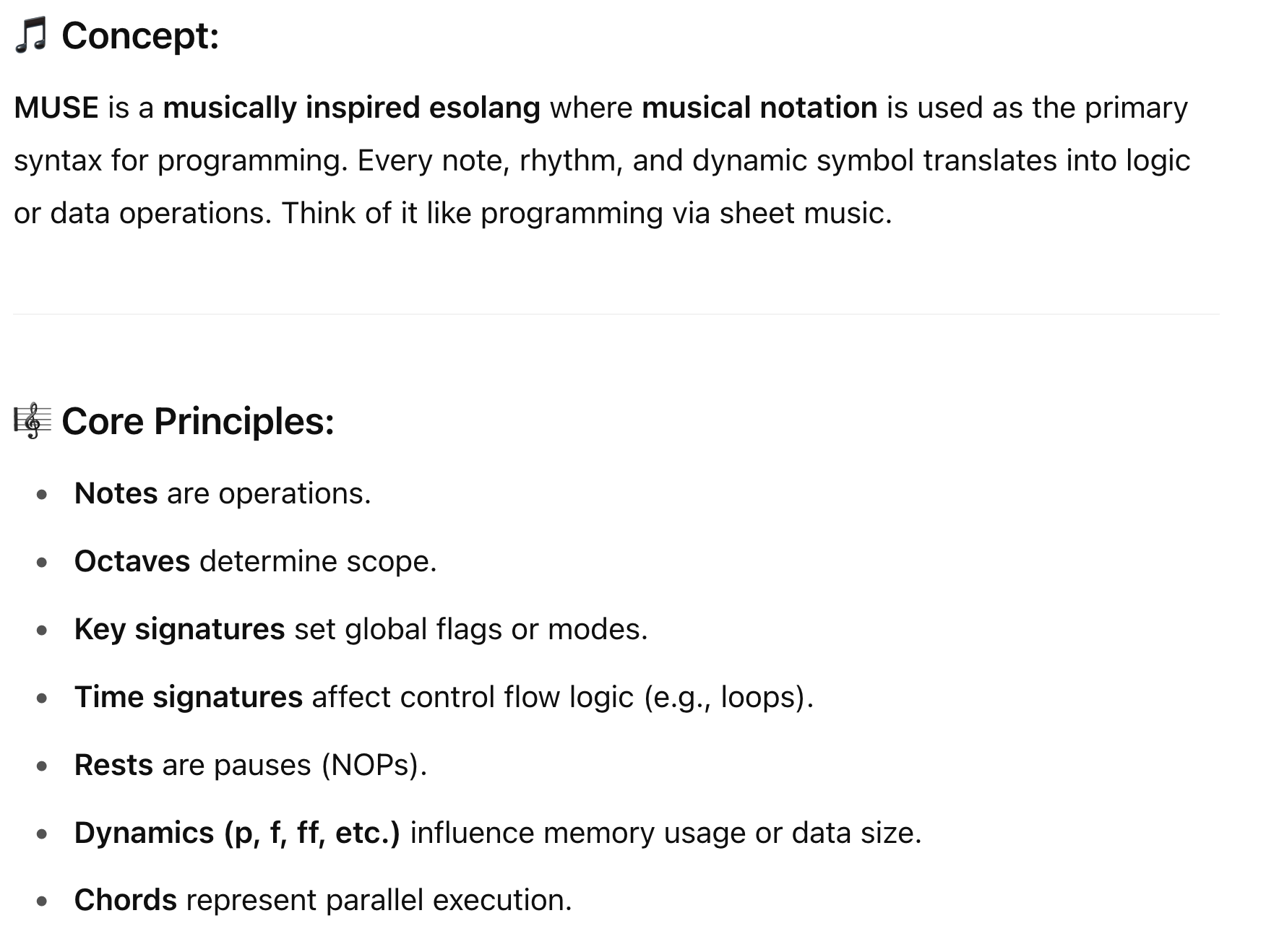
The image presents a textual description of the MUSE esolang, a musically inspired programming language. It outlines the core concept and principles behind its design.
### Components/Axes
The image is divided into two main sections:
1. **Concept:** Introduces the MUSE esolang and its core idea.
2. **Core Principles:** Lists the fundamental principles governing the language's structure and behavior.
### Detailed Analysis or ### Content Details
**Concept:**
* **Title:** Concept:
* **Description:** MUSE is a musically inspired esolang where musical notation is used as the primary syntax for programming. Every note, rhythm, and dynamic symbol translates into logic or data operations. Think of it like programming via sheet music.
**Core Principles:**
* **Title:** Core Principles:
* **Principles (listed as bullet points):**
* Notes are operations.
* Octaves determine scope.
* Key signatures set global flags or modes.
* Time signatures affect control flow logic (e.g., loops).
* Rests are pauses (NOPs).
* Dynamics (p, f, ff, etc.) influence memory usage or data size.
* Chords represent parallel execution.
### Key Observations
The image provides a high-level overview of the MUSE esolang, focusing on its musical inspiration and the mapping of musical elements to programming concepts.
### Interpretation
The text describes MUSE as an esoteric programming language (esolang) that uses musical notation as its primary syntax. This means that instead of traditional programming keywords and symbols, MUSE uses musical elements like notes, rhythms, and dynamics to represent programming logic and data operations.
The core principles highlight how specific musical elements are mapped to programming concepts:
* **Notes:** Represent operations or actions within the program.
* **Octaves:** Define the scope or context in which operations are performed.
* **Key signatures:** Set global flags or modes that affect the program's behavior.
* **Time signatures:** Control the flow of execution, potentially enabling loops or other control structures.
* **Rests:** Represent pauses or no-operations (NOPs) in the program.
* **Dynamics:** Influence memory usage or data size, potentially by controlling the allocation or manipulation of data.
* **Chords:** Enable parallel execution, allowing multiple operations to be performed simultaneously.
The analogy of "programming via sheet music" suggests that writing MUSE code involves composing musical scores that are interpreted as instructions for the computer.