\n
## Text Document: MUSE - A Musical Programming Language
### Overview
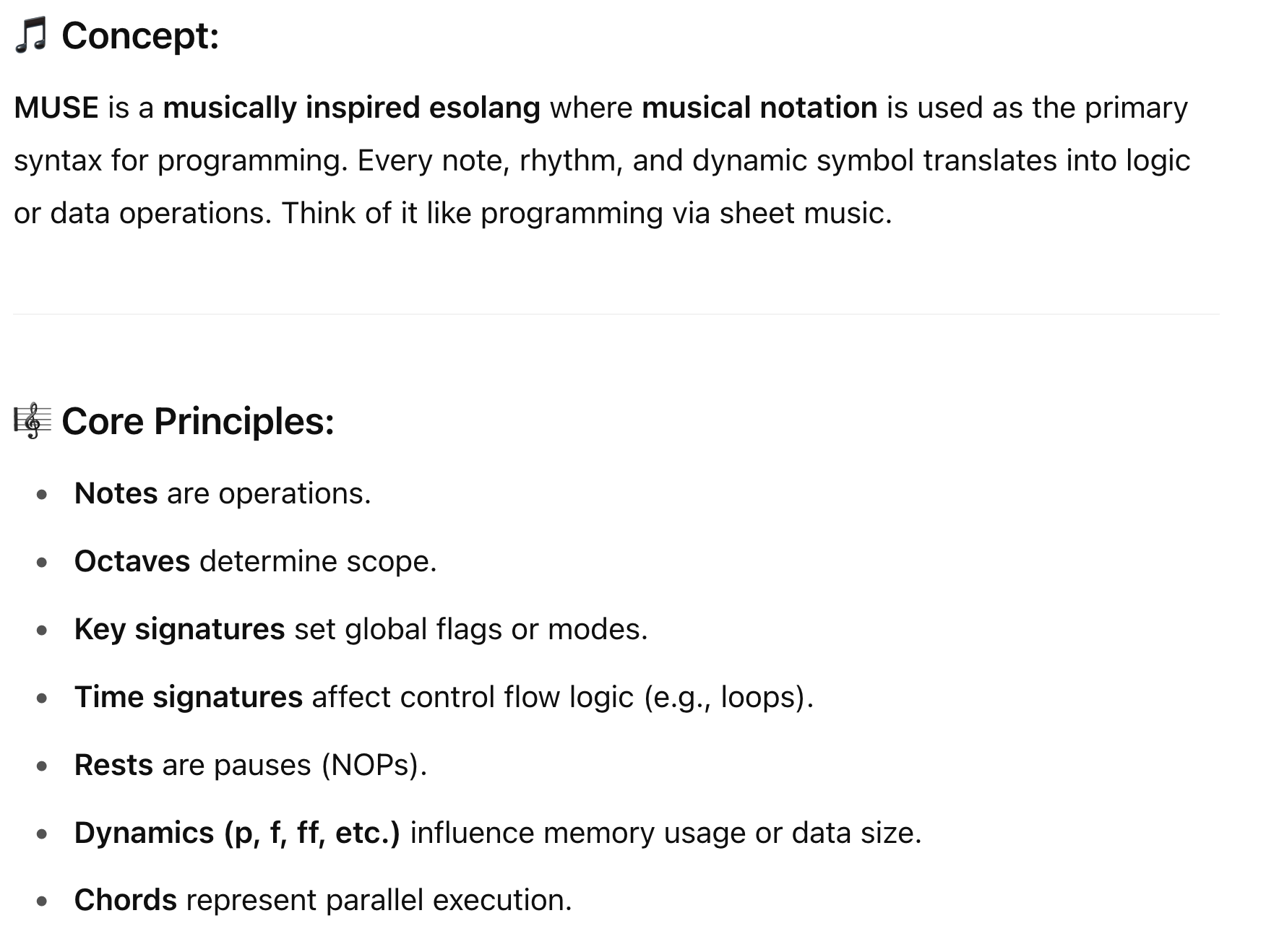
The image presents a textual description of MUSE, a musically inspired esoteric programming language. It outlines the core principles of the language, explaining how musical notation is used as the primary syntax for programming.
### Components/Axes
The document is structured into two main sections: "Concept" and "Core Principles". Each principle is presented as a bullet point. There are no axes or charts in this image.
### Detailed Analysis or Content Details
**Concept:**
"MUSE is a musically inspired esolang where musical notation is used as the primary syntax for programming. Every note, rhythm, and dynamic symbol translates into logic or data operations. Think of it like programming via sheet music."
**Core Principles:**
* "Notes are operations."
* "Octaves determine scope."
* "Key signatures set global flags or modes."
* "Time signatures affect control flow logic (e.g., loops)."
* "Rests are pauses (NOPs)."
* "Dynamics (p, f, ff, etc.) influence memory usage or data size."
* "Chords represent parallel execution."
### Key Observations
The document provides a high-level overview of the MUSE language. It emphasizes the unique approach of using musical notation for programming. The core principles are concise and provide a basic understanding of how the language functions.
### Interpretation
MUSE represents a novel approach to programming, leveraging the familiar structure of musical notation to create a potentially expressive and unique programming experience. The language's principles suggest a mapping between musical elements and programming concepts: notes as commands, octaves as scope delimiters, and dynamics as memory management tools. The use of chords for parallel execution is particularly interesting, hinting at a potential for concurrent programming within the MUSE framework. The language is described as an "esolang," indicating it is likely designed for exploration of programming concepts rather than practical application. The analogy to "programming via sheet music" highlights the conceptual shift required to understand and utilize MUSE.