## Technical Document: MUSE Programming Language Concept
### Overview
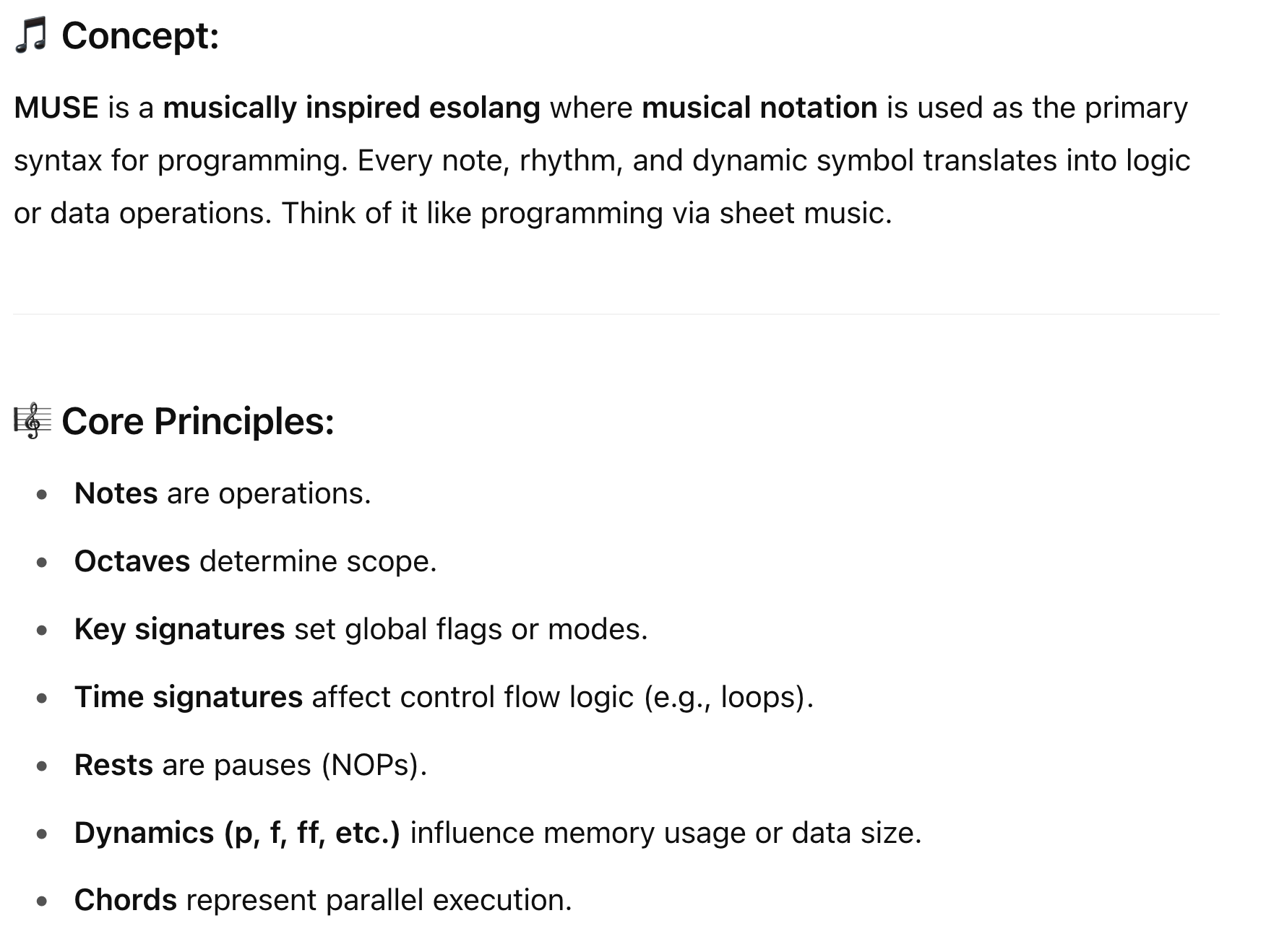
The image presents a conceptual description of **MUSE**, a musically inspired esoteric programming language (esolang). The document outlines the core idea and fundamental principles of the language, where musical notation serves as the primary syntax for programming operations.
### Components/Axes
The document is structured into two main sections, each introduced by a musical icon and a bold heading:
1. **Section 1: Concept**
* **Icon:** A musical note symbol (♪).
* **Heading:** `Concept:`
* **Content:** A paragraph defining MUSE.
2. **Section 2: Core Principles**
* **Icon:** A treble clef symbol (𝄞).
* **Heading:** `Core Principles:`
* **Content:** A bulleted list of seven principles.
### Detailed Analysis / Content Details
**Full Text Transcription:**
**♪ Concept:**
**MUSE** is a **musically inspired esolang** where **musical notation** is used as the primary syntax for programming. Every note, rhythm, and dynamic symbol translates into logic or data operations. Think of it like programming via sheet music.
**𝄞 Core Principles:**
* **Notes** are operations.
* **Octaves** determine scope.
* **Key signatures** set global flags or modes.
* **Time signatures** affect control flow logic (e.g., loops).
* **Rests** are pauses (NOPs).
* **Dynamics (p, f, ff, etc.)** influence memory usage or data size.
* **Chords** represent parallel execution.
### Key Observations
* **Direct Mapping:** The language establishes a direct, one-to-one conceptual mapping between standard musical notation elements and core programming constructs.
* **Scope of Analogy:** The analogy extends beyond simple commands (notes) to encompass structural elements (key/time signatures), execution flow (rests, chords), and data properties (dynamics).
* **Esolang Nature:** It is explicitly defined as an "esolang," indicating it is designed more for conceptual exploration, creativity, or challenge rather than practical, general-purpose software development.
* **Visual Presentation:** The use of musical icons (♪, 𝄞) as section markers visually reinforces the core theme. Key terms within the text (e.g., **musically inspired esolang**, **Notes**, **Octaves**) are bolded for emphasis.
### Interpretation
The document describes a programming paradigm that uses the rich, structured language of music as its foundation. This is not merely a cosmetic theme; it proposes a functional isomorphism where musical concepts have precise computational meanings.
* **What it suggests:** MUSE frames programming as a compositional act. Writing a program becomes analogous to composing a piece of music, where the "score" is the source code. This could potentially offer a novel, intuitive, or artistic way to think about algorithm structure and data flow for those familiar with music theory.
* **Relationships between elements:** The principles show a hierarchical and relational structure. For example, **Key Signatures** (global modes) and **Time Signatures** (control flow) set the overarching context within which individual **Notes** (operations) and **Chords** (parallel tasks) are executed. **Dynamics** modify the properties (memory/data size) of the operations.
* **Notable implications:** The mapping of **Chords** to parallel execution is particularly insightful, as it leverages the inherent simultaneity of musical chords to represent concurrent processes. Similarly, using **Rests** as NOPs (No-Operation instructions) is a clever and direct translation. The language's design implies that the rhythm and structure of the music directly dictate the program's logic and performance characteristics.