\n
## Diagram: LLM for KGC - A Workflow
### Overview
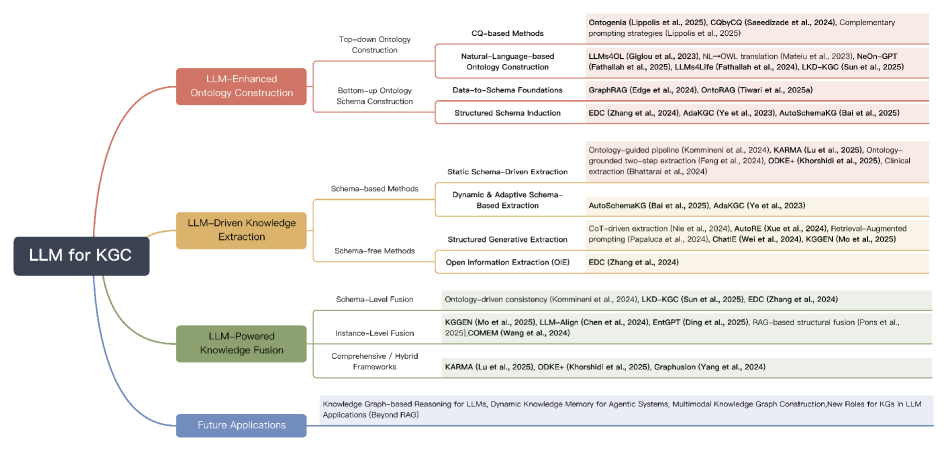
The image presents a diagram illustrating a workflow for utilizing Large Language Models (LLMs) for Knowledge Graph Construction (KGC). The workflow is divided into three main stages: LLM-Enhanced Ontology Construction, LLM-Driven Knowledge Extraction, and LLM-Powered Knowledge Fusion. Each stage is further broken down into sub-categories based on different methodologies. The diagram uses a tree-like structure with arrows indicating the flow of processes.
### Components/Axes
The diagram is structured around a central vertical axis representing the three main stages. Horizontal branches extend from this axis, representing the different methods within each stage. The diagram includes text labels for each stage, sub-category, and specific techniques. There are no explicit axes in the traditional chart sense. The diagram is oriented from top to bottom.
### Detailed Analysis or Content Details
**1. LLM-Enhanced Ontology Construction (Top Section)**
* **Top-down Ontology Construction:**
* CQ-based Methods: Ontogenia (Lippolis et al., 2023), CöbyQ (Saeedizade et al., 2024), Complementary prompting strategies (Lippolis et al., 2023)
* Natural-Language-based Ontology Construction: LLM4OL (Giglou et al., 2023), NL→OWL translation (Marteu et al., 2023), NeoN-GPT (Fathollah et al., 2023), LLM4Life (Fathollah et al., 2023), LKD-KGC (Sun et al., 2023)
* **Bottom-up Ontology Construction:**
* Data-to-Schema Foundations: GraphRAG (Edge et al., 2024), OntoRAG (Tiwari et al., 2023)
* Structured Schema Induction: EDC (Zhang et al., 2024), AdaKGC (Ye et al., 2023), AutoSchemaKG (Bai et al., 2023)
**2. LLM-Driven Knowledge Extraction (Middle Section)**
* **Schema-based Methods:**
* Static Schema-Driven Extraction: Ontology-guided pipeline (Kommineni et al., 2024), KARMA (Kruse et al., 2023), Ontology-grounded two-step extraction (Fang et al., 2024), ODKIE+ (Khorashadi et al., 2023), Clinical extraction (Bhattacharjee et al., 2024)
* Dynamic & Adaptive Schema-Based Extraction: AutoSchemaKG (Bai et al., 2023), AdaKGC (Ye et al., 2023)
* **Schema-free Methods:**
* Structured Generative Extraction: CoT-driven extraction (Nie et al., 2024), AutoPIE (Duan et al., 2024), Retrieval-Augmented prompting (Papulica et al., 2024), ChatIE (Wei et al., 2024), KGGEN (Mao et al., 2023)
* Open Information Extraction (OIE): EDC (Zhang et al., 2024)
**3. LLM-Powered Knowledge Fusion (Bottom Section)**
* **Schema-Level Fusion:** Ontology-driven consistency (Kommineni et al., 2024), LKD-KGC (Sun et al., 2023), EDC (Zhang et al., 2024)
* **Instance-Level Fusion:** KGGEN (Mao et al., 2023), LLM-Align (Chen et al., 2024), EntGPT (Ding et al., 2023), RAG-based structural fusion (Flora et al., 2023), COMEM (Wang et al., 2023)
* **Comprehensive / Hybrid:** MARI (Lu et al., 2023), OOKIE+ (Khorashadi et al., 2023), GraphFusion (Yang et al., 2023)
**Footer:**
* Knowledge Graphs (Böhm-Korn et al., 2023), Dynamic Knowledge Graphs (DGKs) (Paulheim & Bizer, 2023), Graph Construction (Thorsten & Navin, 2023), Future Applications.
### Key Observations
The diagram highlights the increasing use of LLMs in all stages of KGC. There's a clear progression from ontology construction to knowledge extraction and finally to knowledge fusion. The number of methods listed within each stage suggests a rapidly evolving field. The inclusion of publication citations (e.g., "Lippolis et al., 2023") indicates the research-driven nature of this area. The diagram shows a branching structure, indicating that multiple approaches can be taken at each stage.
### Interpretation
This diagram illustrates a paradigm shift in Knowledge Graph Construction, driven by the capabilities of Large Language Models. The workflow demonstrates how LLMs are being applied not only to extract knowledge from text but also to build and refine the underlying ontologies that structure that knowledge. The separation into three stages – Ontology Construction, Knowledge Extraction, and Knowledge Fusion – reflects the core components of a KGC pipeline. The diversity of methods within each stage suggests that there is no single "best" approach, and the optimal strategy will likely depend on the specific application and data characteristics. The inclusion of "Future Applications" in the footer suggests that this is an active area of research with significant potential for future development. The citations provide a pathway for further investigation into the specific techniques mentioned. The diagram serves as a valuable overview for researchers and practitioners interested in leveraging LLMs for KGC.