## Taxonomy Diagram: LLM for Knowledge Graph Construction (KGC)
### Overview
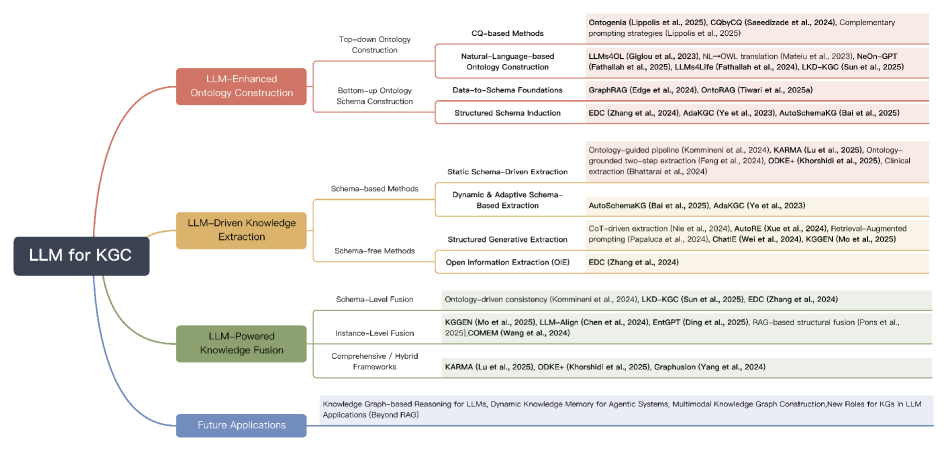
This image is a structured taxonomy diagram (mind map) illustrating the application of Large Language Models (LLMs) in Knowledge Graph Construction (KGC). It organizes the field into four primary research directions, each branching into specific methodological categories and concrete techniques, supported by academic citations. The diagram flows from a central concept on the left to increasingly specific methods on the right.
### Components/Axes
* **Central Node (Left):** "LLM for KGC" - The core subject.
* **Primary Branches (Color-Coded, Top to Bottom):**
1. **LLM-Enhanced Ontology Construction** (Red/Orange box)
2. **LLM-Driven Knowledge Extraction** (Yellow box)
3. **LLM-Powered Knowledge Fusion** (Green box)
4. **Future Applications** (Blue box)
* **Secondary & Tertiary Nodes:** Each primary branch splits into methodological approaches (e.g., "Top-down Ontology Construction," "Schema-based Methods"), which then list specific techniques or frameworks (e.g., "CQ-based Methods," "AutoSchemaKG") along with their associated research citations (e.g., "(Lippolis et al., 2025)").
### Detailed Analysis
The diagram systematically breaks down the LLM-KGC landscape:
**1. LLM-Enhanced Ontology Construction**
* **Top-down Ontology Construction:**
* *CQ-based Methods:* Ontogenia (Lippolis et al., 2025), CQbyCG (Saeedizade et al., 2024), Complementary prompting strategies (Lippolis et al., 2025).
* *Natural-Language-based Ontology Construction:* LLMs4OL (Giglou et al., 2024), NL→OWL translation (Mateu et al., 2023), NeoOn-GPT (Fathallah et al., 2025), LLM4OL (Fathallah et al., 2024), LKD-KGC (San et al., 2025).
* **Bottom-up Ontology Schema Construction:**
* *Data-to-Schema Foundations:* GraphRAG (Edge et al., 2024), OntoRAG (Tiwari et al., 2025a).
* *Structured Schema Induction:* EDC (Zhang et al., 2024), AdaKGC (Ye et al., 2023), AutoSchemaKG (Bai et al., 2025).
**2. LLM-Driven Knowledge Extraction**
* **Schema-based Methods:**
* *Static Schema-Driven Extraction:* Ontology-guided pipeline (Kommineni et al., 2024), KARMA (Lu et al., 2025), Ontology-guided two-step extraction (Feng et al., 2024), OOKG+ (Khoshkish et al., 2025), Clinical extraction (Bhattarai et al., 2024).
* *Dynamic & Adaptive Schema-Based Extraction:* AutoSchemaKG (Bai et al., 2025), AdaKGC (Ye et al., 2023).
* **Schema-free Methods:**
* *Structured Generative Extraction:* CoT-driven extraction (Nie et al., 2024), AutoRE (Xu et al., 2024), Retrieval-Augmented prompting (Pacaus et al., 2024), ChatIE (Wei et al., 2024), KOGEN (Mo et al., 2025).
* *Open Information Extraction (OIE):* EDC (Zhang et al., 2024).
**3. LLM-Powered Knowledge Fusion**
* **Schema-Level Fusion:** Ontology-driven consistency (Kommineni et al., 2024), LKD-KGC (San et al., 2025), EDC (Zhang et al., 2024).
* **Instance-Level Fusion:** KOGSEN (Mo et al., 2025), LLM-Align (Chen et al., 2024), EmpGPT (Ding et al., 2024), RAG-based structural fusion (Pors et al., 2025), COMEM (Wang et al., 2024).
* **Comprehensive / Hybrid Frameworks:** KARMA (Lu et al., 2025), OOKG+ (Khoshkish et al., 2025), Graphusion (Yang et al., 2024).
**4. Future Applications**
* This branch lists forward-looking research areas without specific citations:
* Knowledge Graph-based Reasoning for LLMs
* Dynamic Knowledge Memory for Agentic Systems
* Multimodal Knowledge Graph Construction
* New Roles for KGs in LLM Applications (Beyond RAG)
### Key Observations
* **Methodological Spectrum:** The taxonomy covers the full pipeline, from defining the schema (ontology construction) and extracting facts (knowledge extraction) to integrating information (knowledge fusion).
* **Hybrid Approaches:** Several methods (e.g., AutoSchemaKG, AdaKGC, KARMA, EDC) appear in multiple categories, indicating they are versatile frameworks that bridge different stages of KGC.
* **Prominence of RAG:** Retrieval-Augmented Generation (RAG) is mentioned as a technique within both extraction (Retrieval-Augmented prompting) and fusion (RAG-based structural fusion), highlighting its importance.
* **Citation Density:** The "LLM-Enhanced Ontology Construction" and "LLM-Driven Knowledge Extraction" sections are densely populated with citations, suggesting these are the most actively researched areas. "Future Applications" is notably citation-free, being speculative.
* **Language:** All text in the diagram is in English.
### Interpretation
This diagram serves as a comprehensive map of the current research frontier where LLMs intersect with Knowledge Graph Construction. It demonstrates that LLMs are not being used as a single monolithic tool but are being integrated into every sub-process of KGC.
The structure reveals a field moving from foundational, schema-centric approaches (top-down ontology construction) toward more flexible, data-driven, and adaptive methods (schema-free extraction, dynamic schema induction). The inclusion of "Future Applications" points to an evolving understanding where KGs are not just an output of LLMs but become a core component for enhancing LLM reasoning, memory, and multimodal capabilities.
The repeated appearance of certain method names across different branches suggests the development of integrated, end-to-end frameworks that automate the entire KGC pipeline using LLMs. The heavy reliance on citations underscores that this is an active, academic research domain with rapid iteration. For a practitioner or researcher, this taxonomy provides a clear entry point to understand the landscape, identify key techniques for specific tasks (e.g., choosing a schema-based vs. schema-free extraction method), and spot emerging trends like agentic systems and multimodal KGs.