## Visual Comparison Chart: 3D Gaussian Splatting (3D-GS) Reconstruction Quality and Model Size
### Overview
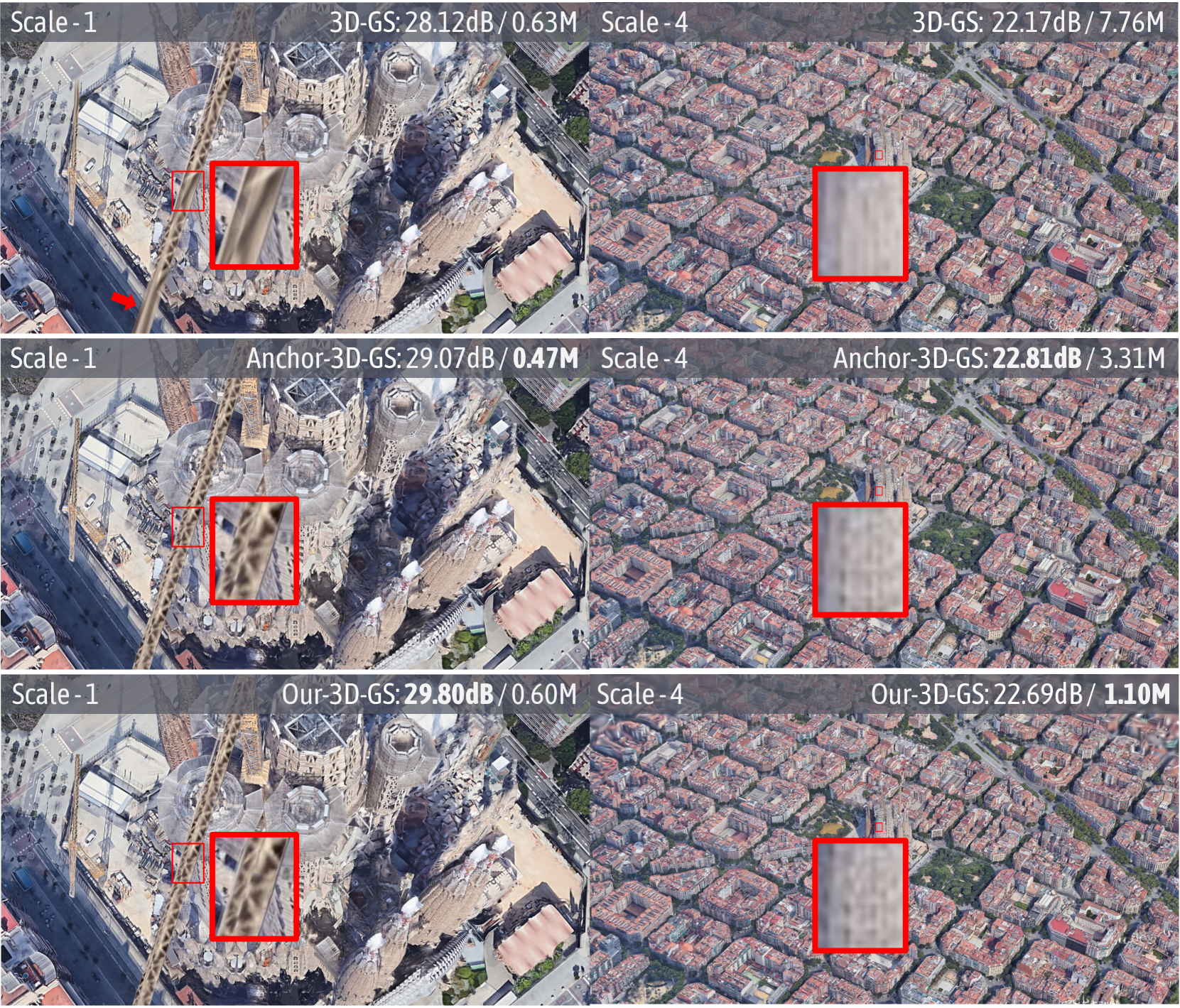
This image presents a qualitative and quantitative comparison of three different 3D Gaussian Splatting (3D-GS) methods for scene reconstruction. The comparison is structured across three rows, each representing a different method, and two columns, each representing a different scene and scale factor. The primary metrics shown are reconstruction quality (in Peak Signal-to-Noise Ratio, PSNR, measured in dB) and model size (in millions of Gaussians, denoted as M).
### Components/Axes
* **Layout:** A 3x2 grid of image panels.
* **Rows (Methods):**
* **Top Row:** Baseline "3D-GS" method.
* **Middle Row:** "Anchor-3D-GS" method.
* **Bottom Row:** "Our-3D-GS" method (the proposed technique).
* **Columns (Scenes & Scales):**
* **Left Column:** A close-up aerial view of a cathedral (likely the Sagrada Família). Labeled "Scale - 1".
* **Right Column:** A wider aerial view of a dense urban city block. Labeled "Scale - 4".
* **Text Overlays (Per Panel):** Each image panel contains text in the top-left and top-right corners.
* **Top-Left Text:** Indicates the scale factor (e.g., "Scale - 1").
* **Top-Right Text:** Indicates the method name, the PSNR value, and the model size, formatted as `[Method]: [PSNR]dB / [Size]M`.
* **Visual Annotations:** Each panel contains red bounding boxes. A smaller red box highlights a specific region of interest in the main image, and a larger red box shows a magnified view of that region to emphasize reconstruction detail and artifacts.
### Detailed Analysis
**Quantitative Data Extraction:**
| Method | Scene / Scale | PSNR (dB) | Model Size (Millions) |
| :--- | :--- | :--- | :--- |
| **3D-GS** | Cathedral / Scale-1 | 28.12 | 0.63M |
| **3D-GS** | City / Scale-4 | 22.17 | 7.76M |
| **Anchor-3D-GS** | Cathedral / Scale-1 | 29.07 | 0.47M |
| **Anchor-3D-GS** | City / Scale-4 | 22.81 | 3.31M |
| **Our-3D-GS** | Cathedral / Scale-1 | 29.80 | 0.60M |
| **Our-3D-GS** | City / Scale-4 | 22.69 | 1.10M |
**Visual Trend Verification:**
* **Left Column (Cathedral, Scale-1):** All three methods produce a clear, detailed reconstruction of the cathedral's intricate stonework. The magnified insets show that "Anchor-3D-GS" and "Our-3D-GS" maintain sharper edges and finer details compared to the baseline "3D-GS", which appears slightly softer.
* **Right Column (City, Scale-4):** This is a more challenging, larger-scale scene. All reconstructions are blurrier at this scale, as indicated by the lower PSNR values. The magnified insets show significant blurring and loss of high-frequency detail (like building windows and textures) across all methods. The baseline "3D-GS" appears the most blurred.
### Key Observations
1. **Scale Impact:** Moving from Scale-1 to Scale-4 (a more distant, wider view) drastically reduces reconstruction quality (PSNR drops by ~6-7 dB) and increases model size for all methods. This highlights the challenge of maintaining detail in large-scale scenes.
2. **Method Performance:**
* **Quality (PSNR):** "Our-3D-GS" achieves the highest PSNR on the close-up cathedral scene (29.80 dB). On the city scene, "Anchor-3D-GS" has a very slight edge (22.81 dB vs. 22.69 dB), but the difference is minimal.
* **Efficiency (Model Size):** The most significant difference is in model size. "Our-3D-GS" is dramatically more efficient on the large-scale city scene, using only **1.10M** Gaussians compared to 3.31M for "Anchor-3D-GS" and 7.76M for the baseline "3D-GS". This represents a **~70% reduction** in model size versus the baseline for a similar quality level.
3. **Visual Fidelity:** The proposed "Our-3D-GS" method visually matches or exceeds the detail of "Anchor-3D-GS" while using a much smaller model, especially evident in the cathedral's detailed structures.
### Interpretation
This comparison chart is designed to demonstrate the superiority of the proposed "Our-3D-GS" method, particularly in terms of **efficiency**. The core message is that the new technique achieves state-of-the-art or comparable reconstruction quality (high PSNR) while using a significantly more compact representation (fewer millions of Gaussians).
The data suggests that the key innovation lies in better handling of large-scale, complex scenes (like the city at Scale-4), where the method achieves a favorable trade-off between visual fidelity and memory/storage requirements. The baseline method's model size explodes (7.76M) for the large scene, making it impractical, whereas "Our-3D-GS" keeps it manageable (1.10M). This implies the proposed method uses a more intelligent or adaptive strategy for allocating Gaussian primitives, focusing them where they are most needed and avoiding redundancy. The chart effectively argues that "Our-3D-GS" advances the practical applicability of 3D Gaussian Splatting for large-scale 3D reconstruction tasks.