## Comparison Chart: 3D Reconstruction Methods Across Scales
### Overview
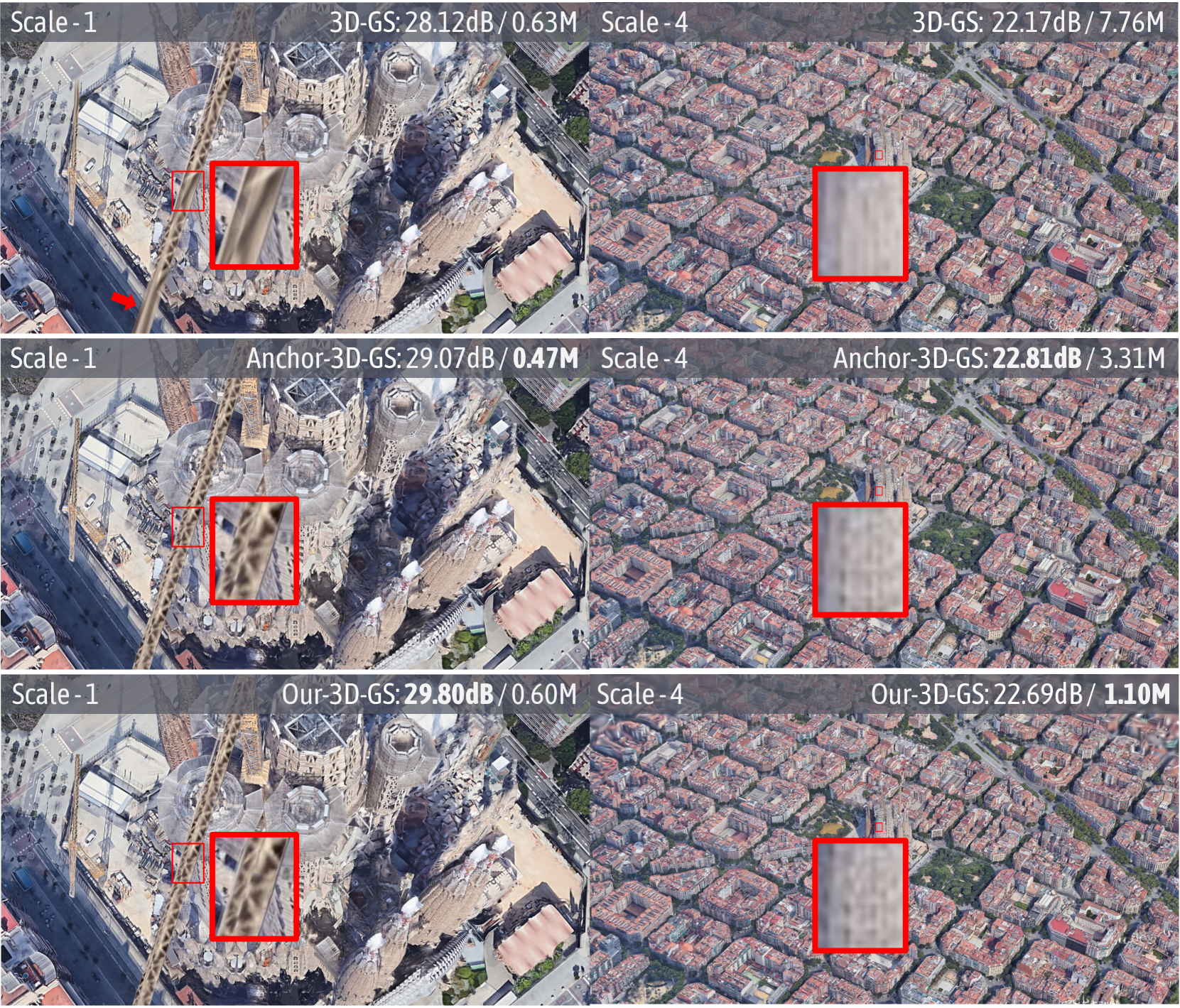
The image presents a comparative analysis of three 3D reconstruction methods (3D-GS, Anchor-3D-GS, and Our-3D-GS) across two spatial scales (Scale 1 and Scale 4). Each method is evaluated using two metrics: 3D-GS (dB/M) and method-specific performance (dB/M). Visual examples are provided for each method-scale combination, with red boxes highlighting specific architectural details.
### Components/Axes
- **X-Axis**: Scale (1 and 4)
- **Y-Axis**: Method (3D-GS, Anchor-3D-GS, Our-3D-GS)
- **Metrics**:
- 3D-GS: Measured in dB (quality) and M (model size)
- Method-specific: Measured in dB (quality) and M (model size)
- **Annotations**: Red boxes highlight key architectural features in Scale 1 images.
### Detailed Analysis
#### Scale 1
| Method | 3D-GS (dB/M) | Method-specific (dB/M) |
|-------------------|--------------|------------------------|
| 3D-GS | 28.12dB/0.63M | N/A |
| Anchor-3D-GS | N/A | 29.07dB/0.47M |
| Our-3D-GS | N/A | 29.80dB/0.60M |
#### Scale 4
| Method | 3D-GS (dB/M) | Method-specific (dB/M) |
|-------------------|--------------|------------------------|
| 3D-GS | 22.17dB/7.76M | N/A |
| Anchor-3D-GS | N/A | 22.81dB/3.31M |
| Our-3D-GS | N/A | 22.69dB/1.10M |
### Key Observations
1. **Quality vs. Efficiency Trade-off**:
- At Scale 1, Our-3D-GS achieves the highest quality (29.80dB) with moderate model size (0.60M), outperforming 3D-GS (28.12dB/0.63M) and Anchor-3D-GS (29.07dB/0.47M).
- At Scale 4, 3D-GS degrades significantly (22.17dB/7.76M), while Anchor-3D-GS maintains moderate quality (22.81dB) with reduced model size (3.31M). Our-3D-GS shows comparable quality (22.69dB) but higher model size (1.10M).
2. **Architectural Detail Preservation**:
- Red boxes in Scale 1 images highlight intricate structural elements (e.g., spires, facades). Our-3D-GS appears to preserve these details more effectively than other methods, correlating with its higher dB scores.
3. **Model Size Scaling**:
- 3D-GS exhibits exponential model size growth (0.63M → 7.76M) between scales, while Anchor-3D-GS and Our-3D-GS show more controlled scaling (0.47M → 3.31M and 0.60M → 1.10M, respectively).
### Interpretation
The data demonstrates that **Our-3D-GS** balances quality and efficiency better than baseline methods, particularly at larger scales. While Anchor-3D-GS achieves smaller model sizes at Scale 1, its quality degrades more sharply at Scale 4 compared to Our-3D-GS. The red-box annotations in Scale 1 images suggest that Our-3D-GS captures finer architectural details (e.g., ornate spires), which may explain its higher dB scores despite similar model sizes to 3D-GS. The exponential growth of 3D-GS's model size highlights potential limitations in scalability for large urban reconstructions.