## Line Chart: CIFAR-10 Test Accuracy vs. d1
### Overview
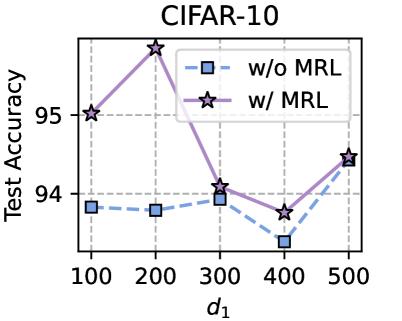
The image is a line chart comparing the test accuracy of a model on the CIFAR-10 dataset with and without MRL (presumably a regularization method) across different values of a parameter 'd1'. The chart displays two lines, one for "w/o MRL" (without MRL) and one for "w/ MRL" (with MRL).
### Components/Axes
* **Title:** CIFAR-10
* **X-axis:** d1, with tick marks at 100, 200, 300, 400, and 500.
* **Y-axis:** Test Accuracy, with tick marks at 94 and 95.
* **Legend:** Located in the top-right corner.
* "w/o MRL": Represented by a dashed light blue line with square markers.
* "w/ MRL": Represented by a solid light purple line with star markers.
### Detailed Analysis
* **"w/o MRL" (dashed light blue line with square markers):**
* At d1 = 100, Test Accuracy ≈ 93.8
* At d1 = 200, Test Accuracy ≈ 93.8
* At d1 = 300, Test Accuracy ≈ 93.9
* At d1 = 400, Test Accuracy ≈ 93.2
* At d1 = 500, Test Accuracy ≈ 94.2
* Trend: Relatively flat with a slight dip at d1 = 400 and a rise at d1 = 500.
* **"w/ MRL" (solid light purple line with star markers):**
* At d1 = 100, Test Accuracy ≈ 95.0
* At d1 = 200, Test Accuracy ≈ 95.8
* At d1 = 300, Test Accuracy ≈ 94.1
* At d1 = 400, Test Accuracy ≈ 93.8
* At d1 = 500, Test Accuracy ≈ 94.3
* Trend: Increases sharply from d1 = 100 to d1 = 200, then decreases to d1 = 400, and increases slightly to d1 = 500.
### Key Observations
* The "w/ MRL" line generally shows higher test accuracy than the "w/o MRL" line, especially at lower values of d1.
* The "w/ MRL" line has a more pronounced peak at d1 = 200 compared to the "w/o MRL" line.
* Both lines converge somewhat at d1 = 500.
### Interpretation
The data suggests that using MRL generally improves the test accuracy of the model on the CIFAR-10 dataset, particularly when the parameter 'd1' is set to lower values. The peak in accuracy for "w/ MRL" at d1 = 200 indicates that there might be an optimal value for 'd1' when using MRL. The convergence of the two lines at d1 = 500 suggests that the effect of MRL diminishes as 'd1' increases. Further investigation would be needed to determine the specific nature of MRL and 'd1' and why their interaction results in the observed trends.