## Line Chart: Model Accuracy vs Number of Operands for Different Recurrence Levels
### Overview
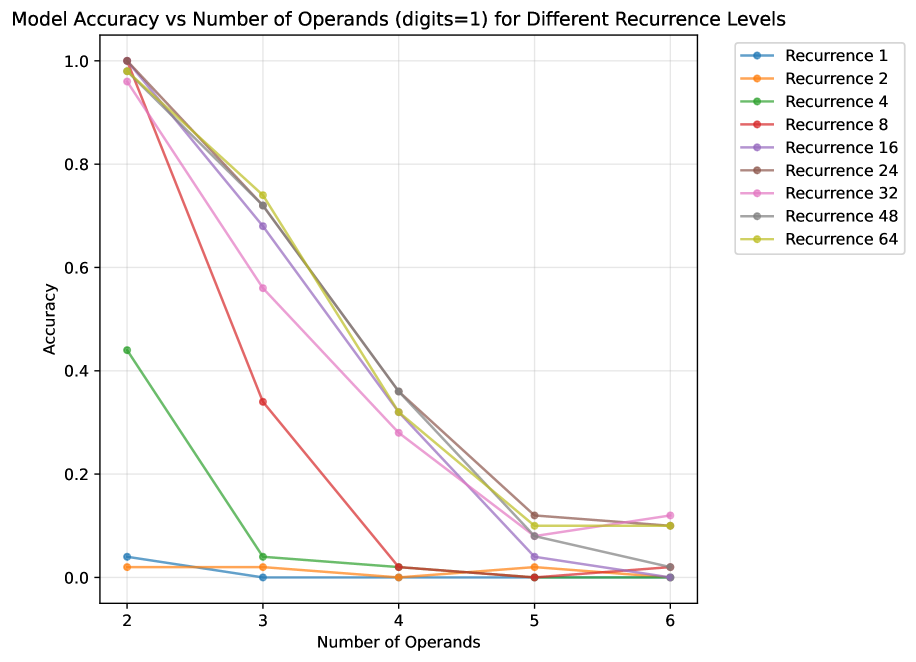
The image is a line chart that illustrates the relationship between model accuracy and the number of operands used, across different recurrence levels. The x-axis represents the number of operands, ranging from 2 to 6. The y-axis represents the accuracy, ranging from 0.0 to 1.0. Multiple lines are plotted, each representing a different recurrence level (1, 2, 4, 8, 16, 24, 32, 48, and 64). The chart aims to show how the model's accuracy changes with an increasing number of operands at various recurrence levels.
### Components/Axes
* **Title:** Model Accuracy vs Number of Operands (digits=1) for Different Recurrence Levels
* **X-axis:**
* Label: Number of Operands
* Scale: 2, 3, 4, 5, 6
* **Y-axis:**
* Label: Accuracy
* Scale: 0.0, 0.2, 0.4, 0.6, 0.8, 1.0
* **Legend:** Located on the top-right of the chart. It maps the line colors to the recurrence levels.
* Blue: Recurrence 1
* Orange: Recurrence 2
* Green: Recurrence 4
* Red: Recurrence 8
* Purple: Recurrence 16
* Brown: Recurrence 24
* Pink: Recurrence 32
* Gray: Recurrence 48
* Yellow-Green: Recurrence 64
### Detailed Analysis
* **Recurrence 1 (Blue):** The accuracy is relatively constant and low, around 0.03-0.04 across all operand numbers.
* (2, 0.04), (3, 0.03), (4, 0.02), (5, 0.01), (6, 0.02)
* **Recurrence 2 (Orange):** The accuracy is also relatively constant and low, around 0.01-0.02 across all operand numbers.
* (2, 0.01), (3, 0.01), (4, 0.01), (5, 0.11), (6, 0.10)
* **Recurrence 4 (Green):** The accuracy starts relatively high but drops sharply between 2 and 3 operands, then remains low.
* (2, 0.44), (3, 0.04), (4, 0.02), (5, 0.01), (6, 0.01)
* **Recurrence 8 (Red):** The accuracy starts high and decreases significantly as the number of operands increases.
* (2, 0.96), (3, 0.34), (4, 0.02), (5, 0.01), (6, 0.01)
* **Recurrence 16 (Purple):** The accuracy starts high and decreases significantly as the number of operands increases.
* (2, 0.98), (3, 0.72), (4, 0.38), (5, 0.04), (6, 0.02)
* **Recurrence 24 (Brown):** The accuracy starts high and decreases significantly as the number of operands increases.
* (2, 0.99), (3, 0.74), (4, 0.36), (5, 0.12), (6, 0.11)
* **Recurrence 32 (Pink):** The accuracy starts high and decreases significantly as the number of operands increases.
* (2, 0.95), (3, 0.56), (4, 0.24), (5, 0.03), (6, 0.11)
* **Recurrence 48 (Gray):** The accuracy starts high and decreases significantly as the number of operands increases.
* (2, 1.00), (3, 0.73), (4, 0.31), (5, 0.11), (6, 0.02)
* **Recurrence 64 (Yellow-Green):** The accuracy starts high and decreases significantly as the number of operands increases.
* (2, 0.99), (3, 0.77), (4, 0.39), (5, 0.12), (6, 0.11)
### Key Observations
* Higher recurrence levels (8, 16, 24, 32, 48, 64) generally exhibit higher accuracy when the number of operands is low (2-3).
* As the number of operands increases, the accuracy for higher recurrence levels drops significantly.
* Recurrence levels 1 and 2 show consistently low accuracy regardless of the number of operands.
* The accuracy for most recurrence levels converges to a low value (around 0.01-0.11) as the number of operands reaches 5 and 6.
### Interpretation
The data suggests that the model's performance, in terms of accuracy, is highly dependent on the recurrence level and the number of operands used. Higher recurrence levels are more effective when dealing with a smaller number of operands, possibly indicating that they are better at capturing complex relationships within simpler expressions. However, as the complexity of the expression increases (more operands), the accuracy of these higher recurrence levels diminishes, suggesting a potential overfitting issue or difficulty in generalizing to more complex scenarios. The consistently low accuracy of recurrence levels 1 and 2 indicates that these levels may be insufficient to capture the underlying patterns in the data, regardless of the number of operands. The convergence of accuracy at higher operand counts suggests a limit to the model's ability to handle very complex expressions, irrespective of the recurrence level.