\n
## Line Chart: Model Accuracy vs Number of Operands for Different Recurrence Levels
### Overview
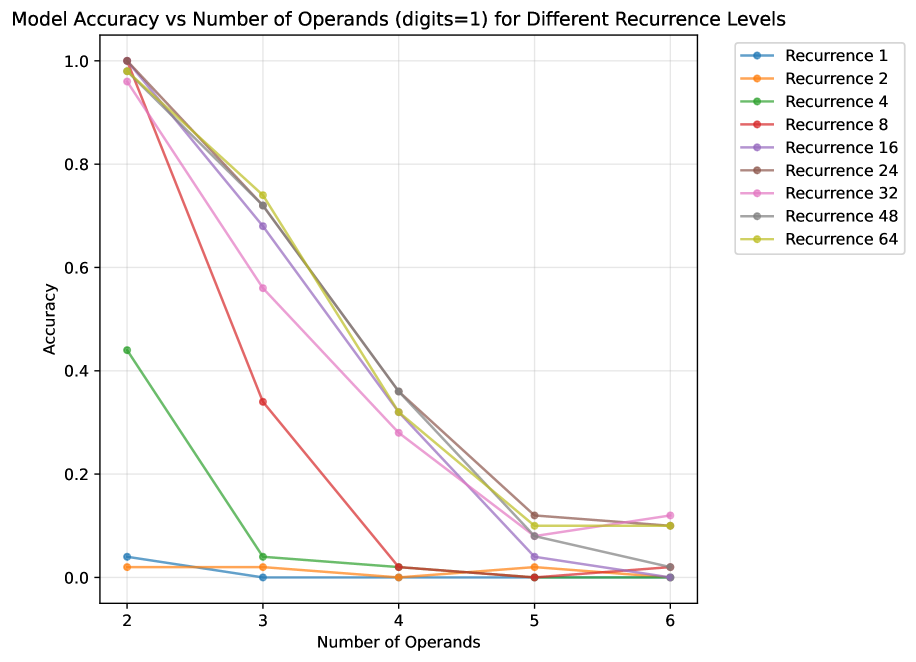
This line chart depicts the relationship between model accuracy and the number of operands, for different levels of recurrence. The chart shows how accuracy degrades as the number of operands increases, and how this degradation varies with the recurrence level. The data appears to be for models trained with digits=1.
### Components/Axes
* **Title:** "Model Accuracy vs Number of Operands (digits=1) for Different Recurrence Levels"
* **X-axis:** "Number of Operands" - Scale ranges from 2 to 6, with markers at each integer value.
* **Y-axis:** "Accuracy" - Scale ranges from 0.0 to 1.0, with markers at 0.2 intervals.
* **Legend:** Located in the top-right corner, listing the following recurrence levels with corresponding colors:
* Recurrence 1 (Blue)
* Recurrence 2 (Orange)
* Recurrence 4 (Green)
* Recurrence 8 (Red)
* Recurrence 16 (Purple)
* Recurrence 24 (Pink)
* Recurrence 32 (Gray)
* Recurrence 48 (Cyan)
* Recurrence 64 (Yellow)
### Detailed Analysis
The chart contains nine lines, each representing a different recurrence level.
* **Recurrence 1 (Blue):** The line starts at approximately 0.98 at Number of Operands = 2, and decreases sharply to approximately 0.02 at Number of Operands = 5, remaining relatively flat at approximately 0.02 until Number of Operands = 6.
* **Recurrence 2 (Orange):** The line starts at approximately 0.95 at Number of Operands = 2, and decreases sharply to approximately 0.01 at Number of Operands = 4, remaining relatively flat at approximately 0.01 until Number of Operands = 6.
* **Recurrence 4 (Green):** The line starts at approximately 0.96 at Number of Operands = 2, and decreases sharply to approximately 0.01 at Number of Operands = 3, remaining relatively flat at approximately 0.01 until Number of Operands = 6.
* **Recurrence 8 (Red):** The line starts at approximately 0.97 at Number of Operands = 2, and decreases sharply to approximately 0.01 at Number of Operands = 4, remaining relatively flat at approximately 0.01 until Number of Operands = 6.
* **Recurrence 16 (Purple):** The line starts at approximately 0.96 at Number of Operands = 2, and decreases sharply to approximately 0.01 at Number of Operands = 4, remaining relatively flat at approximately 0.01 until Number of Operands = 6.
* **Recurrence 24 (Pink):** The line starts at approximately 0.95 at Number of Operands = 2, and decreases sharply to approximately 0.01 at Number of Operands = 4, remaining relatively flat at approximately 0.01 until Number of Operands = 6.
* **Recurrence 32 (Gray):** The line starts at approximately 0.96 at Number of Operands = 2, and decreases sharply to approximately 0.01 at Number of Operands = 4, remaining relatively flat at approximately 0.01 until Number of Operands = 6.
* **Recurrence 48 (Cyan):** The line starts at approximately 0.97 at Number of Operands = 2, and decreases sharply to approximately 0.02 at Number of Operands = 5, increasing slightly to approximately 0.03 at Number of Operands = 6.
* **Recurrence 64 (Yellow):** The line starts at approximately 0.98 at Number of Operands = 2, and decreases sharply to approximately 0.02 at Number of Operands = 5, increasing slightly to approximately 0.04 at Number of Operands = 6.
All lines exhibit a steep decline in accuracy as the number of operands increases from 2 to 4. Beyond 4 operands, the accuracy plateaus near 0.0, with some minor fluctuations.
### Key Observations
* Accuracy is high for all recurrence levels when the number of operands is 2.
* Accuracy drops dramatically for all recurrence levels as the number of operands increases beyond 2.
* The accuracy converges to a very low level (close to 0.0) for all recurrence levels when the number of operands is 5 or 6.
* Recurrence levels 48 and 64 show a slight increase in accuracy at 6 operands compared to 5.
### Interpretation
The data suggests that the model's ability to accurately process information degrades significantly as the complexity of the input increases (as measured by the number of operands). This is likely due to the model struggling to maintain context and relationships between a larger number of inputs. The fact that accuracy converges to a low level for all recurrence levels indicates that increasing the recurrence level does not significantly improve the model's ability to handle a large number of operands, at least under the conditions tested (digits=1). The slight increase in accuracy for recurrence levels 48 and 64 at 6 operands could be due to random noise or a minor benefit from the increased recurrence capacity, but it is not a substantial improvement. The rapid decline in accuracy highlights a limitation of the model architecture or training process when dealing with more complex inputs. The "digits=1" constraint suggests the model may be more robust with more complex input data.