\n
## Diagram: LLM Code Generation Process
### Overview
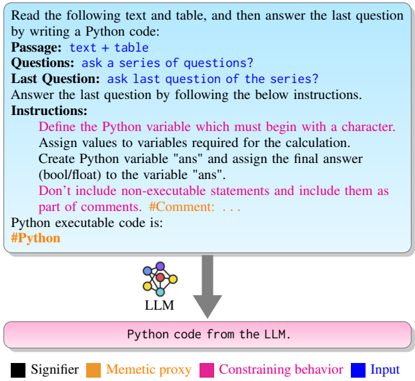
The image depicts a diagram illustrating the process of generating Python code using a Large Language Model (LLM) based on a given passage and table, along with a set of instructions. The diagram highlights the different components involved and their roles in the code generation process.
### Components/Axes
The diagram is segmented into several key areas:
* **Top Section (Input & Instructions):** Contains textual information describing the input (Passage, Questions, Last Question) and the instructions for generating the Python code.
* **Central Section (LLM):** Features a visual representation of the LLM, depicted as a network of interconnected nodes.
* **Bottom Section (Output):** Indicates the output of the LLM, which is Python code.
* **Legend:** Located at the bottom-right, defining the color-coding used in the diagram:
* Black: Signifier
* Orange: Memetic proxy
* Pink: Constraining behavior
* Blue: Input
### Detailed Analysis or Content Details
**Top Section (Input & Instructions):**
* **Passage:** "text + table"
* **Questions:** "ask a series of questions?"
* **Last Question:** "ask last question of the series?"
* **Instructions:**
* "Define the Python variable which must begin with a character."
* "Assign values to variables required for the calculation."
* "Create Python variable "ans" and assign the final answer (bool/float) to the variable "ans"."
* "Don't include non-executable statements and include them as part of comments. #Comment: ..."
* **Python executable code is:** "#Python" (This is a label, not code)
**Central Section (LLM):**
* The LLM is represented by a complex network of interconnected nodes, colored in shades of blue and white.
* The label "LLM" is positioned below the network.
* An arrow points downwards from the LLM towards the bottom section.
**Bottom Section (Output):**
* A rectangular box labeled "Python code from the LLM." is colored in pink.
**Color Coding:**
* The "Passage", "Questions", and "Last Question" text are colored blue, indicating they are "Input".
* The "Instructions" text is colored pink, indicating "Constraining behavior".
* The "#Python" label is colored black, indicating "Signifier".
* The LLM network is colored with a mix of blue and white, with the blue components likely representing "Input" and the white components representing internal processing.
* The "Python code from the LLM." box is colored pink, indicating "Constraining behavior".
### Key Observations
* The diagram emphasizes the flow of information from input (text and questions) through the LLM to the output (Python code).
* The instructions are presented as constraints guiding the LLM's code generation process.
* The color-coding effectively highlights the different roles of each component in the process.
* The diagram is conceptual and does not contain specific data points or numerical values.
### Interpretation
The diagram illustrates a simplified model of how an LLM can be used to generate Python code based on a given input and a set of instructions. The "Passage" and "Questions" serve as the input to the LLM, which then processes this information and generates Python code as output. The "Instructions" act as constraints, guiding the LLM to produce code that meets specific requirements (e.g., variable naming, assignment of the final answer). The color-coding helps to visually differentiate between the input, the LLM's internal processing, and the output. The diagram suggests a process of transformation, where the LLM takes unstructured text and questions and converts them into structured Python code. The diagram is a high-level representation and does not delve into the technical details of how the LLM operates internally. It is a conceptual illustration of the code generation process.