## Diagram: Two-Step Machine Learning Process for Classification
### Overview
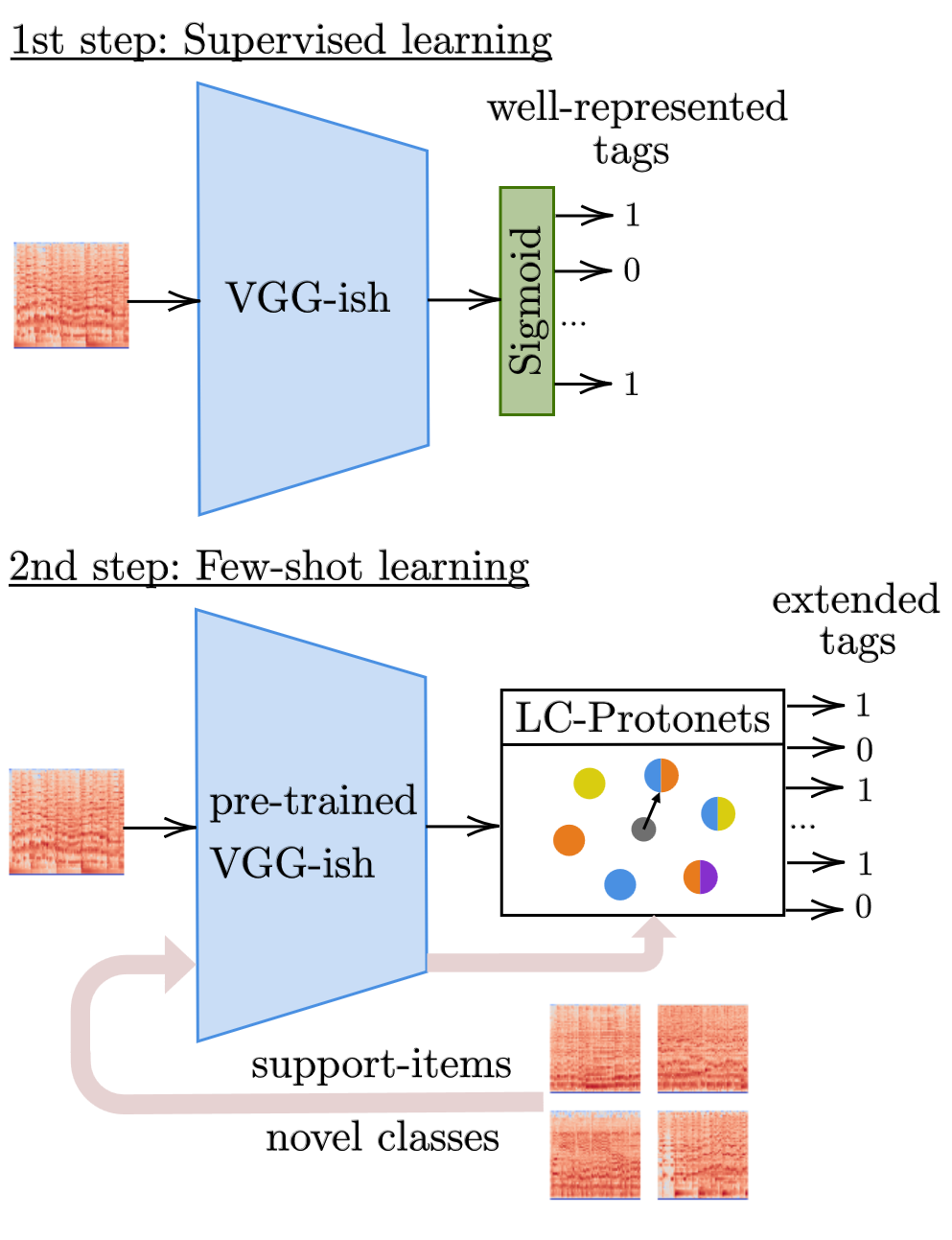
The diagram illustrates a two-phase machine learning workflow for classification tasks. The first phase uses supervised learning with a pre-trained VGG-ish model to generate binary tags (1/0). The second phase introduces few-shot learning capabilities through LC-Protonets, enabling adaptation to novel classes with limited examples. The process includes feedback loops for continuous improvement.
### Components/Axes
1. **Input**: Red spectrogram-like images (likely audio/text features)
2. **Phase 1 Components**:
- **VGG-ish**: Pre-trained convolutional neural network
- **Sigmoid**: Binary classification output (1 = well-represented, 0 = not)
3. **Phase 2 Components**:
- **Pre-trained VGG-ish**: Base model from Phase 1
- **LC-Protonets**: Meta-learning component with colored nodes (yellow, orange, blue, purple)
- **Extended Tags**: Binary outputs (1/0) for novel classes
4. **Support System**:
- **Support Items**: 4 red images (50% of total support data)
- **Novel Classes**: 4 red images (50% of total novel data)
5. **Feedback Loop**: Dashed arrow connecting Phase 2 outputs back to VGG-ish
### Detailed Analysis
- **Phase 1 Flow**:
Input → VGG-ish → Sigmoid → Binary Tags
- Sigmoid outputs show clear binary separation (1/0)
- No uncertainty values provided for Phase 1 predictions
- **Phase 2 Flow**:
Input → Pre-trained VGG-ish → LC-Protonets → Extended Tags
- LC-Protonets contains 5 colored nodes (4 distinct colors + gray)
- Color coding purpose unspecified in diagram
- Feedback loop connects extended tags back to base model
- **Support/Novel Distribution**:
- Equal 50/50 split between support items and novel classes
- All support/novel examples use identical red spectrogram format
- No quantitative performance metrics shown for few-shot adaptation
### Key Observations
1. **Model Architecture**:
- VGG-ish serves as foundational model in both phases
- LC-Protonets introduces meta-learning capabilities without modifying base architecture
2. **Data Flow**:
- Phase 2 maintains identical input format to Phase 1
- Feedback loop suggests iterative model refinement
3. **Color Coding**:
- LC-Protonets uses 4 distinct colors (yellow, orange, blue, purple) + gray
- No legend explaining color significance
- Binary outputs maintain consistent 1/0 labeling across phases
### Interpretation
This diagram demonstrates a hybrid approach combining:
1. **Supervised Learning Foundation**: Using VGG-ish for initial feature extraction and binary classification
2. **Few-Shot Adaptation**: LC-Protonets enables rapid adaptation to new classes with minimal examples
3. **Continuous Learning**: Feedback loop from novel class performance back to base model suggests online learning capabilities
The equal split between support and novel classes (4 each) implies a balanced few-shot scenario, though real-world applications might require different distributions. The absence of uncertainty quantification in both phases' outputs is a notable limitation. The color-coded LC-Protonets component likely represents different meta-learning strategies or class prototypes, but without explicit legend information, this remains speculative.
The process appears designed for scenarios where:
- Initial classification requires high accuracy (Phase 1)
- New classes emerge frequently with limited examples (Phase 2)
- Model must continuously improve through real-world feedback