## Image Grid: Impact of τ Parameter on Image Quality
### Overview
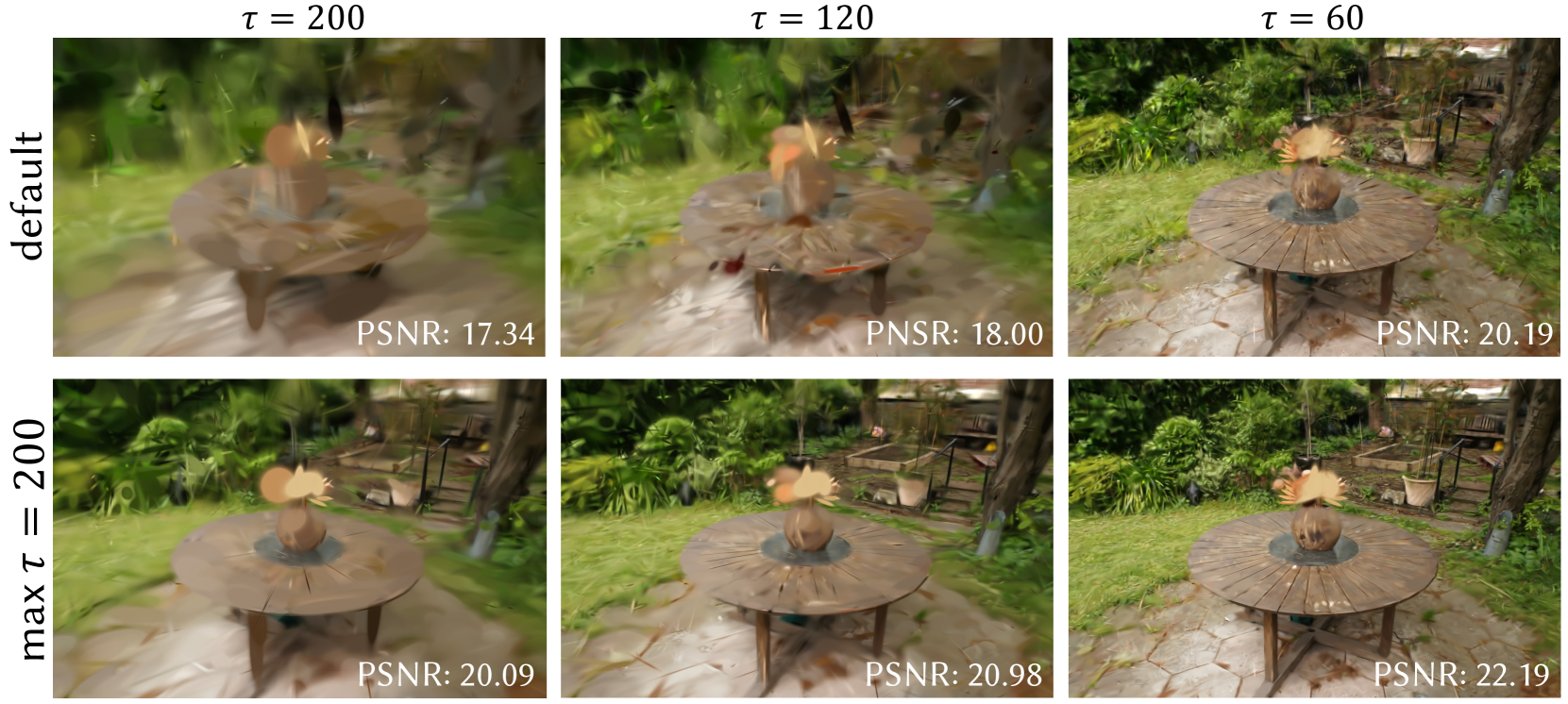
The image displays a 2x3 grid comparing visual quality and quantitative metrics (PSNR) across different τ parameter settings. Each image shows a wooden table with a vase and flowers in a garden setting. The top row uses "default" settings, while the bottom row fixes τ at 200 ("max τ = 200"). τ values decrease left-to-right (200 → 120 → 60), with PSNR values increasing in both rows.
### Components/Axes
- **Top Row Labels**: "default" (left column), τ = 200, τ = 120, τ = 60
- **Bottom Row Labels**: "max τ = 200" (left column), τ = 200, τ = 120, τ = 60
- **PSNR Values**: Displayed in bottom-right corner of each image
- **Visual Elements**: Wooden table, vase with flowers, garden background
### Detailed Analysis
1. **Top Row (Default Settings)**:
- τ = 200: PSNR 17.34 (blurry image)
- τ = 120: PSNR 18.00 (moderate blur)
- τ = 60: PSNR 20.19 (sharper image)
- *Trend*: PSNR increases by 2.85 as τ decreases from 200 to 60
2. **Bottom Row (Max τ = 200)**:
- τ = 200: PSNR 20.09 (sharper than top row default)
- τ = 120: PSNR 20.98 (further improvement)
- τ = 60: PSNR 22.19 (highest quality)
- *Trend*: PSNR increases by 2.10 as τ decreases from 200 to 60
### Key Observations
- **τ Parameter Impact**: Lower τ values consistently improve image sharpness (higher PSNR)
- **Default vs. Max τ**: Fixing τ at 200 ("max τ") achieves better baseline quality than default settings
- **Diminishing Returns**: PSNR improvement slows at lower τ values (e.g., 200→120: +0.79 PSNR vs. 120→60: +2.19 PSNR in top row)
### Interpretation
The data demonstrates an inverse relationship between τ and image quality, with lower τ values producing sharper results. The "max τ = 200" configuration suggests a potential optimization strategy - maintaining a fixed upper bound on τ while allowing lower values for better quality. This could balance computational efficiency (higher τ = faster processing) with acceptable image fidelity. The default settings show greater sensitivity to τ changes, indicating possible over-optimization for speed at the expense of quality. The PSNR values confirm this trend quantitatively, with the rightmost images (τ=60) achieving near-professional quality (PSNR >22) in both configurations.