# Technical Document Extraction: Roofline Model (Llama 7B, A100 80GB PCIe)
## 1. Header Information
* **Title:** Roofline Model (Llama 7B, A100 80GB PCIe)
* **Subject:** Performance analysis of a Llama 7B model running on an NVIDIA A100 80GB PCIe GPU.
## 2. Chart Specifications
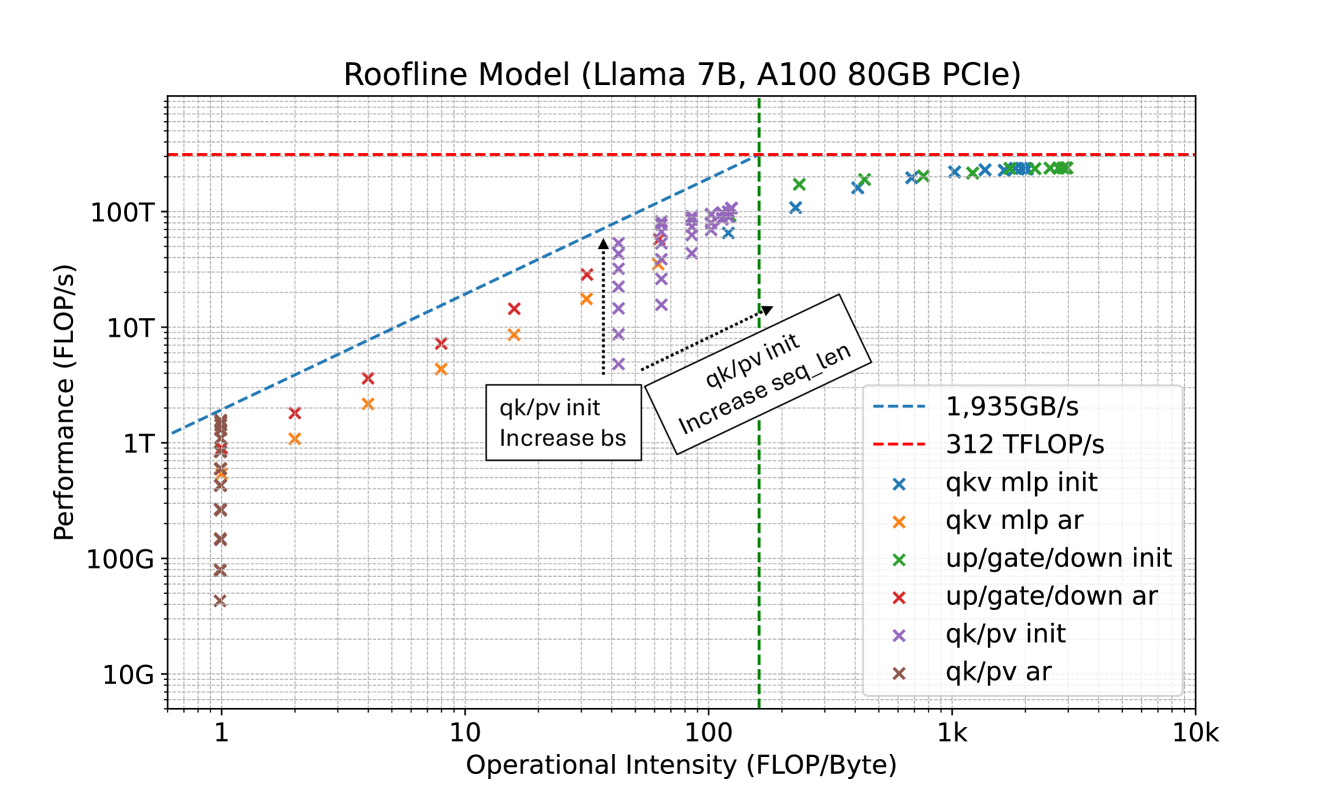
The image is a **Roofline Chart**, a log-log plot used to visualize the performance of algorithms against hardware limits.
### Axis Definitions
* **Y-Axis (Vertical):** Performance (FLOP/s)
* **Scale:** Logarithmic, ranging from 10G to 100T+.
* **Major Markers:** 10G, 100G, 1T, 10T, 100T.
* **X-Axis (Horizontal):** Operational Intensity (FLOP/Byte)
* **Scale:** Logarithmic, ranging from 1 to 10k.
* **Major Markers:** 1, 10, 100, 1k, 10k.
### Hardware Limits (The "Roofline")
The chart features two primary hardware constraint lines that form the "roof":
1. **Memory Bandwidth Limit (Sloped Blue Dashed Line):**
* **Label:** 1,935GB/s
* **Trend:** Slopes upward from left to right. This represents the memory-bound region where performance is limited by how fast data can be moved from memory.
2. **Peak Compute Limit (Horizontal Red Dashed Line):**
* **Label:** 312 TFLOP/s
* **Trend:** Horizontal. This represents the compute-bound region where the GPU's processing power is the bottleneck.
3. **Ridge Point (Vertical Green Dashed Line):**
* **Location:** Approximately 161 FLOP/Byte (where the bandwidth and compute lines intersect).
## 3. Legend and Data Series
The legend is located in the bottom-right quadrant of the chart.
| Symbol | Color | Label | Description/Trend |
| :--- | :--- | :--- | :--- |
| `--` | Blue | 1,935GB/s | Memory bandwidth ceiling. |
| `--` | Red | 312 TFLOP/s | Peak theoretical compute performance. |
| `x` | Blue | qkv mlp init | Initialization phase for QKV and MLP layers. Points cluster between 100 and 1k FLOP/Byte, approaching the compute ceiling. |
| `x` | Orange | qkv mlp ar | Autoregressive (AR) phase for QKV and MLP. Points are at low operational intensity (~1 to 10 FLOP/Byte), following the bandwidth slope. |
| `x` | Green | up/gate/down init | Initialization for Feed-Forward Network (FFN) layers. High intensity (1k - 3k FLOP/Byte), sitting directly on the 312 TFLOP/s ceiling. |
| `x` | Red | up/gate/down ar | AR phase for FFN layers. Low intensity (~1 to 40 FLOP/Byte), following the bandwidth slope. |
| `x` | Purple | qk/pv init | Initialization for Attention (QK/PV) operations. Clustered between 40 and 150 FLOP/Byte. |
| `x` | Brown | qk/pv ar | AR phase for Attention operations. Very low intensity, clustered at the 1 FLOP/Byte mark. |
## 4. Annotated Trends and Logic Checks
The chart contains specific callouts explaining how changing parameters affects performance:
### Component: qk/pv init (Purple 'x' markers)
* **Vertical Trend (Increase bs):** A vertical dotted arrow points upward through the purple markers.
* **Text Box:** `qk/pv init Increase bs`
* **Interpretation:** Increasing the **batch size (bs)** increases the Performance (FLOP/s) without significantly changing the Operational Intensity.
* **Diagonal Trend (Increase seq_len):** A diagonal dotted arrow points upward and to the right through the purple markers.
* **Text Box:** `qk/pv init Increase seq_len`
* **Interpretation:** Increasing the **sequence length (seq_len)** increases both the Operational Intensity and the Performance, moving the kernels closer to the compute-bound "roof."
## 5. Summary of Observations
* **Memory Bound:** Most "ar" (autoregressive/decoding) kernels (Orange, Red, Brown) are located on the sloped part of the graph, indicating they are limited by the 1,935 GB/s memory bandwidth.
* **Compute Bound:** Most "init" (initialization/prefill) kernels (Green, Blue, Purple) are located near or on the horizontal red line, indicating they are utilizing the full 312 TFLOP/s compute capacity of the A100.
* **Efficiency:** The `up/gate/down init` (Green) kernels are the most efficient, reaching the theoretical peak of the hardware. The `qk/pv ar` (Brown) kernels are the least efficient, limited by extremely low operational intensity at the far left of the chart.