## Line Graph: Gradient Updates vs. Dimension
### Overview
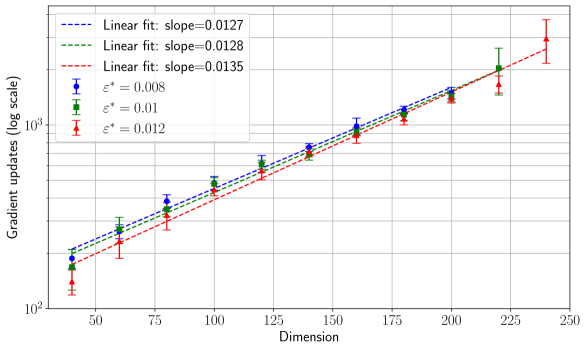
The image is a line graph depicting the relationship between "Dimension" (x-axis) and "Gradient updates (log scale)" (y-axis). Three linear fits with distinct slopes are plotted, alongside data points with error bars corresponding to different ε* values. The graph uses a logarithmic scale for gradient updates, emphasizing exponential growth trends.
### Components/Axes
- **X-axis (Dimension)**: Ranges from 50 to 250 in increments of 25. Labeled "Dimension."
- **Y-axis (Gradient updates)**: Logarithmic scale from 10² to 10³. Labeled "Gradient updates (log scale)."
- **Legend**: Positioned in the top-left corner. Contains:
- Blue dashed line: "Linear fit: slope=0.0127"
- Green dashed line: "Linear fit: slope=0.0128"
- Red dashed line: "Linear fit: slope=0.0135"
- Blue circles: ε* = 0.008
- Green squares: ε* = 0.01
- Red triangles: ε* = 0.012
### Detailed Analysis
1. **Linear Fits**:
- All three lines (blue, green, red) exhibit nearly identical slopes (0.0127–0.0135), indicating a consistent linear relationship between dimension and gradient updates.
- Lines are tightly clustered, with minimal divergence across the dimension range.
2. **Data Points**:
- **ε* = 0.008 (blue circles)**: Follow the blue dashed line closely, with error bars decreasing slightly as dimension increases.
- **ε* = 0.01 (green squares)**: Align with the green dashed line, showing similar error patterns.
- **ε* = 0.012 (red triangles)**: Match the red dashed line, with error bars slightly larger at higher dimensions.
3. **Trends**:
- Gradient updates increase linearly with dimension for all ε* values.
- The logarithmic y-axis reveals exponential growth in absolute gradient updates (e.g., 10² to 10³ represents a 10x increase).
### Key Observations
- **Consistency Across ε***: All ε* values follow nearly identical linear trends, suggesting ε* has minimal impact on the slope of gradient updates.
- **Error Bars**: Variability in gradient updates increases slightly at higher dimensions, particularly for ε* = 0.012 (red triangles).
- **Slope Similarity**: The near-identical slopes (0.0127–0.0135) imply that the relationship between dimension and gradient updates is robust across different ε* conditions.
### Interpretation
The graph demonstrates that gradient updates scale linearly with dimension, regardless of ε* values. The logarithmic y-axis highlights the exponential resource requirements for higher-dimensional models. The tight alignment between data points and linear fits suggests a strong theoretical or empirical basis for the observed trend. The slight increase in error bars at higher dimensions may indicate practical limitations (e.g., computational noise) in extreme-scale scenarios. This trend is critical for optimizing training efficiency in high-dimensional machine learning systems.