## Text-Based Technical Document: Code Definitions, Theorem, and Proof Tree
### Overview
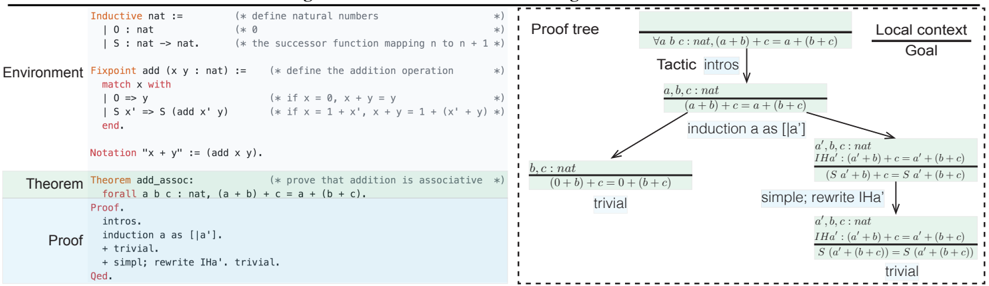
The image contains a technical document split into two sections:
1. **Left Side**: Code definitions (natural numbers, addition operation) and a theorem proof.
2. **Right Side**: A proof tree diagram illustrating the logical steps to prove the theorem.
The document uses a mix of code syntax, mathematical notation, and diagrammatic reasoning. No numerical data or visual trends are present; the focus is on formal logic and proof structure.
---
### Components/Axes
#### Left Side (Code/Theorem)
- **Code Definitions**:
- `Inductive nat := | 0 : nat | S : nat -> nat`
- Defines natural numbers (`0` as base case, `S` as successor function).
- `Fixpoint add (x y : nat) :=`
- Defines addition recursively:
- `0 => y` (base case: `0 + y = y`).
- `S x => S (add x y)` (recursive case: `S x + y = S (x + y)`).
- Notation: `"x + y" := (add x y)`.
- **Theorem**: `Theorem add_assoc : forall a b c : nat, (a + b) + c = a + (b + c).`
- Proves addition is associative.
- **Proof**:
- `intros.` (Introduce variables `a`, `b`, `c`).
- `induction a as [|a'].` (Induction on `a`; splits into base case `a = 0` and inductive step `a = S a'`).
- `+ trivial.` (Base case: `0 + b + c = b + c = 0 + (b + c)`).
- `+ simpl; rewrite IHa'.` (Inductive step: Simplify and apply induction hypothesis `IHa'` for `a'`).
- `trivial.` (Final step confirms equality).
#### Right Side (Proof Tree)
- **Structure**:
- **Root Node**: `a,b,c:nat` (Variables in local context).
- **Goal**: `(a + b) + c = a + (b + c)`.
- **Steps**:
1. **Tactic**: `intros` (Introduce variables).
2. **Induction**: `induction a as [|a']` (Splits into base case `a = 0` and inductive step `a = S a'`).
3. **Base Case**:
- `(0 + b) + c = 0 + (b + c)` (trivial).
4. **Inductive Step**:
- `IHa': (a' + b) + c = a' + (b + c)` (Induction hypothesis).
- `S (a' + b) + c = S (a' + (b + c))` (Apply `IHa'` and simplify).
- `S (a' + (b + c)) = a + (b + c)` (Trivial, since `a = S a'`).
- **Legend**:
- Colors (not visually present in the image) are labeled as:
- `nat` (natural numbers).
- `add` (addition operation).
- `IHa'` (Induction hypothesis).
---
### Detailed Analysis
#### Left Side (Code/Theorem)
- **Natural Numbers**:
- `0` is the base case.
- `S` maps `n` to `n + 1` (successor function).
- **Addition Operation**:
- Defined recursively with two cases:
- `0 + y = y` (base case).
- `S x + y = S (x + y)` (recursive case).
- **Theorem Proof**:
- Uses **mathematical induction** on `a` to prove associativity.
- Base case (`a = 0`) and inductive step (`a = S a'`) are handled separately.
- Relies on the induction hypothesis `IHa'` to generalize the proof.
#### Right Side (Proof Tree)
- **Flow**:
- Starts with the goal `(a + b) + c = a + (b + c)`.
- Applies `intros` to introduce variables.
- Uses `induction a` to split into cases.
- Base case and inductive step are resolved using `trivial` and `rewrite IHa'`.
- **Key Nodes**:
- `a,b,c:nat`: Local context variables.
- `IHa': (a' + b) + c = a' + (b + c)`: Induction hypothesis for the inductive step.
---
### Key Observations
1. **Logical Structure**:
- The proof tree mirrors the code’s recursive definition of addition.
- Induction on `a` ensures the theorem holds for all natural numbers.
2. **No Numerical Data**:
- The document focuses on formal logic, not empirical data.
- No trends or numerical values to analyze.
3. **Color Legend**:
- Colors (e.g., `nat`, `add`, `IHa'`) are textual labels, not visual elements.
---
### Interpretation
- **Purpose**:
- Demonstrates how formal proofs (e.g., in Coq or similar proof assistants) validate mathematical properties (e.g., associativity of addition).
- **Relationships**:
- The code defines the mathematical objects (natural numbers, addition).
- The theorem and proof tree formalize the proof of associativity using induction.
- **Notable Patterns**:
- The proof tree’s structure reflects the recursive nature of the code.
- The use of `trivial` and `rewrite` tactics simplifies the proof steps.
- **Anomalies**:
- No numerical data or visual trends to analyze.
- The document is purely symbolic, relying on formal logic rather than empirical evidence.
---
**Note**: The image contains no numerical data, charts, or visual trends. All information is textual and diagrammatic, focusing on formal logic and proof construction.