## Diagram: Proof Tree and Code Snippets
### Overview
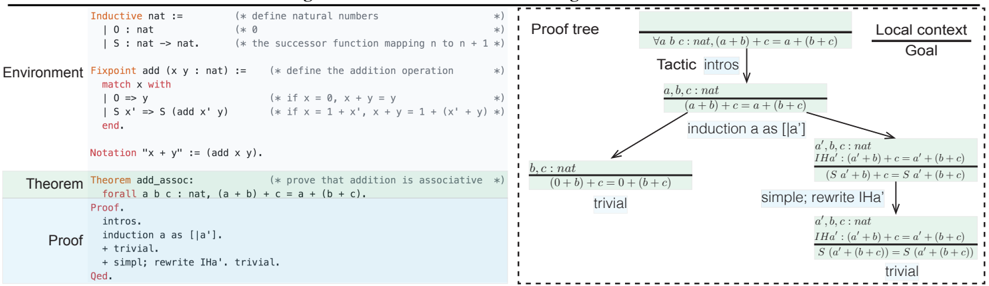
The image presents a combination of code snippets defining natural numbers and addition, alongside a proof tree demonstrating the associative property of addition. The left side shows the environment and theorem definition, while the right side illustrates the proof process using a tree structure.
### Components/Axes
**Left Side (Code Snippets):**
* **Environment:**
* `Inductive nat :=`: Defines natural numbers.
* `| 0 : nat`: Zero is a natural number.
* `| S : nat -> nat`: S is the successor function mapping n to n+1.
* `Fixpoint add (x y : nat) :=`: Defines the addition operation.
* `match x with`: Pattern matching on x.
* `| 0 => y`: If x = 0, then x + y = y.
* `| S x' => S (add x' y)`: If x = 1 + x', then x + y = 1 + (x' + y).
* `end.`: End of the function definition.
* `Notation "x + y" := (add x y).`: Defines the notation for addition.
* **Theorem:**
* `Theorem add_assoc:`: Declares the theorem for the associative property of addition.
* `forall a b c : nat, (a + b) + c = a + (b + c).`: States the theorem: for all natural numbers a, b, and c, (a + b) + c = a + (b + c).
* **Proof:**
* `Proof.`: Starts the proof.
* `intros.`: Introduces the variables.
* `induction a as [|a'].`: Performs induction on 'a'.
* `+ trivial.`: Base case is trivial.
* `+ simpl; rewrite IHa'. trivial.`: Simplifies and rewrites using the induction hypothesis.
* `Qed.`: End of proof.
**Right Side (Proof Tree):**
* **Top Node:**
* `∀ a b c : nat, (a + b) + c = a + (b + c)`: The initial goal.
* `Tactic intros`: Indicates the "intros" tactic is applied.
* `a, b, c : nat`: Declares a, b, and c as natural numbers.
* `(a + b) + c = a + (b + c)`: The goal to prove.
* `induction a as [|a']`: Indicates induction on 'a'.
* **Left Child Node:**
* `b, c : nat`: Declares b and c as natural numbers.
* `(0 + b) + c = 0 + (b + c)`: The base case where a = 0.
* `trivial`: Indicates the base case is trivially true.
* **Right Child Node:**
* `a', b, c : nat`: Declares a', b, and c as natural numbers.
* `IHa' : (a' + b) + c = a' + (b + c)`: The induction hypothesis.
* `(S a' + b) + c = S a' + (b + c)`: The goal to prove in the inductive step.
* `simple; rewrite IHa'`: Indicates simplification and rewriting using the induction hypothesis.
* **Bottom Node:**
* `a', b, c : nat`: Declares a', b, and c as natural numbers.
* `IHa' : (a' + b) + c = a' + (b + c)`: The induction hypothesis.
* `S (a' + b) + c = S a' + (b + c)`: The goal to prove in the inductive step.
* `trivial`: Indicates the inductive step is trivially true.
* **Annotations:**
* `Local context`: Label for the context.
* `Goal`: Label for the goal.
### Detailed Analysis or ### Content Details
The code defines natural numbers using an inductive type with zero and a successor function. It then defines addition recursively. The theorem `add_assoc` states the associative property of addition. The proof uses induction on the variable 'a'. The proof tree visually represents the steps of the inductive proof, showing the base case and the inductive step.
### Key Observations
* The code uses a functional programming style with pattern matching.
* The proof tree clearly illustrates the structure of the inductive proof.
* The "trivial" annotations indicate that certain steps are self-evident.
### Interpretation
The image demonstrates a formal approach to proving mathematical properties using code and a visual proof representation. The code defines the basic concepts, and the proof tree shows how to rigorously establish the associative property of addition. The combination of code and proof tree provides a comprehensive understanding of the theorem and its proof. The proof tree visually breaks down the inductive steps, making the logic easier to follow.