\n
## Diagram: Proof Tree and Code Snippets
### Overview
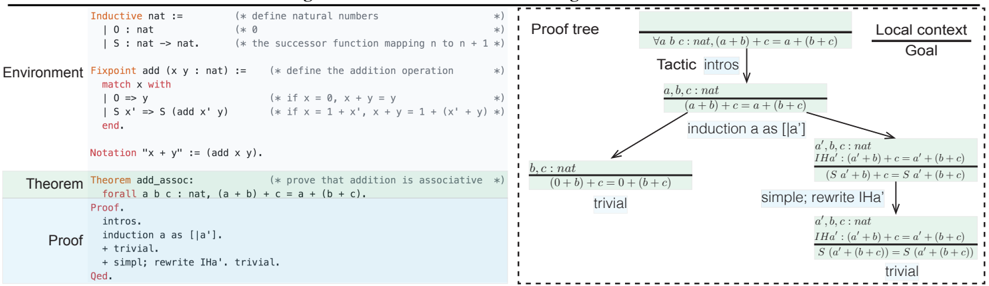
The image presents a combination of code snippets defining natural numbers and addition, alongside a visual representation of a proof tree for the associativity of addition. The left side contains Coq code, while the right side illustrates the proof process.
### Components/Axes
The image is divided into two main sections:
* **Left Section:** Contains Coq code defining natural numbers (`nat`) and the addition operation (`add`). It also includes a theorem statement (`add_assoc`) and its proof.
* **Right Section:** Displays a proof tree diagram, showing the application of tactics and the resulting states of the goal and local context.
The right section has the following labels:
* **Top-right:** "Local context"
* **Top-center:** "Proof tree"
* **Arrows:** Indicate the application of tactics and the flow of the proof.
* **Boxes:** Represent the goal and local context at different stages of the proof.
### Detailed Analysis or Content Details
**Left Section - Code:**
* **Inductive nat :=**
* `0 : nat`
* `S : nat -> nat.` (* the successor function mapping n to n+1 *)
* **Fixpoint add (x y : nat) :=** (* define the addition operation *)
* `match x with`
* `| 0 => y` (* if x = 0, x + y = y *)
* `| S x' => S (add x' y)` (* if x = 1 + x', x + y = 1 + (x' + y) *)
* `end.`
* **Notation "x + y" := (add x y).**
* **Theorem add_assoc:** (* prove that addition is associative *)
* `forall a b c : nat, (a + b) + c = a + (b + c).`
* `Proof.`
* `intros.`
* `induction a as [].`
* `trivial.`
* `simpl; rewrite IHa`. trivial.
* `Qed.`
**Right Section - Proof Tree:**
The proof tree shows the following steps:
1. **Initial State:**
* **Goal:** `∀b c : nat, (a + b) + c = a + (b + c)` (where `a`, `b`, and `c` are natural numbers)
* **Local Context:** `∀b c : nat, (a + b) + c = a + (b + c)`
2. **Tactic: `intros`**
* **Goal:** `(a + b) + c = a + (b + c)`
* **Local Context:** `a, b, c : nat`
3. **Tactic: `induction a as [].`**
* **Goal:** `(a + b) + c = a + (b + c)`
* **Local Context:** `a, b, c : nat`
* **Induction Hypothesis (IH):** `d' + b + c = d + (b + c)` and `S d' + b + c = S d + (b + c)`
4. **Tactic: `trivial`**
* **Goal:** `0 + b + c = 0 + (b + c)`
* **Local Context:** `b, c : nat`
5. **Tactic: `simpl; rewrite IHa`**
* **Goal:** `S d' + b + c = S d + (b + c)`
* **Local Context:** `d', b, c : nat, IHd : d' + b + c = d + (b + c)`
### Key Observations
* The code defines natural numbers using an inductive type and addition recursively.
* The proof of associativity uses induction on the first argument of addition.
* The proof tree clearly illustrates the application of tactics (`intros`, `induction`, `trivial`, `simpl`, `rewrite`) and the resulting changes to the goal and local context.
* The `IH` (Induction Hypothesis) is crucial for completing the proof.
### Interpretation
The image demonstrates a formal proof of the associativity of addition using the Coq proof assistant. The code defines the mathematical objects (natural numbers and addition) and the theorem to be proven. The proof tree visualizes the logical steps involved in the proof, showing how tactics are applied to transform the goal until it becomes trivially true. This illustrates a rigorous approach to mathematical reasoning and verification, common in formal methods and computer science. The use of induction is a standard technique for proving properties of recursively defined structures like natural numbers. The diagram effectively communicates the process of formal proof, making it accessible to those familiar with proof theory and Coq.