\n
## Diagram: MemoryBank and SiliconFriend Interaction
### Overview
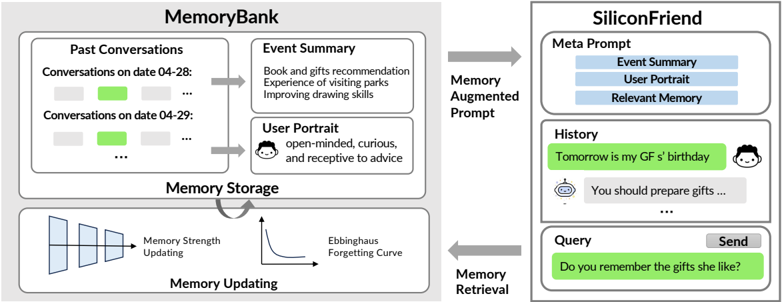
This diagram illustrates the interaction between two components: "MemoryBank" and "SiliconFriend". The diagram depicts a flow of information from the MemoryBank to the SiliconFriend, representing a system for personalized interaction based on stored memories. The MemoryBank handles memory storage and updating, while SiliconFriend utilizes this information through a "Meta Prompt" and "History" interface to respond to user queries.
### Components/Axes
The diagram is divided into two main sections, "MemoryBank" (left) and "SiliconFriend" (right). Within MemoryBank, there are three sub-components: "Past Conversations", "Event Summary", and "Memory Storage". Below Memory Storage is "Memory Updating". SiliconFriend contains "Meta Prompt", "History", and "Query". Arrows indicate the direction of information flow.
### Detailed Analysis or Content Details
**MemoryBank:**
* **Past Conversations:** Displays two entries: "Conversations on date 04-28" and "Conversations on date 04-29". Each entry contains multiple green squares representing individual conversation snippets. The number of squares is not precisely quantifiable, but appears to be approximately 6-8 per date. An ellipsis (...) indicates further conversations exist.
* **Event Summary:** Lists three events: "Book and gifts recommendation", "Experience of visiting parks", and "Improving drawing skills".
* **User Portrait:** Contains the text: "open-minded, curious, and receptive to advice".
* **Memory Storage:** This section is visually represented as a series of stacked rectangular blocks, suggesting a layered storage structure.
* **Memory Updating:** This section contains two components: "Memory Strength Updating" which is represented by a series of stacked rectangular blocks, and "Ebbinghaus Forgetting Curve" which is a downward sloping line. The curve starts at a high value (approximately 80-90%) and decreases to a low value (approximately 10-20%) over time.
**SiliconFriend:**
* **Meta Prompt:** Contains three entries: "Event Summary", "User Portrait", and "Relevant Memory". Each entry is represented by a blue rectangular block.
* **History:** Displays a single entry: "Tomorrow is my GF's birthday". Below this is a chat bubble with the text: "You should prepare gifts...". An ellipsis (...) indicates further history exists. A small robot icon is present next to the chat bubble.
* **Query:** Contains the question: "Do you remember the gifts she like?". A "Send" button is present.
**Information Flow:**
* An arrow points from "Past Conversations" and "Event Summary" to "Memory Augmented Prompt".
* An arrow points from "Memory Storage" to "Memory Augmented Prompt".
* An arrow points from "Memory Augmented Prompt" to "Meta Prompt".
* An arrow points from "Meta Prompt" to "History".
* An arrow points from "History" to "Query".
* An arrow points from "Memory Updating" to "Ebbinghaus Forgetting Curve".
### Key Observations
The diagram highlights a system where past interactions and user characteristics are stored and utilized to provide personalized responses. The Ebbinghaus Forgetting Curve suggests that memory strength decays over time, necessitating the "Memory Strength Updating" process. The "Memory Augmented Prompt" acts as a central point for integrating various memory sources. The use of green squares to represent conversation snippets suggests a granular level of memory storage.
### Interpretation
The diagram illustrates a conceptual architecture for a conversational AI system (SiliconFriend) that leverages a memory component (MemoryBank) to provide contextually relevant responses. The system aims to personalize interactions by considering past conversations, event summaries, and user traits. The inclusion of the Ebbinghaus Forgetting Curve indicates an awareness of the challenges of long-term memory retention and the need for mechanisms to reinforce memory strength. The flow of information suggests a process where the system retrieves relevant memories, augments a prompt with this information, and then uses the augmented prompt to generate a response. The system appears to be designed to proactively remind the user of important events (e.g., birthday) and offer relevant suggestions. The diagram is a high-level overview and does not provide details on the specific algorithms or techniques used for memory storage, retrieval, or prompt augmentation. It is a conceptual illustration of a system, not a detailed technical specification.