## System Architecture Diagram: Memory-Augmented AI Assistant System
### Overview
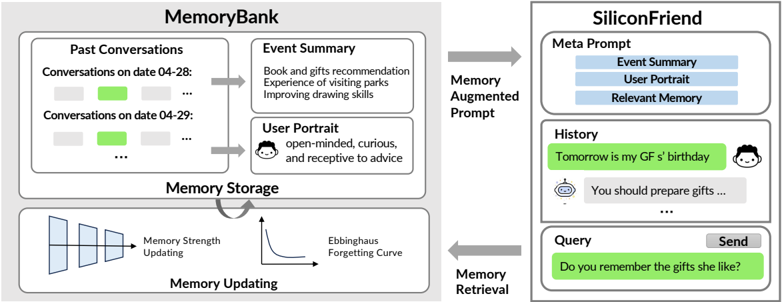
The image is a technical system architecture diagram illustrating a two-component AI system designed for memory-augmented conversation. The system consists of a **MemoryBank** module for storing and updating user interaction history, and a **SiliconFriend** module that acts as the conversational AI interface. Data flows between these components to enable context-aware responses based on past interactions.
### Components/Axes
The diagram is divided into two primary rectangular containers:
1. **Left Container: MemoryBank**
* **Top Section (Memory Storage):** Contains three sub-components:
* **Past Conversations:** A box listing "Conversations on date 04-28:" and "Conversations on date 04-29:", each followed by a series of colored blocks (green and gray) representing individual conversation turns.
* **Event Summary:** A box listing extracted topics: "Book and gifts recommendation", "Experience of visiting parks", "Improving drawing skills".
* **User Portrait:** A box with a user icon and the description: "open-minded, curious, and receptive to advice".
* **Bottom Section (Memory Updating):** Contains two sub-components:
* **Memory Strength Updating:** A diagram of three stacked, fading rectangles.
* **Ebbinghaus Forgetting Curve:** A line graph with a decaying curve, labeled on the axes (though axis labels are not explicitly written, the curve is a standard representation of memory decay over time).
* A circular arrow labeled "Memory Storage" connects the top and bottom sections, indicating a feedback loop.
2. **Right Container: SiliconFriend**
* **Top Section (Meta Prompt):** A box containing three stacked, colored bars labeled: "Event Summary", "User Portrait", and "Relevant Memory".
* **Middle Section (History):** A chat interface showing a conversation history:
* User message (green bubble): "Tomorrow is my GF's birthday"
* AI response (gray bubble with robot icon): "You should prepare gifts ..."
* An ellipsis "..." indicates more history.
* **Bottom Section (Query):** A user input area with a text field containing "Do you remember the gifts she likes?" and a "Send" button.
**Data Flow Arrows:**
* A thick gray arrow labeled **"Memory Augmented Prompt"** points from the MemoryBank container to the SiliconFriend container.
* A thick gray arrow labeled **"Memory Retrieval"** points from the SiliconFriend container back to the MemoryBank container.
### Detailed Analysis
* **MemoryBank - Past Conversations:** The visual uses colored blocks (green and gray) to represent discrete conversation turns. The dates "04-28" and "04-29" are explicitly listed, indicating daily aggregation.
* **MemoryBank - Event Summary & User Portrait:** These are derived outputs from the raw conversations. The text lists specific, high-level topics and a concise user personality profile.
* **MemoryBank - Memory Updating:** This section conceptualizes the system's maintenance of memory. The "Memory Strength Updating" graphic suggests a process of reinforcing or fading memories. The "Ebbinghaus Forgetting Curve" graph explicitly references the psychological model of memory decay, implying the system algorithmically manages memory retention.
* **SiliconFriend - Meta Prompt:** This component constructs a prompt for the language model. It is composed of three elements pulled from MemoryBank: the summarized events, the user portrait, and specifically relevant memories for the current context.
* **SiliconFriend - History & Query:** This shows the live interaction. The user's query ("Do you remember the gifts she likes?") is a direct test of the system's memory retrieval capability, referencing the earlier conversation about a birthday gift.
### Key Observations
1. **Closed-Loop System:** The architecture forms a closed loop where conversations generate memories, memories are stored and updated, and then retrieved to augment future conversations.
2. **Abstraction Layers:** The system doesn't store raw chat logs for direct recall. It processes them into abstractions: **Event Summaries** (what was talked about) and a **User Portrait** (who the user is).
3. **Memory Management:** The inclusion of the "Ebbinghaus Forgetting Curve" and "Memory Strength Updating" indicates an active, algorithmic approach to managing what is remembered and how strongly, rather than passive, permanent storage.
4. **Context Injection:** The "Meta Prompt" is the critical interface where stored memory is formatted and injected into the AI's context to influence its response generation.
### Interpretation
This diagram outlines a sophisticated framework for creating a personalized, long-term AI companion. The core innovation is the **MemoryBank**, which acts as a structured, evolving knowledge base about the user.
* **How it works:** The system continuously distills raw interactions into durable knowledge (summaries, portraits). When a new query arrives (e.g., about a gift), the **Memory Retrieval** process searches the MemoryBank for relevant information (the prior birthday conversation). This information is then packaged with the user's profile and recent events into a **Meta Prompt**, which gives the **SiliconFriend** AI the necessary context to provide a coherent, personalized, and helpful response that feels like genuine remembering.
* **Why it matters:** This addresses a fundamental limitation of standard chatbots: their lack of persistent memory and user understanding. By maintaining and intelligently retrieving a user-specific knowledge base, the system can build rapport, provide consistent advice, and offer a more human-like, continuous conversational experience over time.
* **Notable Design Choice:** The separation of "Memory Storage" (what is known) from "Memory Updating" (how knowledge is maintained) is crucial. It suggests the system is designed not just to accumulate data, but to curate it, potentially forgetting irrelevant details or strengthening important memories, mimicking human cognitive processes.