## Diagram: MemoryBank and SiliconFriend System Architecture
### Overview
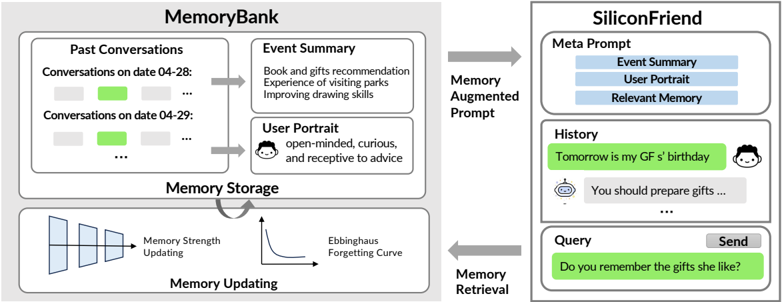
The image depicts a technical architecture for a memory-augmented AI system called **SiliconFriend**, integrated with a **MemoryBank** component. The system processes past conversations, user profiles, and event summaries to generate context-aware responses. Key elements include memory storage, updating mechanisms, and retrieval workflows.
### Components/Axes
#### Left Diagram (MemoryBank):
1. **Past Conversations**:
- Dates: `04-28` and `04-29` (highlighted in green).
- Content: Unspecified text snippets (represented by gray rectangles with ellipses).
2. **Event Summary**:
- Text: *"Book and gifts recommendation Experience of visiting parks Improving drawing skills"*.
3. **User Portrait**:
- Text: *"open-minded, curious, and receptive to advice"* (accompanied by a cartoon avatar).
4. **Memory Storage**:
- Graph: A line chart titled *"Memory Strength Updating"* with an axis labeled *"Ebbinghaus Forgetting Curve"*.
- Visual: A decaying curve (blue line) illustrating memory retention over time.
5. **Memory Updating**:
- Arrows indicate bidirectional flow between storage and updating processes.
#### Right Diagram (SiliconFriend):
1. **Meta Prompt**:
- Sub-components:
- *Event Summary* (blue rectangle).
- *User Portrait* (blue rectangle).
- *Relevant Memory* (blue rectangle).
2. **History**:
- Text: *"Tomorrow is my GF’s birthday"* (green background).
- Response: *"You should prepare gifts..."* (gray background).
3. **Query**:
- Text: *"Do you remember the gifts she like?"* (green background).
- UI Element: A *"Send"* button (gray rectangle).
### Detailed Analysis
- **MemoryBank**:
- Past conversations are timestamped and partially highlighted (green), suggesting prioritization of recent or critical interactions.
- The **Event Summary** and **User Portrait** are synthesized from raw data, indicating automated summarization and profiling.
- The **Memory Storage** graph uses the **Ebbinghaus Forgetting Curve** to model memory decay, with a decay rate implied by the curve’s slope.
- **SiliconFriend**:
- The **Meta Prompt** integrates event summaries, user profiles, and relevant memories to generate contextually appropriate responses.
- The **History** section shows a user reminder about a birthday, with the system acknowledging the task.
- The **Query** demonstrates retrieval of past interactions (e.g., gift preferences) to inform future actions.
### Key Observations
1. **Temporal Prioritization**: Green highlights on `04-28` and `04-29` suggest recent conversations are prioritized in memory retrieval.
2. **Memory Decay**: The Ebbinghaus curve indicates that memory strength diminishes over time, necessitating periodic updates.
3. **Contextual Integration**: SiliconFriend combines event summaries, user traits, and memory to personalize responses (e.g., gift recommendations).
4. **Workflow**: Data flows from MemoryBank (storage/updating) to SiliconFriend (meta-prompting and retrieval), forming a closed-loop system.
### Interpretation
The system is designed to enhance AI interactions by leveraging historical data and user-specific traits. The Ebbinghaus curve implies that without regular updates, critical information (e.g., gift preferences) may fade, reducing response relevance. The integration of event summaries and user portraits allows SiliconFriend to tailor responses to individual needs, as seen in the birthday example. This architecture could improve user experience by making interactions more context-aware and personalized, though the decay curve highlights the need for robust memory maintenance mechanisms.