## Diagram: Grid-Based Pattern Demonstration and Test
### Overview
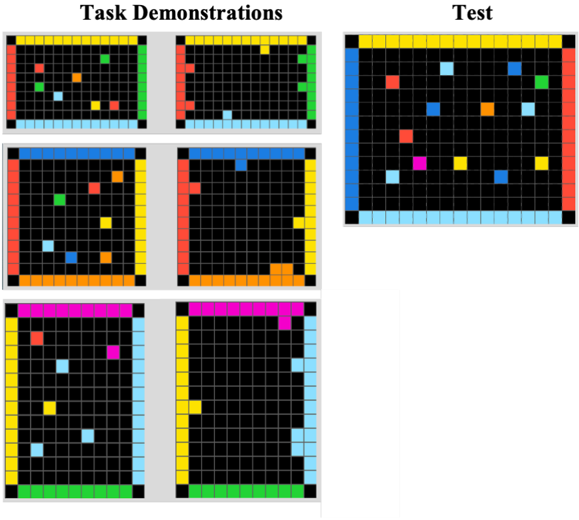
The image displays a set of grid-based visual patterns organized into two main sections: "Task Demonstrations" on the left and a single "Test" panel on the right. Each panel consists of a black grid (approximately 10x10 cells) containing scattered colored squares and surrounded by a multi-colored border. The layout suggests a pattern recognition or puzzle-solving task where the demonstrations provide examples, and the test presents a new instance to solve.
### Components/Axes
* **Titles:** The text "Task Demonstrations" is centered above the left section. The text "Test" is centered above the right section.
* **Panels:** There are seven distinct grid panels in total.
* **Task Demonstrations:** Contains six panels arranged in three rows of two.
* **Test:** Contains one larger panel.
* **Grid Structure:** Each panel is a black grid with visible cell lines. The grids appear to be 10 columns by 10 rows.
* **Border:** Each grid is framed by a border composed of colored segments. The border is divided into four sides (top, right, bottom, left), with each side typically being a single solid color.
* **Internal Elements:** Inside each black grid, there are several solid-colored squares occupying individual cells. The colors include red, green, blue, cyan, yellow, orange, and magenta.
### Detailed Analysis
**Task Demonstrations - Row 1 (Top):**
* **Left Panel:**
* **Border Colors:** Top: Yellow, Right: Green, Bottom: Cyan, Left: Red.
* **Internal Squares:** Contains approximately 8 squares. Colors and approximate positions: Red (top-left quadrant), Green (top-right quadrant), Blue (center-left), Orange (center), Yellow (center-right), Cyan (bottom-left), another Red (bottom-center).
* **Right Panel:**
* **Border Colors:** Top: Yellow, Right: Green, Bottom: Cyan, Left: Red. (Identical to left panel).
* **Internal Squares:** Contains approximately 6 squares. Notably different arrangement from the left panel. Colors: Red (top-left), Yellow (top-center), Green (top-right), Cyan (bottom-center).
**Task Demonstrations - Row 2 (Middle):**
* **Left Panel:**
* **Border Colors:** Top: Blue, Right: Yellow, Bottom: Orange, Left: Red.
* **Internal Squares:** Contains approximately 7 squares. Colors: Green (top-left), Red (top-center), Orange (top-right), Yellow (center-right), Cyan (bottom-left), Blue (bottom-center).
* **Right Panel:**
* **Border Colors:** Top: Blue, Right: Yellow, Bottom: Orange, Left: Red. (Identical to left panel).
* **Internal Squares:** Contains approximately 5 squares. Colors: Red (top-left), Blue (top-center), Yellow (center-right), Orange (bottom-right).
**Task Demonstrations - Row 3 (Bottom):**
* **Left Panel:**
* **Border Colors:** Top: Magenta, Right: Cyan, Bottom: Green, Left: Yellow.
* **Internal Squares:** Contains approximately 7 squares. Colors: Red (top-left), Magenta (top-right), Cyan (center-left), Yellow (center), Blue (bottom-left), another Cyan (bottom-center).
* **Right Panel:**
* **Border Colors:** Top: Magenta, Right: Cyan, Bottom: Green, Left: Yellow. (Identical to left panel).
* **Internal Squares:** Contains approximately 4 squares. Colors: Magenta (top-right), Yellow (center-left), Cyan (bottom-right).
**Test Panel:**
* **Border Colors:** Top: Yellow, Right: Red, Bottom: Cyan, Left: Blue.
* **Internal Squares:** Contains approximately 11 squares, more densely packed than the demonstration panels. Colors and approximate positions: Red (top-left), Cyan (top-center), Blue (top-right), Green (top-right corner), Orange (center), Magenta (center-left), Yellow (center-right), another Blue (center-right), Cyan (bottom-left), another Yellow (bottom-right).
### Key Observations
1. **Border Consistency:** Within each row of the "Task Demonstrations," the two panels share identical border color schemes. The "Test" panel has a unique border color combination not seen in any single demonstration panel.
2. **Internal Square Variation:** The arrangement and count of internal colored squares differ between the paired demonstration panels, even with identical borders. The test panel has the highest number of internal squares.
3. **Color Palette:** The set of colors used for borders and internal squares is consistent across the entire image (Red, Green, Blue, Cyan, Yellow, Orange, Magenta).
4. **Spatial Layout:** The demonstrations are presented as comparative pairs, while the test stands alone, implying it is the problem to be solved based on the learned patterns from the demonstrations.
### Interpretation
This image likely represents a **visual reasoning or abstract pattern learning task**, common in cognitive science or machine learning benchmarks. The structure suggests the following:
* **Learning from Examples:** The "Task Demonstrations" provide paired examples. The rule or relationship is not between the left and right panels of a pair (as their internals differ), but likely between the **border color scheme** and some property of the **internal square distribution**. The model or subject must infer this implicit rule from the six examples.
* **The Test Challenge:** The "Test" panel presents a new border configuration. The task is to apply the inferred rule to predict, generate, or identify the correct pattern of internal squares for this new border. The higher density of squares in the test might indicate increased complexity or a different rule application.
* **Underlying Logic:** The rule could involve mapping specific border colors to the presence, absence, count, or spatial arrangement of certain internal colors. For instance, a yellow top border might correlate with having red squares in the top row, or a cyan bottom border might require squares in the bottom-left corner. The paired demonstrations with identical borders but different internals might show that the rule is probabilistic or has multiple valid outputs.
* **Purpose:** This type of task evaluates systematic generalization—the ability to extract a abstract rule from limited examples and apply it to a novel situation. It tests understanding beyond mere memorization, probing for compositional reasoning about color, position, and relational rules.