\n
## Stacked Bar Chart: Performance Comparison - CPU Only vs. CPU-GPU-NPU
### Overview
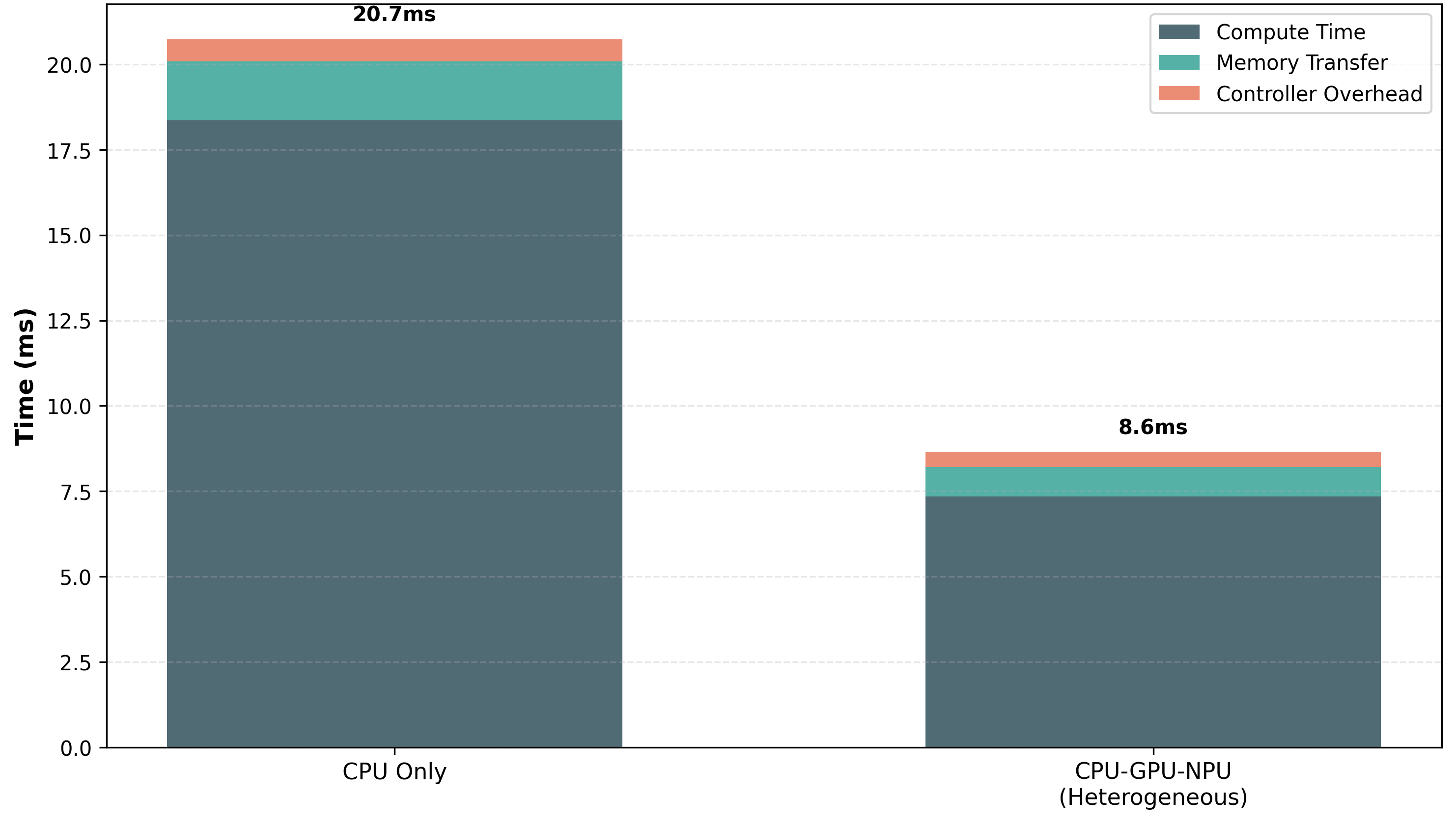
This is a stacked bar chart comparing the total execution time of a task performed on a system using only a CPU versus a heterogeneous system utilizing a CPU, GPU, and NPU. The chart breaks down the total time into three components: Compute Time, Memory Transfer, and Controller Overhead. The total time is displayed above each bar.
### Components/Axes
* **X-axis:** Represents the system configuration. Categories are "CPU Only" and "CPU-GPU-NPU (Heterogeneous)".
* **Y-axis:** Represents Time in milliseconds (ms), ranging from 0.0 to 22.5 ms, with increments of 2.5 ms.
* **Legend (Top-Right):**
* Compute Time (Dark Gray)
* Memory Transfer (Light Teal)
* Controller Overhead (Light Orange)
* **Total Time Labels:** Displayed above each bar, indicating the total execution time for each configuration.
### Detailed Analysis
The chart consists of two stacked bars, one for each system configuration.
**CPU Only:**
* Total Time: Approximately 20.7 ms.
* Compute Time: Approximately 16.5 ms. This is the largest component of the total time.
* Memory Transfer: Approximately 3.2 ms.
* Controller Overhead: Approximately 1.0 ms.
**CPU-GPU-NPU (Heterogeneous):**
* Total Time: Approximately 8.6 ms.
* Compute Time: Approximately 6.0 ms.
* Memory Transfer: Approximately 1.7 ms.
* Controller Overhead: Approximately 0.9 ms.
### Key Observations
* The heterogeneous system (CPU-GPU-NPU) demonstrates a significant reduction in total execution time compared to the CPU-only system. The total time is reduced from approximately 20.7 ms to 8.6 ms, representing a decrease of approximately 58%.
* Compute Time is the dominant factor in both configurations, but the reduction in Compute Time in the heterogeneous system is substantial.
* Memory Transfer and Controller Overhead are relatively small components of the total time in both configurations, but they are also reduced in the heterogeneous system.
### Interpretation
The data strongly suggests that utilizing a heterogeneous computing architecture (CPU-GPU-NPU) significantly improves performance for the task being measured. The substantial reduction in Compute Time indicates that the GPU and NPU are effectively offloading computational workload from the CPU. The reduction in Memory Transfer and Controller Overhead suggests that the heterogeneous system is also more efficient in data handling and resource management.
The chart highlights the benefits of hardware acceleration and parallel processing. By leveraging the specialized capabilities of the GPU and NPU, the heterogeneous system can complete the task much faster than a CPU-only system. This is likely due to the GPU and NPU being optimized for specific types of computations, allowing them to perform these tasks more efficiently than a general-purpose CPU.
The relatively small contribution of Memory Transfer and Controller Overhead suggests that these are not major bottlenecks in either configuration. However, even small improvements in these areas can contribute to the overall performance gain.