## State Transition Diagram: Propositional Logic Transitions
### Overview
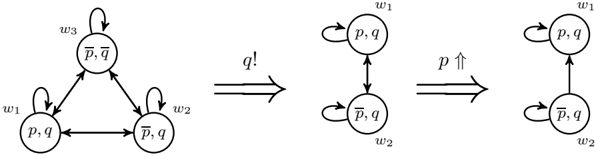
The image depicts a series of state transition diagrams illustrating changes in propositional logic states based on the application of operators. The diagram shows transitions between states defined by the truth values of propositions p and q.
### Components/Axes
* **States:** Represented by circles, each labeled with the truth values of propositions p and q (e.g., "p, q" or "¬p, q"). The overline symbol (¬) indicates negation.
* **Transitions:** Represented by arrows, indicating movement from one state to another.
* **Operators:** Represented by arrows with labels (e.g., "q!", "p↑"), indicating the operation causing the state transition.
* **State Labels:** Each state is labeled with a 'w' subscripted with a number (w1, w2, w3), indicating a specific world or state.
### Detailed Analysis
**Initial State Diagram (Left):**
* Three states arranged in a triangle:
* Bottom-left: State labeled "p, q" with label "w1". Has a self-loop transition.
* Bottom-right: State labeled "¬p, q" with label "w2". Has a self-loop transition.
* Top: State labeled "¬p, ¬q" with label "w3". Has a self-loop transition.
* Transitions:
* "p, q" transitions to "¬p, ¬q".
* "¬p, q" transitions to "¬p, ¬q".
* "¬p, ¬q" transitions to "p, q" and "¬p, q".
**First Transition (q!):**
* An arrow labeled "q!" points from the initial state diagram to the next state diagram.
**Intermediate State Diagram (Middle):**
* Two states arranged vertically:
* Top: State labeled "p, q" with label "w1". Has a self-loop transition.
* Bottom: State labeled "¬p, q" with label "w2". Has a self-loop transition.
* Transitions:
* "p, q" transitions to "¬p, q".
* "¬p, q" transitions to "p, q".
**Second Transition (p↑):**
* An arrow labeled "p↑" points from the intermediate state diagram to the final state diagram.
**Final State Diagram (Right):**
* Two states arranged vertically:
* Top: State labeled "p, q" with label "w1". Has a self-loop transition.
* Bottom: State labeled "¬p, q" with label "w2". Has a self-loop transition.
* Transitions:
* "¬p, q" transitions to "p, q".
### Key Observations
* The initial state diagram has three states, while the subsequent diagrams have only two.
* The operators "q!" and "p↑" cause specific transitions between states.
* The self-loop transitions indicate that the states can remain unchanged.
### Interpretation
The diagram illustrates how the truth values of propositions p and q change as a result of applying logical operators. The initial state diagram represents a scenario where all possible combinations of truth values for p and q are present. The "q!" operator likely represents an update or assertion related to q, causing the system to transition to a state where only states with 'q' being true are possible. The "p↑" operator then causes a further transition, where the system moves towards a state where 'p' tends to become true. The self-loops indicate that once a state is reached, it can persist unless another operator is applied. The diagram demonstrates a dynamic system where the truth values of propositions evolve based on the application of logical operations.