## Diagram: Super-Relation Set S_i
### Overview
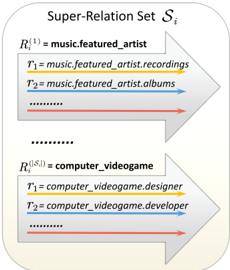
The diagram illustrates a hierarchical structure of "Super-Relation Sets" (S_i) with two primary categories: `music.featured_artist` and `computer_videogame`. Each super-relation is decomposed into sub-relations (T1, T2, ...) represented by color-coded arrows. The structure emphasizes relationships between parent categories and their specific sub-components.
### Components/Axes
- **Main Title**: "Super-Relation Set S_i" (top-center, bold black text).
- **Left Section**:
- **Super-Relation**: `R_i^(1) = music.featured_artist` (black text, top-left).
- **Sub-Relations**:
- `T1 = music.featured_artist.recordings` (yellow arrow, underlined).
- `T2 = music.featured_artist.albums` (blue arrow, underlined).
- Additional sub-relations implied by ellipses (`...`).
- **Right Section**:
- **Super-Relation**: `R_i^(|S_i|) = computer_videogame` (black text, top-right).
- **Sub-Relations**:
- `T1 = computer_videogame.designer` (yellow arrow, underlined).
- `T2 = computer_videogame.developer` (blue arrow, underlined).
- Additional sub-relations implied by ellipses (`...`).
- **Arrows**:
- Yellow arrows denote the first sub-relation (T1) for each super-relation.
- Blue arrows denote the second sub-relation (T2).
- Red arrows (unlabeled) point to ellipses, suggesting further sub-relations beyond T2.
### Detailed Analysis
- **Color Coding**:
- Yellow (`#FFD700`): First-order sub-relations (e.g., recordings, designer).
- Blue (`#0000FF`): Second-order sub-relations (e.g., albums, developer).
- Red (`#FF0000`): Unlabeled, likely representing higher-order or unspecified sub-relations.
- **Textual Labels**:
- All sub-relations are explicitly labeled with dot-separated paths (e.g., `music.featured_artist.recordings`).
- No numerical values or quantitative data are present.
### Key Observations
1. **Hierarchical Structure**: Each super-relation (e.g., `music.featured_artist`) branches into at least two sub-relations, with potential for more (indicated by ellipses).
2. **Color Consistency**: Yellow and blue arrows are consistently used across both sections, suggesting a standardized categorization system.
3. **Ambiguity in Red Arrows**: The red arrows lack labels, leaving their purpose undefined (e.g., additional sub-relations, metadata, or external links).
### Interpretation
The diagram represents a taxonomy or ontology where super-relations are decomposed into granular sub-relations. For example:
- **Music Domain**: A featured artist (`music.featured_artist`) is associated with recordings (`T1`) and albums (`T2`), with potential for further subdivisions (e.g., singles, EPs).
- **Computer/Videogame Domain**: A videogame (`computer_videogame`) involves roles like designer (`T1`) and developer (`T2`), with possible extensions (e.g., tester, producer).
The use of color-coded arrows implies a prioritization or categorization of sub-relations, though the absence of a legend or explicit key leaves the exact meaning of colors open to interpretation. The ellipses suggest scalability, allowing the structure to accommodate additional sub-relations as needed. This could model relationships in a knowledge graph, database schema, or conceptual framework for organizing data.