## Diagram: Super-Relation Set Schema
### Overview
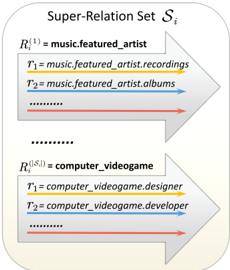
The image displays a technical diagram illustrating a "Super-Relation Set" denoted as **S_i**. It presents a hierarchical or compositional schema where a super-relation is composed of multiple primary relations, each of which is further defined by specific attributes or sub-relations. The diagram uses a structured, code-like notation with a clean, monospaced font on a light gray background.
### Components/Axes
The diagram is organized into a header and two main relational blocks.
1. **Header/Title:**
* **Text:** `Super-Relation Set S_i`
* **Position:** Centered at the top of the diagram.
2. **First Relational Block (Top):**
* **Primary Relation Label:** `R_i^(1) = music.featured_artist`
* **Sub-Items (indented below):**
* `T_1 = music.featured_artist.recordings`
* `T_2 = music.featured_artist.albums`
* **Visual Element:** A red arrow points from the left edge of this block to the right, indicating a flow, mapping, or progression associated with this relation.
3. **Second Relational Block (Bottom):**
* **Primary Relation Label:** `R_i^(2) = computer_videogame`
* **Sub-Items (indented below):**
* `T_1 = computer_videogame.designer`
* `T_2 = computer_videogame.developer`
* **Visual Element:** A red arrow, identical to the one above, points from the left edge of this block to the right.
### Detailed Analysis
* **Notation:** The diagram uses a formal, dot-notation syntax common in ontology modeling, knowledge graphs, or database schemas (e.g., `entity.attribute`).
* **Structure:** The set **S_i** contains at least two relations, **R_i^(1)** and **R_i^(2)**. Each relation is defined by a domain-specific identifier (e.g., `music.featured_artist`).
* **Hierarchy:** Each primary relation (**R**) is decomposed into specific sub-components or attributes labeled **T_1** and **T_2**. These sub-components are more granular descriptors of the parent relation.
* **Spatial Layout:** The two relational blocks are stacked vertically. The primary relation label is left-aligned at the top of each block, with its sub-items indented beneath it. The red arrows are positioned on the right side of each block, suggesting a directional relationship or output.
### Key Observations
1. **Consistent Pattern:** Both blocks follow an identical structural pattern: a primary relation (**R**) defined by two sub-components (**T**).
2. **Domain Separation:** The relations belong to distinct domains: the first to **music** and the second to **computer_videogame**.
3. **Ambiguity in Arrows:** The red arrows are visually prominent but lack explicit labels. Their meaning (e.g., "maps to," "produces," "contains") is implied by context but not explicitly defined in the diagram itself.
4. **Ellipsis Implication:** The use of `...` (ellipsis) between the two blocks suggests that the set **S_i** may contain more than the two relations shown, and this is a partial view.
### Interpretation
This diagram models a **knowledge representation schema**. It defines a "Super-Relation Set" as a container for multiple, domain-specific relations. Each relation acts as a bridge or a category linking a high-level concept (like a featured artist in music or a video game) to its concrete, measurable, or queryable attributes (like their recordings/albums or the game's designer/developer).
The structure suggests an investigative or data-organization framework where complex entities are broken down into standardized, relational components. The red arrows likely signify a process of **instantiation, data retrieval, or logical implication**—moving from the abstract relation definition to its specific instances or properties.
The primary value of this schema is in creating a unified, queryable structure across disparate domains (music and video games in this example). It allows a system to ask consistent types of questions ("What are the recordings of this artist?" and "Who designed this game?") using a common relational framework, even though the underlying data is completely different. The ellipsis indicates this framework is extensible to other domains.