## Diagram: System Data Flow with Restricted Database Access
### Overview
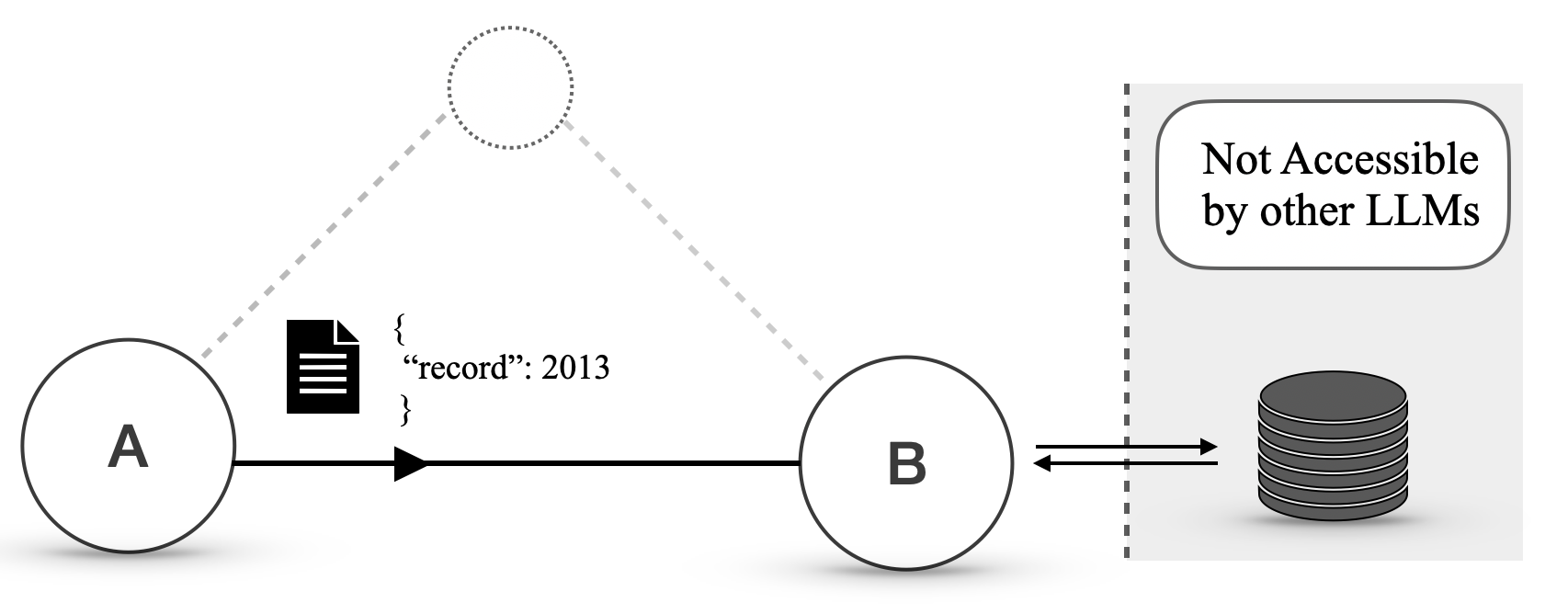
The image is a technical system diagram illustrating a data flow between two primary components (A and B) and a database. The diagram emphasizes that the database is not accessible by other Large Language Models (LLMs). The visual style is a clean, monochromatic schematic with circles representing nodes, arrows representing data flow, and a shaded region indicating a restricted zone.
### Components/Axes
The diagram consists of the following spatially arranged components:
1. **Left Region:**
* **Circle A:** A large, solid-outlined circle labeled with the letter "A" in its center. It is positioned on the far left.
* **Document Icon:** A black icon resembling a text file or document is placed to the right of Circle A.
* **JSON Data Snippet:** Adjacent to the document icon is a block of text formatted as JSON:
```
{
"record": 2013
}
```
2. **Center Region:**
* **Circle B:** A large, solid-outlined circle labeled with the letter "B" in its center. It is positioned to the right of Circle A.
* **Dotted Circle:** A smaller circle with a dotted outline is positioned above and between Circles A and B.
3. **Right Region (Shaded Zone):**
* **Shaded Box:** A light gray rectangular area with a dashed vertical border on its left side, indicating a separate or restricted zone.
* **Database Icon:** A standard cylinder icon representing a database is located within this shaded zone.
* **Restriction Label:** A rounded rectangle label inside the shaded zone contains the text: "Not Accessible by other LLMs".
4. **Connectors (Flow Lines):**
* **Solid Arrow (A → B):** A thick, solid black arrow points directly from Circle A to Circle B. The document icon and JSON snippet are placed along this path.
* **Bidirectional Arrow (B ↔ Database):** A pair of thin, parallel arrows (one pointing right, one pointing left) connects Circle B to the Database icon, indicating two-way communication.
* **Dotted Lines:** Two dashed gray lines form a triangle. One line connects Circle A to the top Dotted Circle. The other line connects the Dotted Circle to Circle B.
### Detailed Analysis
* **Data Flow:** The primary data flow is from Component A to Component B, carrying a data record. The record's structure is shown as a JSON object with a key `"record"` and a numeric value `2013`.
* **Interaction with Database:** Component B has a bidirectional relationship with the database, suggesting it can both write data to and read data from it.
* **Inaccessible Component:** The database is explicitly contained within a shaded region labeled "Not Accessible by other LLMs," defining a security or access boundary.
* **Indirect Connection:** The dotted lines and the unlabeled dotted circle suggest an indirect, potential, or secondary relationship between A and B that bypasses the direct data path. The purpose of this dotted circle is not defined by any label.
### Key Observations
1. **Access Control:** The most prominent feature is the explicit restriction on database access for "other LLMs," highlighting a security or proprietary data boundary.
2. **Data Specificity:** The example data record `"record": 2013` is concrete, though its meaning (e.g., a year, an ID) is not explained.
3. **Unlabeled Element:** The dotted circle at the top of the diagram is a significant visual component but lacks any label or explanatory text, leaving its function open to interpretation.
4. **Flow Directionality:** The solid arrow defines a clear, one-way data transfer from A to B. The database connection is explicitly two-way.
### Interpretation
This diagram models a system where a component (A) generates or possesses a specific data record and transmits it to another component (B). Component B acts as an intermediary or processor that stores this data in a database. The critical design constraint is that this database is walled off from access by any other Large Language Models, suggesting the data is sensitive, proprietary, or part of a closed system.
The dotted triangle connection could represent several possibilities: an alternative communication channel, a monitoring or logging pathway, a potential failure mode, or a higher-level orchestration layer. Its lack of labeling is a notable information gap.
The use of "LLMs" in the restriction label is key. It implies the context is an AI or machine learning system where multiple models might operate, and this specific data store is siloed for the exclusive use of the model(s) associated with components A and B. The diagram effectively communicates a architecture of data flow with a clear emphasis on access control and isolation.