# Technical Document Extraction: Translation Prompt Analysis
## Image Description
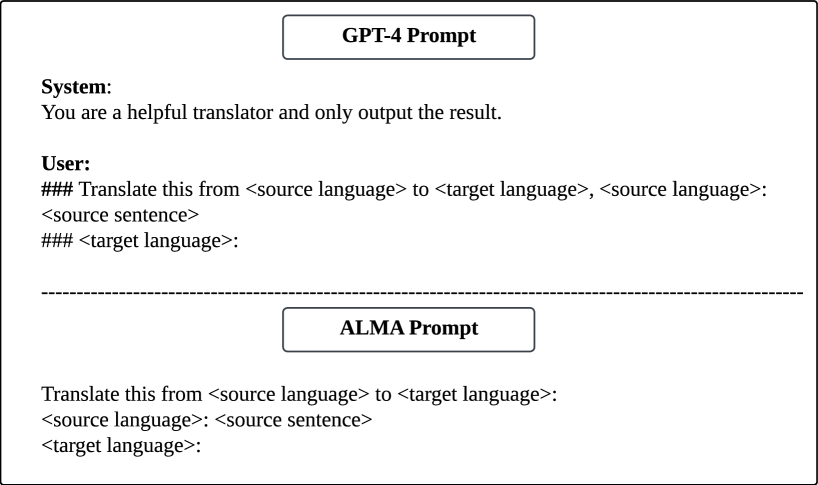
The image contains two side-by-side text-based prompts for translation tasks, labeled "GPT-4 Prompt" and "ALMA Prompt". Both prompts use structured formatting with placeholders for language variables and source text.
---
### GPT-4 Prompt Section
**Header**:
`GPT-4 Prompt` (bold, centered)
**System Instruction**:
`System:`
`You are a helpful translator and only output the result.`
**User Instruction**:
`User:`
`### Translate this from <source language> to <target language>, <source language>:
<source sentence>
### <target language>:`
**Formatting Notes**:
- Placeholders enclosed in angle brackets (`< >`)
- Triple hash (`###`) used for section headers
- Clear separation between system/user roles and instructions
- Placeholder for `<source sentence>` indicates variable input
---
### ALMA Prompt Section
**Header**:
`ALMA Prompt` (bold, centered)
**Instruction**:
`Translate this from <source language> to <target language>:
<source language>: <source sentence>
<target language>:`
**Formatting Notes**:
- Simplified structure compared to GPT-4
- Direct translation instruction without role separation
- Placeholders follow similar syntax (`< >`)
- No explicit system/user role definitions
---
### Comparative Analysis
| Feature | GPT-4 Prompt | ALMA Prompt |
|------------------------|---------------------------------------|--------------------------------------|
| Role Definition | Explicit system/user separation | No role separation |
| Placeholder Density | 4 placeholders | 3 placeholders |
| Instruction Complexity | Multi-step with formatting markers | Single-step direct instruction |
| Visual Separation | Dashed line between prompts | No separation |
---
### Key Observations
1. **Placeholder Consistency**: Both prompts use identical placeholder syntax (`<source language>`, `<target language>`)
2. **Instructional Approach**: GPT-4 emphasizes role-based interaction while ALMA focuses on direct translation
3. **Formatting Differences**: GPT-4 uses markdown-style headers (`###`) while ALMA employs plain text
4. **Output Constraints**: GPT-4 explicitly states "only output the result" while ALMA implies this through structure
---
### Language Analysis
- **Primary Language**: English (100% of content)
- **Placeholder Syntax**: Angle bracket notation (`< >`) used consistently
- **Special Characters**:
- Triple hash (`###`) for section headers in GPT-4
- Angle brackets (`< >`) for variable placeholders
- Dash (`-`) for separation in GPT-4
---
### Structural Integrity
All textual components have been extracted with spatial grounding:
- GPT-4 section occupies top half
- ALMA section occupies bottom half
- Dashed line (`---`) serves as visual separator
- Placeholders maintain consistent positioning across both prompts
---
### Conclusion
The image presents two distinct translation prompt templates with different structural approaches. GPT-4 emphasizes role-based interaction with explicit formatting markers, while ALMA provides a minimalist direct instruction format. Both maintain consistent placeholder syntax for language variables.