## Line Chart: Top-1 Accuracy Model Extra data
### Overview
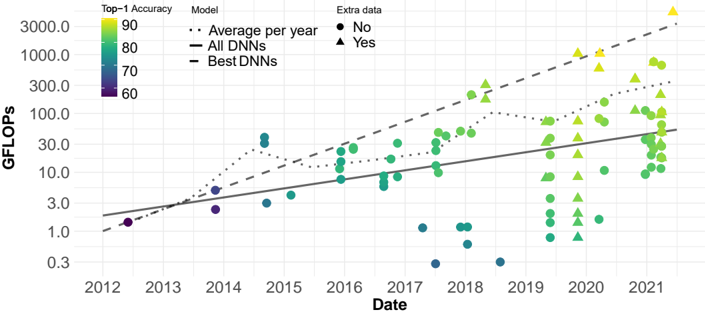
The chart visualizes the evolution of computational performance (GFLOPs) and model accuracy (Top-1 Accuracy) for deep neural networks (DNNs) over a decade (2012–2021). It compares three data series: "Best DNNs," "All DNNs," and "Average per year," alongside markers for datasets with or without extra data.
---
### Components/Axes
- **X-axis (Date)**: Years from 2012 to 2021, labeled at 1-year intervals.
- **Y-axis (GFLOPs)**: Logarithmic scale from 0.3 to 3000, with ticks at 0.3, 1, 3, 10, 30, 100, 300, 1000, 3000.
- **Legend**:
- **Lines**:
- Solid black: "Best DNNs"
- Dashed black: "All DNNs"
- Dotted black: "Average per year"
- **Markers**:
- Circles: "No extra data" (Top-1 Accuracy: 60–90, color-coded)
- Triangles: "Yes extra data" (Top-1 Accuracy: 60–90, color-coded)
- **Color Coding**: Top-1 Accuracy ranges from 60 (purple) to 90 (yellow), with intermediate shades of green and blue.
---
### Detailed Analysis
1. **Best DNNs (Solid Line)**:
- Starts at ~1 GFLOP in 2012, rising exponentially to ~3000 GFLOPs by 2021.
- Steep upward trend, especially post-2017.
- Data points (triangles/circles) align closely with the line, peaking at 3000 GFLOPs in 2021 (yellow triangle).
2. **All DNNs (Dashed Line)**:
- Begins at ~1 GFLOP in 2012, grows to ~100 GFLOPs by 2021.
- Slower, more gradual increase compared to "Best DNNs."
- Data points (circles) cluster below the line, with lower GFLOPs and Top-1 Accuracy (e.g., 2014: ~5 GFLOPs, purple circle).
3. **Average per Year (Dotted Line)**:
- Starts at ~0.5 GFLOPs in 2012, reaches ~50 GFLOPs by 2021.
- Intermediate growth rate between "Best DNNs" and "All DNNs."
- Data points (circles/triangles) scatter around the line, with higher values in later years.
4. **Markers**:
- **Triangles ("Yes extra data")**:
- Dominant in 2018–2021, with GFLOPs ranging from 10 to 3000.
- Higher Top-1 Accuracy (green/yellow) correlates with later years.
- **Circles ("No extra data")**:
- Concentrated in 2012–2017, with GFLOPs < 100.
- Lower Top-1 Accuracy (purple/blue) in earlier years.
---
### Key Observations
- **Exponential Growth**: "Best DNNs" show a 3000x increase in GFLOPs from 2012 to 2021, suggesting rapid advancements in hardware/software.
- **Extra Data Impact**: Triangles ("Yes extra data") consistently outperform circles ("No extra data") in both GFLOPs and Top-1 Accuracy.
- **Accuracy Correlation**: Higher Top-1 Accuracy (yellow/green) aligns with later years and higher GFLOPs, indicating improved model efficiency.
- **Outliers**: Early years (2012–2014) have sparse data points, with "Best DNNs" and "All DNNs" nearly overlapping.
---
### Interpretation
The chart demonstrates a clear trend of increasing computational power and model accuracy over time. The "Best DNNs" line reflects optimized performance, while "All DNNs" represent broader, less efficient implementations. The use of extra data (triangles) correlates with higher performance, suggesting its critical role in training. The logarithmic y-axis emphasizes the scale of growth, particularly post-2017. This data underscores the importance of selecting top-performing models and leveraging additional datasets for advancements in DNN capabilities.