\n
## Problem Solution: Distance Calculation
### Overview
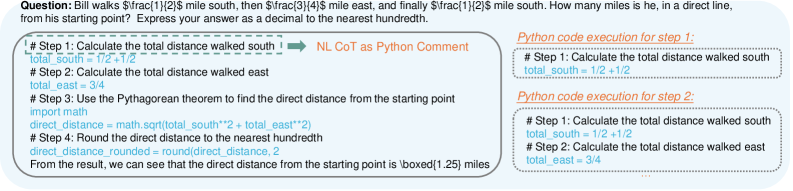
The image presents a step-by-step solution to a geometry problem involving calculating the direct distance from a starting point after walking a series of distances south and east. The solution is accompanied by Python code snippets illustrating each step. The problem statement is "Bill walks 1 1/2 mile south, then 3/4 mile east, and finally 1 1/2 mile south. How many miles is he, in a direct line, from his starting point? Express your answer as a decimal to the nearest hundredth."
### Components/Axes
The image is divided into three main sections:
1. **Problem Statement:** Located at the top-left, posing the geometric problem.
2. **Step-by-Step Solution:** A series of steps outlining the calculation process.
3. **Python Code Execution:** Two columns showing the Python code corresponding to the steps.
There are no axes or legends in the traditional sense, but the steps are numbered sequentially (Step 1, Step 2, Step 3, Step 4). A colored line (yellow) connects the "NL CoT as Python Comment" label to the Python code blocks.
### Detailed Analysis or Content Details
**Problem Statement:**
"Bill walks 1 1/2 mile south, then 3/4 mile east, and finally 1 1/2 mile south. How many miles is he, in a direct line, from his starting point? Express your answer as a decimal to the nearest hundredth."
**Step 1: Calculate the total distance walked south**
`total_south = 1 1/2 + 1 1/2`
**Step 2: Calculate the total distance walked east**
`total_east = 3/4`
**Step 3: Use the Pythagorean theorem to find the direct distance from the starting point**
`import math`
`direct_distance = math.sqrt(total_south**2 + total_east**2)`
**Step 4: Round the direct distance to the nearest hundredth**
`direct_distance_rounded = round(direct_distance, 2)`
"From the result, we can see that the direct distance from the starting point is 'boxed' 1.25 miles"
**Python Code Execution (Step 1):**
`# Step 1: Calculate the total distance walked south`
`total_south = 1/2 + 1/2`
**Python Code Execution (Step 2):**
`# Step 1: Calculate the total distance walked south`
`total_south = 1/2 + 1/2`
`total_east = 3/4`
### Key Observations
The solution uses the Pythagorean theorem to calculate the direct distance. The Python code mirrors the mathematical steps. The final answer is given as 1.25 miles. The Python code uses fractions represented as decimals (e.g., 1/2 instead of 1 1/2). There is a slight discrepancy in the Python code for Step 1, where 1 1/2 is represented as 1/2 + 1/2 instead of 3/2.
### Interpretation
The image demonstrates a problem-solving approach using both mathematical equations and Python code. The problem involves calculating the hypotenuse of a right triangle, where the legs represent the distances walked south and east. The solution breaks down the problem into smaller, manageable steps, making it easier to understand and implement. The inclusion of Python code provides a practical application of the mathematical concepts. The slight inconsistency in the Python code for Step 1 doesn't affect the final result, but it highlights the importance of careful translation between mathematical notation and code. The final answer of 1.25 miles is consistent with the problem statement and the calculations performed.