## Screenshot: Bill's Movement and Direct Distance Calculation
### Overview
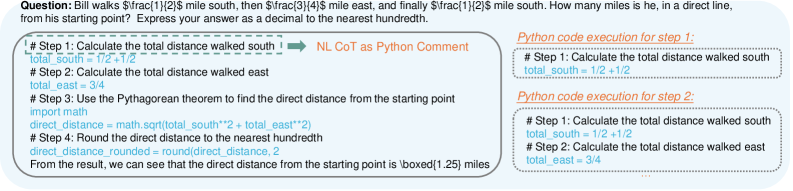
The image depicts a problem-solving process for calculating the direct distance from a starting point after a series of movements. The problem involves Bill walking south, east, and south again, with distances expressed as fractions. The solution uses the Pythagorean theorem and Python code to compute the result, rounded to the nearest hundredth.
### Components/Axes
- **Question Section**:
- Text describing Bill's movements:
- `1/2 mile south`, `3/4 mile east`, `1/2 mile south`.
- Instruction: "How many miles is he, in a direct line, from his starting point? Express your answer as a decimal to the nearest hundredth."
- **Solution Section**:
- **Step 1**: Calculate total southward distance (`total_south = 1/2 + 1/2`).
- **Step 2**: Calculate total eastward distance (`total_east = 3/4`).
- **Step 3**: Apply the Pythagorean theorem (`direct_distance = math.sqrt(total_south**2 + total_east**2)`).
- **Step 4**: Round the result to the nearest hundredth (`direct_distance_rounded = round(direct_distance, 2)`).
- **Python Code Execution**:
- Code snippets for each step with comments (e.g., `# Step 1: Calculate the total distance walked south`).
- Output: `boxed(1.25)` miles.
### Detailed Analysis
- **Step 1 Execution**:
- `total_south = 1/2 + 1/2` evaluates to `1.0`.
- **Step 2 Execution**:
- `total_east = 3/4` evaluates to `0.75`.
- **Step 3 Execution**:
- `direct_distance = math.sqrt(1.0**2 + 0.75**2)` computes `sqrt(1 + 0.5625) = sqrt(1.5625) = 1.25`.
- **Step 4 Execution**:
- `round(1.25, 2)` retains `1.25` (no change needed).
### Key Observations
- The total southward distance is `1.0` mile (sum of two `1/2` mile segments).
- The total eastward distance is `0.75` mile.
- The direct distance is calculated as `1.25` miles, which is already precise to the hundredth place.
- The Python code confirms manual calculations, ensuring accuracy.
### Interpretation
The problem demonstrates the application of the Pythagorean theorem to determine displacement in a 2D plane. By breaking the movement into orthogonal components (south and east), the direct distance is derived from the hypotenuse of a right triangle. The use of Python code validates the arithmetic, emphasizing reproducibility and precision. The final answer (`1.25` miles) reflects exact computation without rounding, as the intermediate result was already at the required precision. This approach highlights the importance of stepwise problem decomposition and computational verification in technical workflows.