\n
## Scatter Plot & Bar Chart: Performance vs. Power Consumption
### Overview
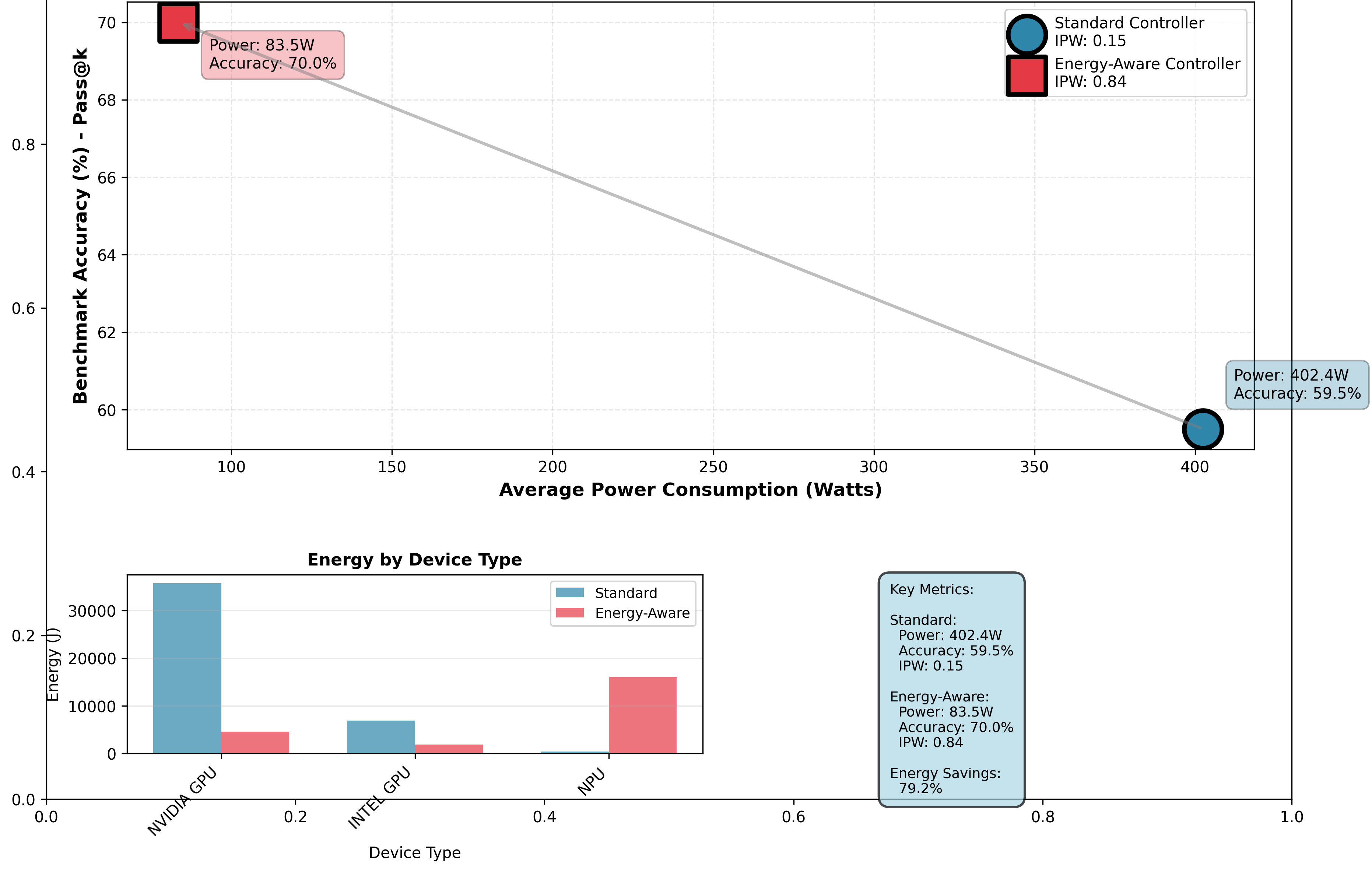
The image presents a comparison between a "Standard Controller" and an "Energy-Aware Controller" in terms of benchmark accuracy and power consumption. The top portion of the image is a scatter plot showing the relationship between average power consumption (Watts) and benchmark accuracy (% Pass@k). The bottom portion is a bar chart illustrating energy usage by device type (NVIDIA GPU, Intel CPU, NPU) for both controllers.
### Components/Axes
**Scatter Plot:**
* **X-axis:** Average Power Consumption (Watts), ranging from approximately 0 to 420 Watts.
* **Y-axis:** Benchmark Accuracy (% Pass@k), ranging from approximately 58% to 70%.
* **Data Series:** Two lines representing the performance of the Standard Controller (grey) and the Energy-Aware Controller (blue).
* **Data Points:** Two data points are highlighted with labels indicating Power and Accuracy values for each controller.
* **Legend (Top-Right):**
* Standard Controller (Grey): IPW: 0.15
* Energy-Aware Controller (Blue): IPW: 0.84
**Bar Chart:**
* **X-axis:** Device Type (NVIDIA GPU, Intel CPU, NPU).
* **Y-axis:** Energy (J) ranging from 0 to 30000.
* **Data Series:** Two bars for each device type, representing the energy consumption of the Standard Controller (blue) and the Energy-Aware Controller (red).
* **Legend (Bottom-Right):**
* Standard (Blue)
* Energy-Aware (Red)
* **Key Metrics (Bottom-Right):**
* Standard: Power: 402.4W, Accuracy: 59.5%, IPW: 0.15
* Energy-Aware: Power: 83.5W, Accuracy: 70.0%, IPW: 0.84
* Energy Savings: 79.2%
### Detailed Analysis or Content Details
**Scatter Plot Analysis:**
* **Standard Controller (Grey):** The line slopes downward, indicating that as power consumption increases, benchmark accuracy decreases.
* Starting point (approximate): Power ~83.5W, Accuracy ~70.0%
* Ending point (approximate): Power ~402.4W, Accuracy ~59.5%
* **Energy-Aware Controller (Blue):** The line is relatively flat, suggesting that accuracy remains relatively stable even as power consumption increases.
* Starting point (approximate): Power ~83.5W, Accuracy ~70.0%
* Ending point (approximate): Power ~402.4W, Accuracy ~59.5%
**Bar Chart Analysis:**
* **NVIDIA GPU:** The Standard Controller consumes significantly more energy (~25000 J) than the Energy-Aware Controller (~3000 J).
* **Intel CPU:** The Standard Controller consumes slightly more energy (~2000 J) than the Energy-Aware Controller (~1000 J).
* **NPU:** The Standard Controller consumes significantly more energy (~15000 J) than the Energy-Aware Controller (~2000 J).
### Key Observations
* The Energy-Aware Controller consistently consumes less power across all device types.
* The Energy-Aware Controller maintains a higher benchmark accuracy, especially at lower power consumption levels.
* The Standard Controller exhibits a more pronounced trade-off between power consumption and accuracy.
* The largest energy savings are observed with the NVIDIA GPU.
* The overall energy savings are reported as 79.2%.
### Interpretation
The data strongly suggests that the Energy-Aware Controller is significantly more efficient than the Standard Controller. It achieves comparable or even better benchmark accuracy while consuming substantially less power. This is particularly evident in the NVIDIA GPU, where the energy savings are most substantial. The scatter plot illustrates a clear inverse relationship between power and accuracy for the Standard Controller, while the Energy-Aware Controller demonstrates a more stable performance profile. The IPW (Inference Performance per Watt) values (0.15 for Standard vs. 0.84 for Energy-Aware) quantify this efficiency gain.
The data implies that the Energy-Aware Controller employs techniques to optimize power usage without sacrificing performance, potentially through dynamic frequency scaling, voltage adjustments, or more efficient algorithm implementations. The flat line of the Energy-Aware controller suggests that the controller is able to maintain accuracy even as power increases, indicating a more robust and efficient design. The overall 79.2% energy savings represent a significant improvement, making the Energy-Aware Controller a compelling choice for applications where power efficiency is critical.