## System Architecture Diagram: Token Processing and Memory Management
### Overview
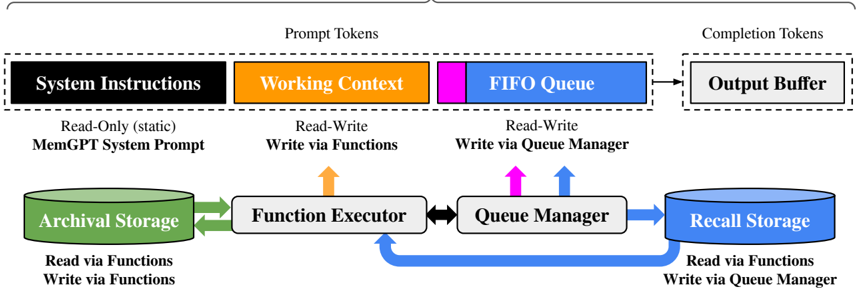
This image is a technical system architecture diagram illustrating the flow of data and control within a memory-augmented language model system, likely referencing the "MemGPT" architecture. It depicts how different types of tokens (prompt and completion) are processed and how they interact with various storage and execution components. The diagram uses color-coding and directional arrows to show data flow and access permissions.
### Components/Axes
The diagram is organized into two primary horizontal layers:
**Top Layer: Token Processing Pipeline**
* **Prompt Tokens Block:** A dashed rectangle containing three sequential components:
1. **System Instructions:** A black rectangle. Label below: "Read-Only (static) MemGPT System Prompt".
2. **Working Context:** An orange rectangle. Label below: "Read-Write Write via Functions".
3. **FIFO Queue:** A blue rectangle with a magenta left border. Label below: "Read-Write Write via Queue Manager".
* **Completion Tokens Block:** A dashed rectangle to the right, containing:
1. **Output Buffer:** A light gray rectangle.
* An arrow points from the "Prompt Tokens" block to the "Completion Tokens" block.
**Bottom Layer: Storage and Execution Components**
* **Archival Storage:** A green cylinder (database icon) on the far left. Label below: "Read via Functions Write via Functions".
* **Function Executor:** A light gray rectangle in the center-left.
* **Queue Manager:** A light gray rectangle in the center-right.
* **Recall Storage:** A blue cylinder (database icon) on the far right. Label below: "Read via Functions Write via Queue Manager".
**Data Flow Arrows & Connections:**
* A green double-headed arrow connects **Archival Storage** and **Function Executor**.
* An orange upward arrow connects **Function Executor** to the **Working Context** (orange rectangle above).
* A black double-headed arrow connects **Function Executor** and **Queue Manager**.
* A magenta upward arrow connects **Queue Manager** to the **FIFO Queue** (magenta/blue rectangle above).
* A blue upward arrow connects **Queue Manager** to the **FIFO Queue**.
* A blue arrow points from **Queue Manager** to **Recall Storage**.
* A large, curved blue arrow originates from **Recall Storage**, loops underneath, and points back to the **Function Executor**.
### Detailed Analysis
The diagram defines a clear separation of concerns and data access patterns:
1. **Token Context Segmentation:** The prompt is segmented into three distinct parts with different mutability:
* **System Instructions (Black):** Static, read-only core directives.
* **Working Context (Orange):** Dynamic, read-write space modified by function calls.
* **FIFO Queue (Blue/Magenta):** A read-write queue for managing operations, written to by the Queue Manager.
2. **Storage Hierarchy:**
* **Archival Storage (Green):** Long-term, external storage. Accessed (read/write) exclusively via the **Function Executor**.
* **Recall Storage (Blue):** Short-term or working memory. Readable via functions, but writable only via the **Queue Manager**.
3. **Core Control Flow:**
* The **Function Executor** is the central processing unit. It reads from and writes to **Archival Storage**, executes functions that modify the **Working Context**, and communicates bidirectionally with the **Queue Manager**.
* The **Queue Manager** orchestrates operations for the **FIFO Queue** (writing to it) and **Recall Storage** (writing to it). It receives instructions from the Function Executor.
* A critical feedback loop is established: data from **Recall Storage** is fed back into the **Function Executor** via the large curved blue arrow, enabling iterative processing.
### Key Observations
* **Color-Coding Consistency:** Colors are used thematically: Black for static instructions, Orange for active working memory, Blue for queue/recall functions, Green for archival storage, and Magenta for queue-specific pathways.
* **Access Control Clarity:** Each storage component has explicitly defined read/write permissions tied to specific system modules (Functions vs. Queue Manager).
* **Asymmetric Write Access:** The **FIFO Queue** and **Recall Storage** have a shared write path through the **Queue Manager**, while the **Working Context** is written to directly by the **Function Executor**.
* **Closed-Loop System:** The architecture forms a closed loop where outputs from Recall Storage become inputs for further processing by the Function Executor, suggesting an iterative or recursive memory recall process.
### Interpretation
This diagram models a sophisticated memory management system for an AI agent, designed to overcome the fixed context window limitations of standard language models. It implements a form of **hierarchical memory**:
* **Short-Term/Working Memory:** Represented by the **Working Context** and **FIFO Queue** within the active prompt tokens. This is the immediate "conscious" context.
* **Long-Term/External Memory:** Represented by **Archival Storage** (for persistent, large-scale data) and **Recall Storage** (for retrievable, relevant information).
The system's intelligence lies in the **Function Executor** and **Queue Manager**. They act as the "cognitive processes" that decide when to:
1. **Retrieve** information from long-term storage (Archival).
2. **Load** relevant memories into the short-term recall buffer.
3. **Update** the working context based on new functions or retrieved memories.
4. **Queue** operations for systematic processing.
The **Peircean** investigative lens reveals this as a system of **signs and interpretation**. The tokens (System Instructions, Working Context) are the *representamen*—the signs being processed. The storage systems (Archival, Recall) hold the *objects*—the external knowledge or past experiences. The **Function Executor** is the *interpretant*, the process that dynamically links signs to objects to generate new meaning (the Completion Tokens), creating a continuous cycle of semiosis. The architecture's core innovation is making this interpretant process explicit and manageable through dedicated components (Queue Manager, Function Executor), allowing the AI to actively control its own context and memory retrieval, rather than being a passive recipient of a static prompt.