\n
## Diagram: MemGPT System Architecture
### Overview
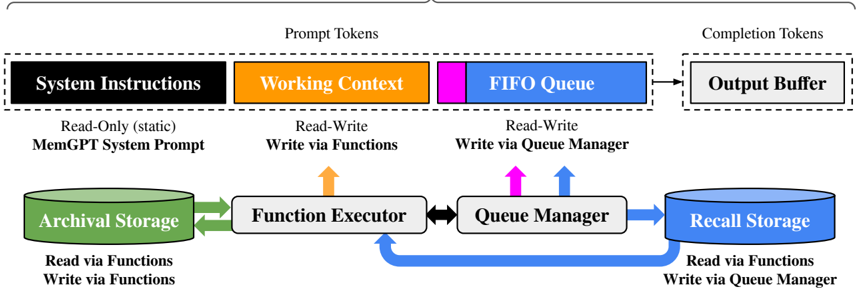
The image depicts a diagram of the MemGPT system architecture, illustrating the flow of information and interaction between various components. It shows a layered structure with prompt tokens at the top and completion tokens at the right, connected by a processing pipeline. The diagram highlights data access permissions (Read-Only, Read-Write) for each component.
### Components/Axes
The diagram consists of the following components:
* **System Instructions:** (Black rectangle) - Read-Only (static) MemGPT System Prompt.
* **Working Context:** (Orange rectangle) - Read-Write via Functions.
* **FIFO Queue:** (Magenta rectangle) - Read-Write via Queue Manager.
* **Output Buffer:** (Light Blue rectangle) - Completion Tokens.
* **Archival Storage:** (Green capsule) - Read via Functions, Write via Functions.
* **Function Executor:** (Grey rectangle)
* **Queue Manager:** (Grey rectangle)
* **Recall Storage:** (Blue capsule) - Read via Functions, Write via Queue Manager.
Arrows indicate the direction of data flow between these components. Text labels below each component specify the access permissions. The top of the diagram is labeled "Prompt Tokens" and the right side is labeled "Completion Tokens". A dashed line separates the prompt tokens from the completion tokens.
### Detailed Analysis / Content Details
The diagram illustrates a data flow pipeline.
1. **Prompt Tokens** enter the system and are processed sequentially through **System Instructions**, **Working Context**, and **FIFO Queue**.
2. The **FIFO Queue** feeds into the **Output Buffer**, generating **Completion Tokens**.
3. The **Archival Storage** interacts with the **Function Executor** via orange arrows, representing data read and write operations through functions.
4. The **Function Executor** interacts with the **Queue Manager** via a purple arrow.
5. The **Queue Manager** interacts with the **FIFO Queue** via a purple arrow.
6. The **Recall Storage** interacts with the **Queue Manager** via a blue arrow, and with the **Function Executor** via a light blue arrow.
7. The **Function Executor** and **Recall Storage** are connected by a curved blue arrow, indicating a cyclical data flow.
The access permissions are as follows:
* **System Instructions:** Read-Only (static)
* **Working Context:** Read-Write via Functions
* **FIFO Queue:** Read-Write via Queue Manager
* **Archival Storage:** Read via Functions, Write via Functions
* **Recall Storage:** Read via Functions, Write via Queue Manager
### Key Observations
The diagram emphasizes the separation of concerns and the controlled flow of data within the MemGPT system. The use of different colors for the components and arrows helps to visually distinguish the different data paths and access permissions. The cyclical connection between the Function Executor and Recall Storage suggests an iterative process of information retrieval and processing.
### Interpretation
This diagram represents a memory-augmented language model architecture (MemGPT). The system is designed to manage a long-term memory (Archival Storage and Recall Storage) alongside a short-term working context. The prompt tokens are processed through a series of stages, including system instructions, working context, and a queue, before generating completion tokens. The Function Executor and Queue Manager act as intermediaries, facilitating data access and manipulation.
The read/write permissions highlight the security and control mechanisms in place. System Instructions are static and immutable, while the Working Context and FIFO Queue are dynamic and can be modified during runtime. The Archival and Recall Storage are accessed through specific functions and the Queue Manager, ensuring controlled access to long-term memory.
The cyclical flow between the Function Executor and Recall Storage suggests a mechanism for iterative refinement of information, where the system can retrieve relevant information from memory, process it, and then update its memory based on the results. This architecture allows MemGPT to maintain a consistent and coherent context over extended interactions.