## Diagram: System Architecture Workflow
### Overview
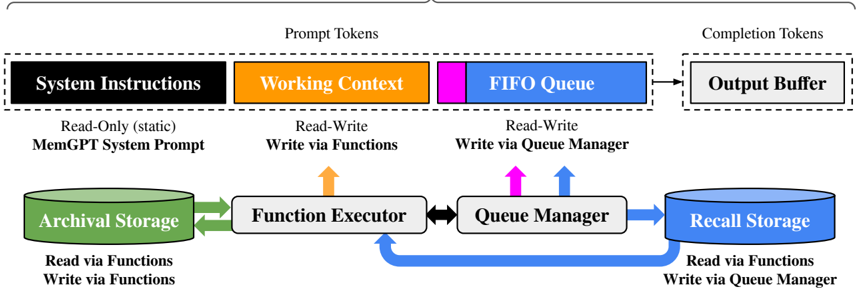
The diagram illustrates a system architecture workflow with components for processing, storage, and data flow. It includes static and dynamic data handling, function execution, and queue management. Arrows indicate data movement between components, with color-coded elements representing different system parts.
### Components/Axes
- **System Instructions** (Black box, read-only, static): Contains "MemGPT System Prompt."
- **Working Context** (Orange box, read-write via functions): Dynamic data processed by the Function Executor.
- **FIFO Queue** (Pink box, read-write via Queue Manager): Manages ordered data flow to the Output Buffer.
- **Output Buffer** (Gray box): Receives "Completion Tokens" from the FIFO Queue.
- **Archival Storage** (Green cylinder): Read/write via functions; connected to the Function Executor.
- **Function Executor** (Gray box): Processes data between Archival Storage and Queue Manager.
- **Queue Manager** (Gray box): Coordinates data flow between FIFO Queue and Recall Storage.
- **Recall Storage** (Blue cylinder): Read via functions, written via Queue Manager.
### Detailed Analysis
- **Data Flow**:
1. **System Instructions** (static) → **Working Context** (dynamic) via Function Executor.
2. **Working Context** → **FIFO Queue** via Queue Manager.
3. **FIFO Queue** → **Output Buffer** (completion tokens).
4. **Archival Storage** ↔ **Function Executor** (read/write via functions).
5. **Queue Manager** ↔ **Recall Storage** (read via functions, write via Queue Manager).
- **Color Coding**:
- Black: Static system instructions.
- Orange: Dynamic working context.
- Pink: FIFO Queue (ordered processing).
- Blue: Recall Storage (dynamic retrieval).
- Green: Archival Storage (persistent data).
- Gray: Functional components (executor, queue manager).
### Key Observations
- **Static vs. Dynamic Data**: System Instructions (static) are isolated from dynamic Working Context and FIFO Queue.
- **Ordered Processing**: FIFO Queue ensures sequential data handling before reaching the Output Buffer.
- **Storage Segregation**: Archival Storage (green) and Recall Storage (blue) serve distinct roles, with Recall Storage managed by the Queue Manager.
- **Function Executor Role**: Acts as a bridge between static/dynamic data and storage systems.
### Interpretation
This architecture emphasizes modularity and controlled data flow. The separation of static (System Instructions) and dynamic (Working Context, FIFO Queue) data ensures stability and scalability. The Function Executor and Queue Manager centralize processing logic, while Archival and Recall Storage handle persistence and retrieval. The Output Buffer aggregates final results, suggesting a pipeline optimized for ordered, function-driven operations. The use of color coding and directional arrows clarifies component roles and dependencies, critical for debugging or optimizing the system.