## Bar Chart: Code Number Increase with Groups
### Overview
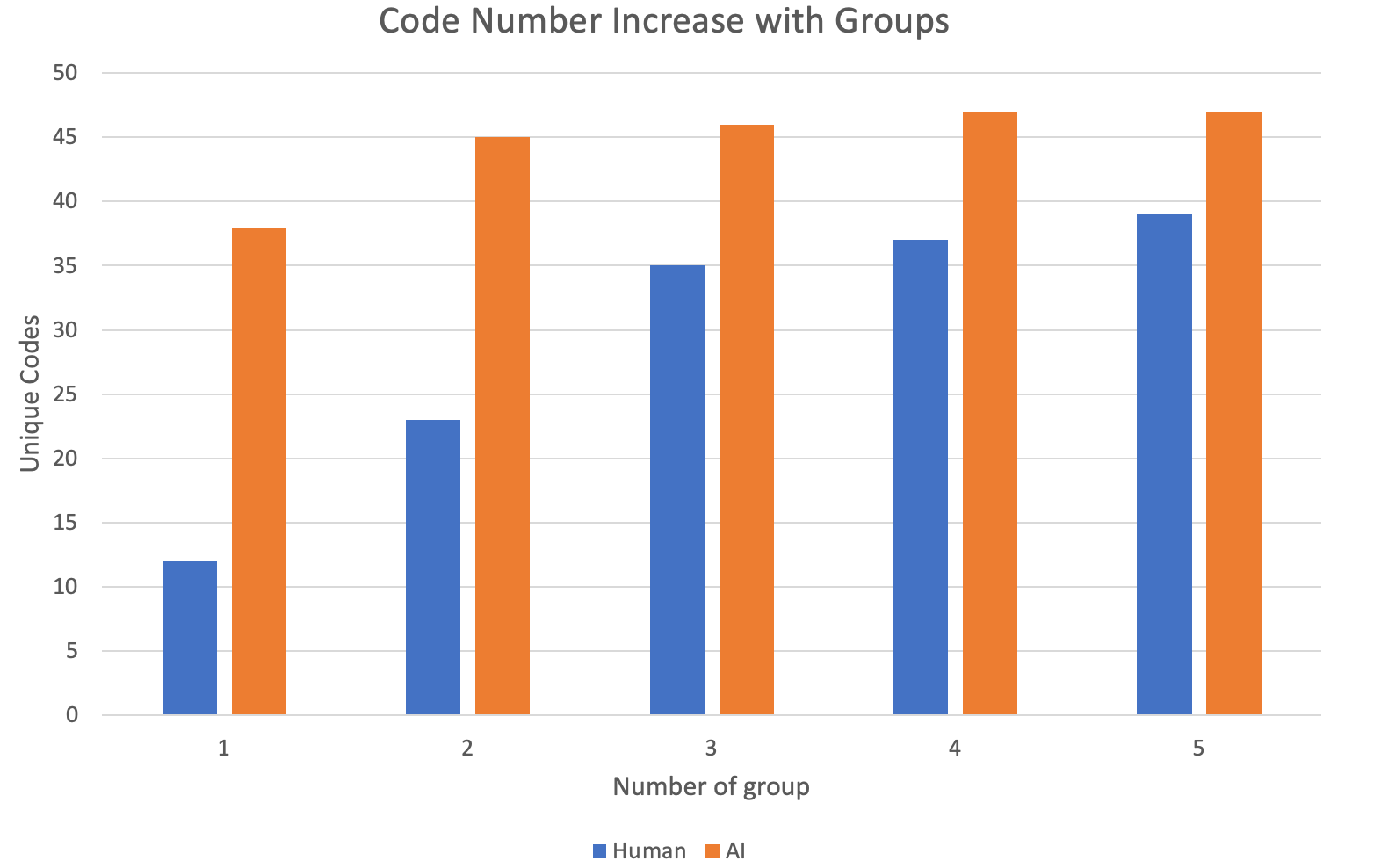
This is a vertical grouped bar chart titled "Code Number Increase with Groups." It compares the number of "Unique Codes" generated by two entities, "Human" and "AI," across five different group sizes (labeled 1 through 5). The chart demonstrates that the AI consistently generates a higher number of unique codes than the Human across all group sizes, with both showing an increasing trend as the group number increases.
### Components/Axes
* **Chart Title:** "Code Number Increase with Groups" (centered at the top).
* **Y-Axis (Vertical):**
* **Label:** "Unique Codes" (rotated 90 degrees).
* **Scale:** Linear scale from 0 to 50, with major gridlines and labels at intervals of 5 (0, 5, 10, 15, 20, 25, 30, 35, 40, 45, 50).
* **X-Axis (Horizontal):**
* **Label:** "Number of group".
* **Categories:** Five discrete categories labeled "1", "2", "3", "4", and "5".
* **Legend:** Located at the bottom center of the chart.
* **Blue Square:** Labeled "Human".
* **Orange Square:** Labeled "AI".
* **Data Series:** Two series of bars, grouped by the x-axis category.
* **Series 1 (Blue):** Represents "Human" data.
* **Series 2 (Orange):** Represents "AI" data.
### Detailed Analysis
The chart presents the following approximate data points for each group. Values are estimated based on the y-axis gridlines.
**Trend Verification:**
* **Human (Blue Bars):** The series shows a consistent, positive linear trend. The height of the blue bars increases steadily from Group 1 to Group 5.
* **AI (Orange Bars):** The series shows a strong positive trend that is steepest between Groups 1 and 2, then continues to increase at a slower rate, appearing to plateau between Groups 4 and 5.
**Data Points (Approximate Values):**
| Number of Group | Human (Unique Codes) | AI (Unique Codes) |
| :--- | :--- | :--- |
| **1** | ~12 | ~38 |
| **2** | ~23 | 45 |
| **3** | 35 | ~46 |
| **4** | ~37 | ~47 |
| **5** | ~39 | ~47 |
**Spatial Grounding & Component Isolation:**
* For each x-axis category (1-5), the blue "Human" bar is positioned to the left, and the orange "AI" bar is positioned to the right.
* The legend is clearly separated from the plot area at the bottom, ensuring no overlap with data.
* The y-axis gridlines extend horizontally across the plot area, aiding in value estimation.
### Key Observations
1. **Consistent AI Superiority:** The AI bar is taller than the Human bar in every single group, indicating a higher output of unique codes regardless of group size.
2. **Diverging Growth Rates:** While both series increase, the initial jump for AI from Group 1 (~38) to Group 2 (45) is significant (+7). The Human series shows a more uniform rate of increase across all groups.
3. **Plateau Effect:** The AI's output appears to reach a near-maximum or plateau around 47 unique codes by Group 4, with negligible increase to Group 5. The Human output, while still increasing, shows no sign of plateauing within the given range.
4. **Narrowing Gap (Proportionally):** The absolute difference between AI and Human output is largest at Group 1 (~26 codes) and smallest at Group 5 (~8 codes). However, the *ratio* of AI to Human output decreases from approximately 3.2:1 at Group 1 to about 1.2:1 at Group 5, suggesting the Human's output is catching up in relative terms.
### Interpretation
This chart likely illustrates the results of an experiment or analysis comparing the generative capacity of humans versus an AI system in a coding or categorization task. The "Number of group" could represent increasing task complexity, team size, or iterative sessions.
The data suggests that the AI system has a significantly higher baseline capacity for generating unique codes (or identifiers, categories, etc.), especially in simpler or initial scenarios (Group 1). Its rapid early increase implies it can scale its output quickly with modest increases in group/complexity. The plateau at higher groups might indicate a system limit, a saturation of the problem space, or that the AI reaches optimal performance quickly.
The Human performance, while lower, shows steady, scalable improvement. The narrowing proportional gap suggests that humans may require more groups (or iterations) to approach their peak performance, but they demonstrate consistent learning or adaptation. The chart does not measure the *quality* or *correctness* of the unique codes, only their quantity. Therefore, while the AI is more prolific, the value of its output versus the human's would require additional qualitative analysis.