## Bar Chart: Code Number Increase with Groups
### Overview
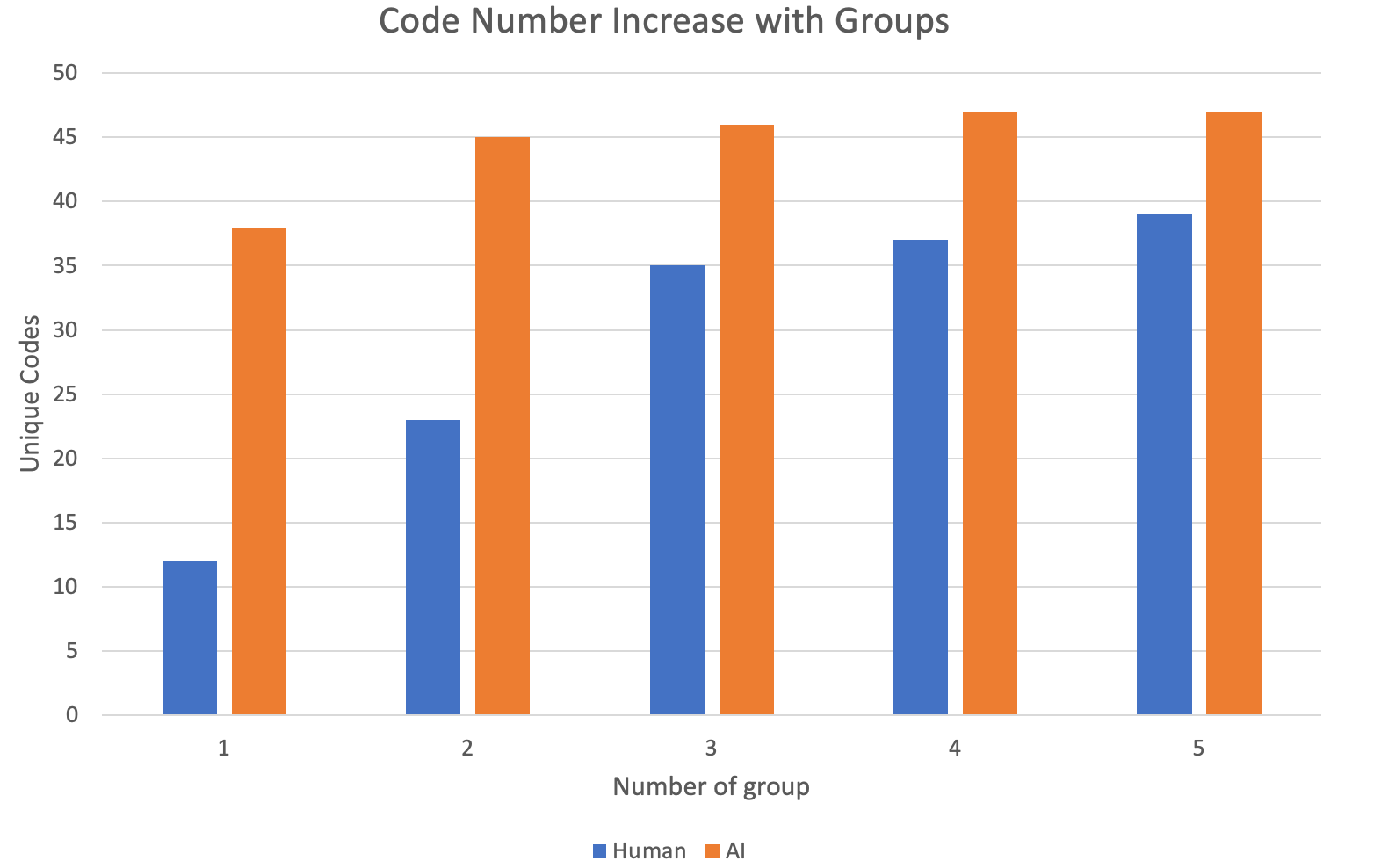
The chart compares the number of unique codes generated by humans and AI across five groups. It uses vertical bars to represent two data series: "Human" (blue) and "AI" (orange). The x-axis represents the "Number of group" (1–5), while the y-axis shows "Unique Codes" (0–50). The legend at the bottom confirms the color coding for each series.
### Components/Axes
- **X-axis**: Labeled "Number of group" with discrete markers (1, 2, 3, 4, 5). Each group has two bars (Human and AI).
- **Y-axis**: Labeled "Unique Codes" with increments of 5 (0, 5, 10, ..., 50).
- **Legend**: Positioned at the bottom center, with "Human" (blue) and "AI" (orange) labels.
- **Bars**: Paired bars for each group, with AI consistently taller than Human.
### Detailed Analysis
- **Group 1**:
- Human: ~12 unique codes (blue bar).
- AI: ~38 unique codes (orange bar).
- **Group 2**:
- Human: ~23 unique codes.
- AI: ~45 unique codes.
- **Group 3**:
- Human: ~35 unique codes.
- AI: ~46 unique codes.
- **Group 4**:
- Human: ~37 unique codes.
- AI: ~47 unique codes.
- **Group 5**:
- Human: ~39 unique codes.
- AI: ~47 unique codes.
### Key Observations
1. **AI Dominance**: AI consistently generates more unique codes than humans across all groups.
2. **Narrowing Gap**: The difference between AI and Human decreases as the group number increases (e.g., 26 in Group 1 vs. 8 in Group 5).
3. **Human Growth**: Human-generated codes increase steadily from 12 (Group 1) to 39 (Group 5).
4. **AI Saturation**: AI’s output plateaus at ~47 codes in Groups 4 and 5, showing minimal growth after Group 3.
### Interpretation
The data suggests that while AI maintains a significant advantage in code generation, the gap narrows as the number of groups increases. This could indicate:
- **Human Adaptation**: Humans may improve efficiency or collaboration in larger groups.
- **AI Limitations**: AI’s performance may plateau due to inherent constraints in scalability or creativity.
- **Task Complexity**: The problem’s complexity might reduce the relative advantage of AI as groups grow, requiring more nuanced solutions.
The chart highlights a critical trend: AI’s lead diminishes with scale, raising questions about the long-term viability of AI dominance in code generation tasks.