## Diagram: Cellular Automaton Transition
### Overview
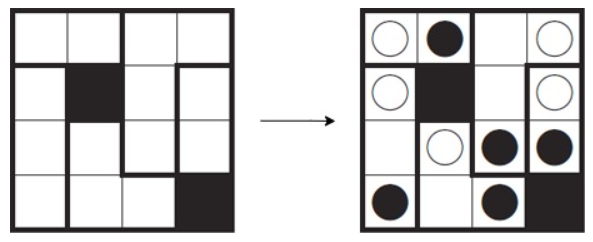
The image depicts a single step in a cellular automaton. It shows a 5x5 grid transforming from one state (left) to another (right) based on a set of rules. The cells in the grid are either filled (black) or empty (white). The transformation is indicated by an arrow pointing from the initial state to the final state.
### Components/Axes
* **Grids:** Two 5x5 grids representing the initial and final states of the cellular automaton.
* **Cells:** Each grid is composed of 25 cells. Cells can be either filled (black) or empty (white).
* **Arrow:** A horizontal arrow pointing from the left grid to the right grid, indicating the transition from the initial state to the final state.
### Detailed Analysis
**Left Grid (Initial State):**
* Row 1: All cells are white.
* Row 2: Cell 2 is black.
* Row 3: Cell 2 is white, Cell 3 is black.
* Row 4: Cell 3 is white, Cell 4 is black.
* Row 5: Cell 5 is black.
**Right Grid (Final State):**
* Row 1: Cells 1 and 2 are white circles, Cell 3 is black, Cells 4 and 5 are white circles.
* Row 2: Cells 1 and 2 are white circles, Cell 3 is black, Cell 4 is white circle, Cell 5 is black.
* Row 3: All cells are white.
* Row 4: Cells 1 and 2 are white, Cell 3 and 4 are black, Cell 5 is white.
* Row 5: Cell 1 is black, Cells 2, 3, and 4 are white, Cell 5 is black.
### Key Observations
* The transformation involves changing the state of individual cells based on the states of their neighbors.
* The specific rules governing the transformation are not explicitly stated in the image, but can be inferred by comparing the initial and final states.
* The cells in the right grid are represented as circles, while the cells in the left grid are represented as squares.
### Interpretation
The image illustrates a fundamental concept in cellular automata: the evolution of a system from one state to another based on local rules. The specific rules governing this particular automaton are not provided, but the image demonstrates how a simple set of rules can lead to complex and dynamic patterns. The change in representation from squares to circles between the initial and final states is a stylistic choice and does not affect the underlying concept.