\n
## Diagram: Visual Stimuli Sets
### Overview
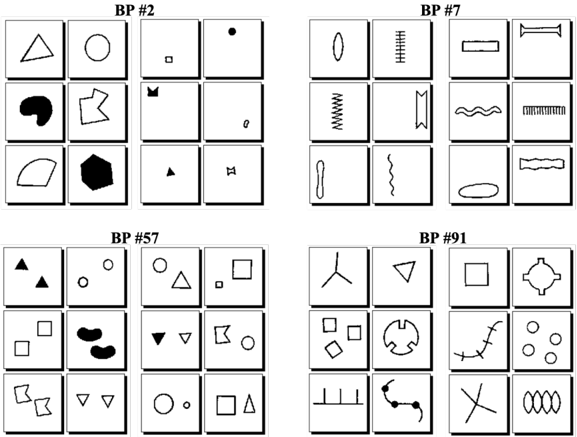
The image presents four sets of visual stimuli, labeled BP #2, BP #7, BP #57, and BP #91. Each set consists of a 3x3 grid of distinct black and white shapes or patterns. The purpose appears to be to display a collection of visual elements for potential use in a study or experiment.
### Components/Axes
The image is organized into four distinct quadrants, each representing a different stimulus set. Each quadrant is labeled with a "BP #" identifier at the top-center. Within each quadrant, the stimuli are arranged in a 3x3 grid. There are no explicit axes or legends beyond the BP labels.
### Detailed Analysis or Content Details
**BP #2 (Top-Left)**
* Row 1: Triangle, Circle, Square
* Row 2: Irregular blob, Star-shaped polygon, Small square
* Row 3: Irregular polygon, Hexagon, Triangle
**BP #7 (Top-Right)**
* Row 1: Oval, Vertical lines, Rectangle
* Row 2: Wavy lines, Chevron shape, Wavy lines
* Row 3: Curved line, Sinuous line, Oval
**BP #57 (Bottom-Left)**
* Row 1: Triangle, Circle, Square
* Row 2: Irregular blob, Triangle, Square
* Row 3: Triangle, Triangle, Circle
**BP #91 (Bottom-Right)**
* Row 1: Humanoid shape, Triangle, Square
* Row 2: Square, Spiral, Circle
* Row 3: Lines, Curved line, Circles
### Key Observations
Each BP set contains a variety of shapes and patterns. There is some repetition of basic shapes (circles, triangles, squares) across different BP sets, but the overall composition of each set is unique. The shapes vary in complexity, ranging from simple geometric forms to more irregular and complex patterns.
### Interpretation
The image likely represents a set of visual stimuli designed for a perceptual or cognitive study. The different BP sets could be used to investigate how humans process and discriminate between different visual features. The variation in shape complexity and pattern density within each set may be intended to manipulate the difficulty of the task. The BP labels suggest that these are different "blocks of presentation" or experimental conditions. The lack of further context makes it difficult to determine the specific purpose of these stimuli, but they appear to be carefully selected to elicit specific responses from participants. The repetition of shapes across sets could be used to control for certain variables or to assess the effects of context on perception.