## Diagram: Abstract Symbol Grids (BP #2, #7, #57, #91)
### Overview
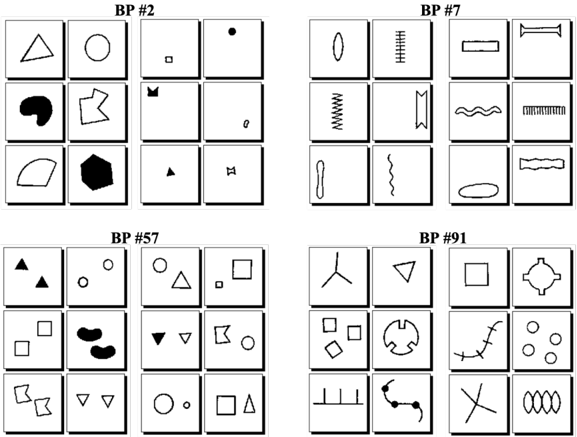
The image displays four distinct panels, each containing a 3x3 grid of squares. Each square contains a unique abstract black-and-white symbol or shape. The panels are labeled with identifiers in the top-left corner of each panel's area. There is no numerical data, axes, or traditional chart elements. The content is purely graphical, presenting a collection of visual forms.
### Components/Axes
* **Panel Labels:** Four text labels are present, each positioned above a corresponding grid:
* `BP #2` (Top-left panel)
* `BP #7` (Top-right panel)
* `BP #57` (Bottom-left panel)
* `BP #91` (Bottom-right panel)
* **Grid Structure:** Each panel is a 3x3 matrix of outlined squares. The squares are arranged in three rows and three columns.
* **Content:** Each square contains a single, distinct black shape or line drawing on a white background. The shapes are abstract and vary in complexity, from simple geometric forms to more organic or intricate patterns.
### Detailed Analysis
**Panel BP #2 (Top-Left):**
* **Row 1:** Triangle (top-left), Circle (top-center), Small square (top-right).
* **Row 2:** Irregular blob (middle-left), Irregular polygon (middle-center), Small irregular shape (middle-right).
* **Row 3:** Quarter-circle/arc shape (bottom-left), Solid hexagon (bottom-center), Small triangle (bottom-right).
**Panel BP #7 (Top-Right):**
* **Row 1:** Vertical oval (top-left), Vertical line with cross-hatching (top-center), Horizontal rectangle (top-right).
* **Row 2:** Vertical zigzag line (middle-left), Vertical line with a forked top (middle-center), Horizontal wavy line (middle-right).
* **Row 3:** Vertical line with a loop at the bottom (bottom-left), Vertical wavy line (bottom-center), Horizontal oval (bottom-right).
**Panel BP #57 (Bottom-Left):**
* **Row 1:** Two triangles (top-left), Two circles (top-center), Circle and triangle (top-right).
* **Row 2:** Two squares (middle-left), Two irregular blobs (middle-center), Triangle and inverted triangle (middle-right).
* **Row 3:** Two irregular polygons (bottom-left), Two inverted triangles (bottom-center), Circle and square (bottom-right).
**Panel BP #91 (Bottom-Right):**
* **Row 1:** Three-pronged shape (top-left), Inverted triangle (top-center), Square (top-right).
* **Row 2:** Two squares (middle-left), Circular shape with indentations (middle-center), Curved line with cross-marks (middle-right).
* **Row 3:** Three vertical lines with bases (bottom-left), Chain of connected dots (bottom-center), Four intersecting lines (bottom-right).
### Key Observations
1. **Categorical Grouping:** The panels appear to be categorized by the `BP #` label, suggesting they belong to different sets or classes.
2. **Internal Variation:** Within each panel, the symbols show variation in form (geometric vs. organic), complexity (simple vs. intricate), and composition (single shape vs. multiple elements).
3. **Spatial Consistency:** The 3x3 grid layout is consistent across all four panels.
4. **Absence of Data:** There are no numerical values, scales, legends, or axes. The information is entirely qualitative and visual.
### Interpretation
This image does not present factual data or measurable trends. Instead, it serves as a **visual catalog or reference sheet of abstract symbols**.
* **Purpose:** The grids likely function as a stimulus set for a psychological test (e.g., a perceptual or memory test), a design system's icon library, or a dataset for training a machine learning model in shape recognition. The `BP #` labels are identifiers for different categories or batches of these symbols.
* **Relationships:** The primary relationship is categorical. Symbols within the same `BP #` panel are presumed to share a common attribute or belong to the same class, as defined by the unseen criteria of the test or system. The variation within a panel demonstrates the range of forms that class can take.
* **Notable Patterns:** The progression from simpler shapes in `BP #2` to more complex, composite, or linear forms in `BP #7` and `BP #91` might indicate increasing difficulty or a different category of symbol. `BP #57` is distinct in frequently featuring pairs of related shapes.
* **Underlying Logic:** The "data" here is the visual morphology itself. The arrangement suggests an investigation into how visual forms are categorized, remembered, or distinguished. The lack of explicit meaning for the symbols implies their value is in their structural properties, not in representing real-world objects.