TECHNICAL ASSET FINGERPRINT
45988a4d51e3dfa69023fac6
Click to view fullscreen
Press ESC or click to close
FOUND IN PAPERS
EXPERT: gemini-2.5-flash-lite-free VERSION 1
RUNTIME: google-free/gemini-2.5-flash-lite
INTEL_VERIFIED
## Diagram: Math Knowledge Graph Representation
### Overview
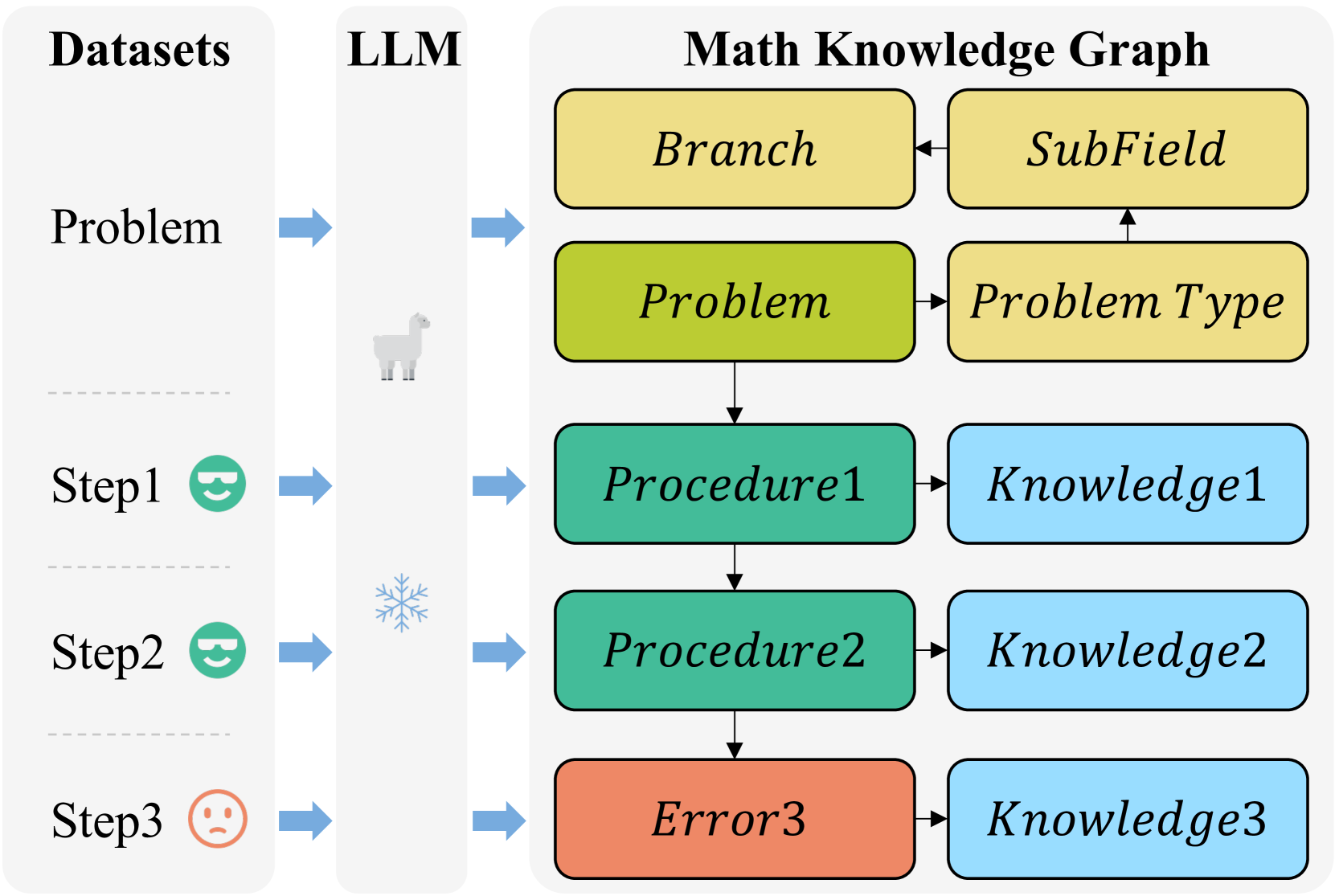
This diagram illustrates a conceptual framework for representing mathematical knowledge, likely within the context of a Large Language Model (LLM) or a similar AI system. It depicts a flow from "Datasets" and "LLM" inputs into a structured "Math Knowledge Graph." The graph is composed of interconnected nodes representing different aspects of mathematical concepts, procedures, and outcomes.
### Components/Axes
The diagram is organized into three main vertical columns: "Datasets," "LLM," and "Math Knowledge Graph."
**Column 1: Datasets**
This column lists potential inputs or stages:
* **Problem**: Represented by text.
* **Step 1**: Accompanied by a "thumbs up" emoji (indicating success or a positive state).
* **Step 2**: Accompanied by a "thumbs up" emoji (indicating success or a positive state) and a snowflake icon.
* **Step 3**: Accompanied by a "sad face" emoji (indicating an error or a negative state).
**Column 2: LLM**
This column contains symbolic representations that likely indicate the LLM's processing or state at different stages:
* A llama icon is positioned next to "Problem."
* A snowflake icon is positioned next to "Step 2."
* Blue arrows connect the "Datasets" column to this "LLM" column and then to the "Math Knowledge Graph" column, indicating a flow of information or processing.
**Column 3: Math Knowledge Graph**
This column contains a series of interconnected rectangular nodes, color-coded and labeled, representing the structure of mathematical knowledge:
* **Yellow Nodes**:
* `Branch`: Positioned at the top-left.
* `SubField`: Positioned at the top-right, with an arrow pointing towards `Branch`.
* **Green Nodes**:
* `Problem`: Positioned below `Branch`, with an arrow pointing towards `Problem Type`.
* `Procedure1`: Positioned below `Problem`, with a downward arrow from `Problem`.
* `Procedure2`: Positioned below `Procedure1`, with a downward arrow from `Procedure1`.
* **Orange Node**:
* `Error3`: Positioned below `Procedure2`, with a downward arrow from `Procedure2`.
* **Blue Nodes**:
* `Knowledge1`: Positioned to the right of `Procedure1`, with an arrow pointing from `Procedure1`.
* `Knowledge2`: Positioned to the right of `Procedure2`, with an arrow pointing from `Procedure2`.
* `Knowledge3`: Positioned to the right of `Error3`, with an arrow pointing from `Error3`.
**Arrows:**
* Blue arrows indicate the primary flow of information from "Datasets" through "LLM" into the "Math Knowledge Graph."
* Black arrows within the "Math Knowledge Graph" indicate relationships and dependencies between nodes. Specifically:
* An arrow points from `SubField` to `Branch`.
* An arrow points from `Problem` to `Problem Type`.
* Downward arrows connect `Problem` to `Procedure1`, `Procedure1` to `Procedure2`, and `Procedure2` to `Error3`.
* Arrows point from `Procedure1` to `Knowledge1`, `Procedure2` to `Knowledge2`, and `Error3` to `Knowledge3`.
### Detailed Analysis or Content Details
The diagram outlines a hierarchical and procedural representation of mathematical knowledge.
* **Top Level**: `Branch` and `SubField` are related, with `SubField` potentially being a component or precursor to `Branch`.
* **Problem Representation**: A `Problem` is linked to its `Problem Type`. This suggests that problems are categorized.
* **Procedural Flow**: The diagram shows a sequence of procedures (`Procedure1`, `Procedure2`) that are likely executed to solve a problem.
* **Error Handling**: `Error3` is presented as a distinct outcome, possibly representing a failure or a specific type of error encountered during a procedure.
* **Knowledge Association**: Each procedure and the error state are associated with specific `Knowledge` components (`Knowledge1`, `Knowledge2`, `Knowledge3`). This implies that solving a procedure or encountering an error leads to or requires specific knowledge.
The "Datasets" column, with its emojis and icons, suggests a progression through different states or types of data being processed.
* "Problem" is the initial input, processed by the LLM (llama icon).
* "Step 1" (thumbs up) leads to a procedure and knowledge.
* "Step 2" (thumbs up, snowflake) leads to another procedure and knowledge. The snowflake might indicate a specific condition or type of problem/procedure.
* "Step 3" (sad face) leads to an error and associated knowledge.
### Key Observations
* The diagram emphasizes a structured approach to mathematical knowledge, moving from abstract concepts (`Branch`, `SubField`) to concrete problem-solving steps (`Procedure`) and outcomes (`Knowledge`, `Error`).
* The use of emojis in the "Datasets" column provides a qualitative indication of the success or failure of processing steps.
* The snowflake icon associated with "Step 2" and the LLM column suggests a potential specialization or condition related to that step.
* The explicit inclusion of "Error3" indicates that the system accounts for potential failures and links them to specific knowledge.
### Interpretation
This diagram likely represents a model for how an LLM might process and understand mathematical problems. The "Datasets" column could represent user input or intermediate states in a problem-solving process. The "LLM" column signifies the AI's engagement with these inputs. The "Math Knowledge Graph" is the core representation, where mathematical entities are organized and related.
The flow suggests that a problem is first understood in terms of its `Branch` and `SubField`, then its `Problem Type`. Subsequently, a series of `Procedures` are applied, each associated with specific `Knowledge`. The inclusion of `Error3` indicates that the model is designed to handle and potentially learn from errors. The emojis in the "Datasets" column could be interpreted as feedback mechanisms or indicators of the quality of the input or the success of a particular step. The snowflake icon might represent a specific type of mathematical problem (e.g., related to calculus, physics, or a specific algorithm) that the LLM is processing.
Overall, the diagram illustrates a structured, knowledge-driven approach to mathematical problem-solving, where different components of mathematical understanding are interconnected and processed sequentially. It suggests a system that can not only solve problems but also potentially diagnose errors and associate knowledge with different stages of the process.
DECODING INTELLIGENCE...