# Technical Document Extraction: MSE vs. Pilot Size Analysis
## Image Description
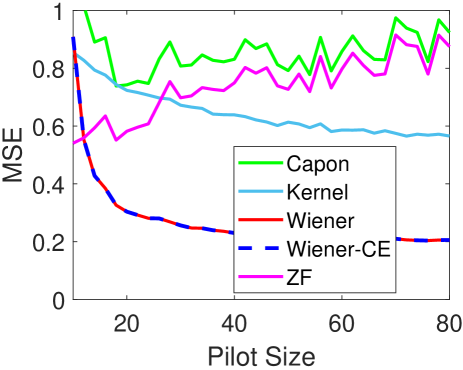
The image is a line graph titled **"MSE vs. Pilot Size"**, plotting the **Mean Squared Error (MSE)** against **Pilot Size** (x-axis). The y-axis ranges from 0 to 1, and the x-axis ranges from 0 to 80. Five distinct data series are represented, each with unique line styles and colors, as detailed in the legend.
---
## Key Components
### 1. **Axis Labels**
- **Y-Axis**: Labeled **"MSE"** (Mean Squared Error), with values ranging from 0 to 1 in increments of 0.2.
- **X-Axis**: Labeled **"Pilot Size"**, with values ranging from 0 to 80 in increments of 20.
### 2. **Legend**
- Located in the **bottom-right corner** of the graph.
- **Color-Coded Labels**:
- **Green (Solid)**: Capon
- **Blue (Solid)**: Kernel
- **Red (Solid)**: Wiener
- **Dashed Blue**: Wiener-CE
- **Magenta (Solid)**: ZF
### 3. **Line Series**
Five data series are plotted, each corresponding to a method or algorithm. Below is a detailed breakdown of their trends:
---
## Data Series Analysis
### 1. **Capon (Green Solid Line)**
- **Trend**:
- Starts at **~0.8** (x=0).
- Exhibits **high-frequency oscillations** (peaks ~0.8–0.9, troughs ~0.6–0.7) between x=0 and x=40.
- Gradually **declines** to **~0.6** by x=80.
- **Key Points**:
- x=0: ~0.8
- x=20: ~0.7
- x=40: ~0.7
- x=60: ~0.65
- x=80: ~0.6
### 2. **Kernel (Blue Solid Line)**
- **Trend**:
- Starts at **~0.8** (x=0).
- **Gradually declines** to **~0.6** by x=40.
- Stabilizes at **~0.6** for x > 40.
- **Key Points**:
- x=0: ~0.8
- x=20: ~0.7
- x=40: ~0.6
- x=60: ~0.6
- x=80: ~0.6
### 3. **Wiener (Red Solid Line)**
- **Trend**:
- Starts at **~0.8** (x=0).
- **Sharp decline** to **~0.2** by x=20.
- Remains **flat at ~0.2** for x > 20.
- **Key Points**:
- x=0: ~0.8
- x=20: ~0.2
- x=40: ~0.2
- x=60: ~0.2
- x=80: ~0.2
### 4. **Wiener-CE (Dashed Blue Line)**
- **Trend**:
- Starts at **~0.8** (x=0).
- **Sharp decline** to **~0.2** by x=20.
- Remains **flat at ~0.2** for x > 20.
- **Key Points**:
- x=0: ~0.8
- x=20: ~0.2
- x=40: ~0.2
- x=60: ~0.2
- x=80: ~0.2
### 5. **ZF (Magenta Solid Line)**
- **Trend**:
- Starts at **~0.6** (x=0).
- **Fluctuates** between ~0.6 and ~0.8 for x=0–40.
- **Gradually increases** to **~0.8** by x=80.
- **Key Points**:
- x=0: ~0.6
- x=20: ~0.7
- x=40: ~0.75
- x=60: ~0.8
- x=80: ~0.8
---
## Cross-Reference Verification
- **Legend Colors vs. Line Colors**:
- Confirmed: Green = Capon, Blue = Kernel, Red = Wiener, Dashed Blue = Wiener-CE, Magenta = ZF.
- **Line Styles**:
- Solid lines: Capon, Kernel, Wiener, ZF.
- Dashed line: Wiener-CE.
---
## Spatial Grounding
- **Legend Position**: Bottom-right corner (x=70–80, y=0.2–0.8).
- **Line Placement**:
- All lines originate at x=0 and extend to x=80.
- No overlapping lines except for Wiener and Wiener-CE (both start at x=0, y=0.8).
---
## Observations
1. **Wiener and Wiener-CE** perform identically, suggesting the "CE" modification does not alter the MSE trend.
2. **Capon** shows the most variability but trends downward over time.
3. **ZF** improves performance (lower MSE) as pilot size increases.
4. **Kernel** stabilizes at a moderate MSE (~0.6) after initial decline.
---
## Conclusion
The graph illustrates the performance of five methods (Capon, Kernel, Wiener, Wiener-CE, ZF) in terms of MSE across varying pilot sizes. Wiener and Wiener-CE achieve the lowest MSE (~0.2) by x=20, while ZF shows the most improvement with increasing pilot size. Capon and Kernel exhibit higher MSE values but demonstrate distinct trends.