## Line Graph: Peak Memory Usage vs. Model Parameters
### Overview
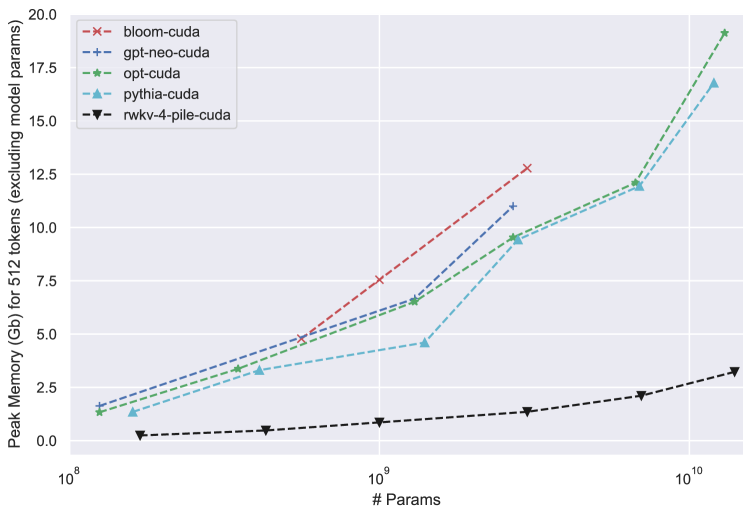
The graph illustrates the relationship between the number of parameters (# Params) and peak memory usage (excluding model parameters) for five different CUDA-optimized models. The x-axis uses a logarithmic scale (10⁸ to 10¹⁰ parameters), while the y-axis ranges from 0 to 20 GB. Each model is represented by a distinct line style and color, with trends showing how memory requirements scale with model complexity.
### Components/Axes
- **X-axis**: "# Params" (logarithmic scale: 10⁸, 10⁹, 10¹⁰)
- **Y-axis**: "Peak Memory (GB) for 512 tokens (excluding model params)" (linear scale: 0–20 GB)
- **Legend**: Located in the top-left corner, mapping colors and markers to models:
- Red crosses: bloom-cuda
- Blue pluses: gpt-neo-cuda
- Green stars: opt-cuda
- Cyan triangles: pythia-cuda
- Black triangles: rwkv-4-pile-cuda
### Detailed Analysis
1. **bloom-cuda (Red Cross)**:
- Starts at ~2 GB for 10⁸ params, rising steeply to ~12.5 GB at 10⁹ params, then plateauing.
- At 10¹⁰ params, memory usage spikes to ~17.5 GB.
2. **gpt-neo-cuda (Blue Plus)**:
- Begins at ~1.5 GB for 10⁸ params, increasing to ~6 GB at 10⁹ params, then ~10 GB at 10¹⁰ params.
3. **opt-cuda (Green Star)**:
- Starts at ~1 GB for 10⁸ params, rising to ~5 GB at 10⁹ params, then ~11 GB at 10¹⁰ params.
4. **pythia-cuda (Cyan Triangle)**:
- Begins at ~0.5 GB for 10⁸ params, increasing to ~4 GB at 10⁹ params, then ~11.5 GB at 10¹⁰ params.
5. **rwkv-4-pile-cuda (Black Triangle)**:
- Remains flat at ~0.1 GB for 10⁸ params, rising slightly to ~0.5 GB at 10⁹ params, then ~2.5 GB at 10¹⁰ params.
### Key Observations
- **Scaling Trends**: All models except rwkv-4-pile-cuda exhibit exponential memory growth with parameter count. bloom-cuda and pythia-cuda show the steepest increases.
- **Efficiency Outlier**: rwkv-4-pile-cuda maintains significantly lower memory usage across all parameter ranges.
- **Divergence at 10¹⁰ Params**: bloom-cuda and pythia-cuda surpass other models in memory consumption, while rwkv-4-pile-cuda remains the most efficient.
### Interpretation
The data suggests that memory efficiency varies dramatically between models. rwkv-4-pile-cuda’s flat curve implies architectural optimizations (e.g., sparse attention, quantization) that reduce memory overhead, making it suitable for resource-constrained deployments. In contrast, bloom-cuda and pythia-cuda’s steep curves highlight their unsuitability for large-scale models without specialized hardware. The divergence at 10¹⁰ params underscores the trade-off between model size and practicality, with rwkv-4-pile-cuda offering a viable alternative for memory-constrained environments.