## Line Graph: Shannon and Bayesian Surprises
### Overview
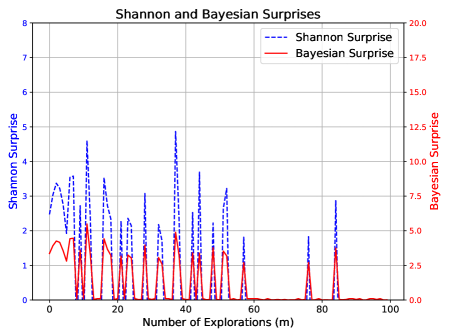
The image is a line graph comparing two metrics, "Shannon Surprise" and "Bayesian Surprise," plotted against the "Number of Explorations (m)" on the x-axis. The graph includes two y-axes: the left axis (blue dashed line) represents "Shannon Surprise" (0–8), and the right axis (red solid line) represents "Bayesian Surprise" (0–20). The legend is positioned in the top-right corner, with blue dashed lines for Shannon Surprise and red solid lines for Bayesian Surprise.
### Components/Axes
- **Title**: "Shannon and Bayesian Surprises" (centered at the top).
- **X-axis**: "Number of Explorations (m)" with a linear scale from 0 to 100.
- **Y-axes**:
- Left: "Shannon Surprise" (0–8, increments of 1).
- Right: "Bayesian Surprise" (0–20, increments of 2.5).
- **Legend**: Top-right corner, with:
- Blue dashed line: "Shannon Surprise"
- Red solid line: "Bayesian Surprise"
### Detailed Analysis
- **Shannon Surprise (Blue Dashed Line)**:
- Peaks occur at approximately 10m, 20m, 30m, 40m, 50m, 60m, 70m, 80m, and 90m.
- Maximum value: ~7.5 (at ~20m and ~40m).
- Minimum value: ~0 (at ~0m, ~60m, and ~100m).
- Trend: Irregular, with sharp spikes and troughs, suggesting high variability.
- **Bayesian Surprise (Red Solid Line)**:
- Peaks occur at approximately 10m, 30m, 50m, 70m, and 90m.
- Maximum value: ~15 (at ~30m and ~70m).
- Minimum value: ~0 (at ~0m, ~60m, and ~100m).
- Trend: More consistent peaks compared to Shannon Surprise, with smoother transitions between values.
### Key Observations
1. **Scale Disparity**: The Bayesian Surprise metric operates on a scale 2.5× larger than Shannon Surprise, despite both being labeled as "surprise" measures.
2. **Peak Correlation**: Both metrics share peak positions at ~10m, ~30m, ~50m, ~70m, and ~90m, suggesting a shared underlying pattern in exploration milestones.
3. **Shannon Variability**: Shannon Surprise exhibits more frequent and erratic fluctuations (e.g., ~20m, ~40m, ~80m), while Bayesian Surprise remains relatively stable between peaks.
4. **Axis Independence**: The dual y-axes imply the metrics are not directly comparable in magnitude but may represent different dimensions of "surprise."
### Interpretation
The graph illustrates two distinct methods of quantifying "surprise" during exploration. The Shannon Surprise metric (blue) appears more sensitive to short-term fluctuations, with sharp peaks and troughs, possibly reflecting immediate uncertainties or information gains. In contrast, the Bayesian Surprise metric (red) shows broader, more sustained peaks, potentially capturing cumulative or probabilistic surprises over exploration intervals. The shared peak positions suggest that certain exploration milestones (e.g., 10m, 30m) are critical for both metrics, though their magnitudes differ significantly. The scale disparity raises questions about normalization or unit differences between the two methods. This could indicate that Bayesian Surprise is designed to aggregate or smooth data, while Shannon Surprise prioritizes granular, real-time variability. The absence of data beyond 100m explorations may imply a cutoff in the study or a stabilization of surprise metrics at later stages.