\n
## Line Chart: Shannon and Bayesian Surprises
### Overview
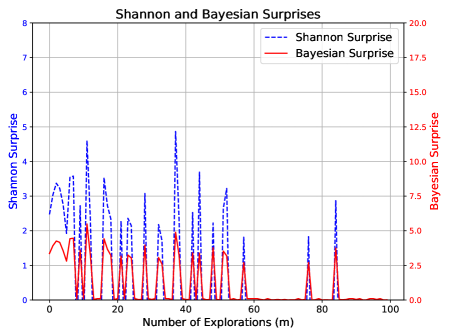
The image presents a line chart comparing Shannon Surprise and Bayesian Surprise over a number of explorations (m). The chart displays two distinct lines representing each surprise metric, plotted against the number of explorations, ranging from 0 to 100. The y-axis for Shannon Surprise is on the left, ranging from 0 to 8, while the y-axis for Bayesian Surprise is on the right, ranging from 0 to 20.
### Components/Axes
* **Title:** "Shannon and Bayesian Surprises" (centered at the top)
* **X-axis:** "Number of Explorations (m)" (bottom, ranging from 0 to 100)
* **Left Y-axis:** "Shannon Surprise" (ranging from 0 to 8)
* **Right Y-axis:** "Bayesian Surprise" (ranging from 0 to 20)
* **Legend:** Located in the top-right corner.
* "Shannon Surprise" - represented by a dashed blue line.
* "Bayesian Surprise" - represented by a solid red line.
### Detailed Analysis
**Bayesian Surprise (Red Line):**
The red line representing Bayesian Surprise starts at approximately 1.8 at m=0, rises to a peak of around 2.2 at m=2, then rapidly declines to near 0 by m=10. It remains very close to 0 for the majority of the exploration range (m=10 to m=90), with minor fluctuations. At m=90, it rises to approximately 1.5 and then falls back to near 0 at m=100. The trend is generally decreasing, with a sharp initial drop and then a sustained low level.
**Shannon Surprise (Blue Dashed Line):**
The blue dashed line representing Shannon Surprise exhibits a much more volatile pattern. It starts at approximately 0.5 at m=0, rises to a peak of around 3.5 at m=4, then falls to approximately 1.5 at m=8. It continues to fluctuate significantly throughout the exploration range, with multiple peaks and valleys. Notable peaks occur around m=12 (approximately 3.0), m=20 (approximately 3.5), m=30 (approximately 4.0), m=40 (approximately 5.0), m=50 (approximately 3.0), m=60 (approximately 3.5), m=70 (approximately 2.5), and m=80 (approximately 3.0). The line ends at approximately 1.0 at m=100. The trend is highly variable, with no clear overall direction.
### Key Observations
* Bayesian Surprise is consistently much lower than Shannon Surprise for most of the exploration range.
* Shannon Surprise exhibits significant fluctuations, indicating a high degree of uncertainty or information gain during exploration.
* Bayesian Surprise drops rapidly and remains low, suggesting that the initial surprise quickly diminishes as the exploration progresses.
* There is a noticeable peak in Shannon Surprise around m=40, which is significantly higher than other peaks.
* Both lines show some activity around m=90, but the Bayesian Surprise remains very low.
### Interpretation
The chart suggests that the initial explorations provide a significant amount of information (high Shannon Surprise), but this information quickly becomes predictable (low Bayesian Surprise). The sustained low Bayesian Surprise indicates that the exploration process is converging on a relatively stable understanding of the environment. The fluctuations in Shannon Surprise suggest that there are still unexpected events or discoveries occurring throughout the exploration process, even after the initial period of high surprise. The peak at m=40 could represent a particularly informative or surprising event during the exploration. The difference between the two surprise measures highlights the distinction between the raw amount of information gained (Shannon Surprise) and the information that is relevant given prior beliefs (Bayesian Surprise). The chart demonstrates how Bayesian Surprise can filter out irrelevant information, focusing on the unexpected events that truly challenge existing beliefs.