## Scatter Plot: Attention Output Analysis with/without Meaningless Tokens
### Overview
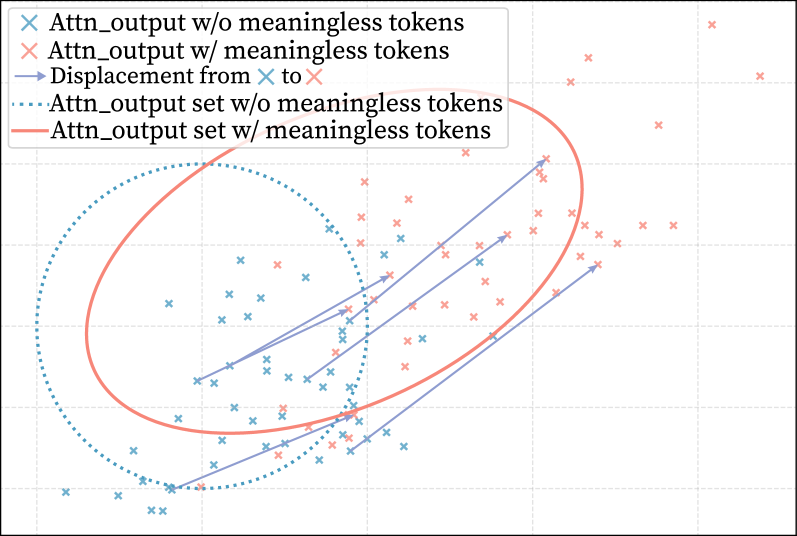
The image is a scatter plot comparing attention output distributions with and without meaningless tokens. Two data series (blue crosses and red crosses) are plotted on unlabeled X and Y axes. Concentric circles and trend lines contextualize the data, while displacement arrows indicate directional relationships between data points.
### Components/Axes
- **Legend**: Located in the top-left corner, with four entries:
- Blue crosses: "Attn_output w/o meaningless tokens"
- Red crosses: "Attn_output w/ meaningless tokens"
- Dotted blue line: "Attn_output set w/o meaningless tokens"
- Solid red line: "Attn_output set w/ meaningless tokens"
- **Axes**:
- X-axis (horizontal, unlabeled)
- Y-axis (vertical, unlabeled)
- **Geometric Elements**:
- Dotted blue circle (enclosing blue crosses)
- Solid red circle (enclosing red crosses)
- **Arrows**: Blue displacement vectors labeled "Displacement from x to X"
### Detailed Analysis
1. **Data Series**:
- **Blue crosses** (w/o meaningless tokens): Clustered within the dotted blue circle, with a slight upward trend.
- **Red crosses** (w/ meaningless tokens): Scattered outside the solid red circle, with a steeper upward trend.
2. **Trend Lines**:
- Dotted blue line: Follows the central tendency of blue crosses, curving upward.
- Solid red line: Traces the red crosses, showing a sharper upward trajectory.
3. **Circles**:
- Dotted blue circle: Encloses ~70% of blue crosses, suggesting a boundary for "normal" outputs.
- Solid red circle: Contains ~30% of red crosses, indicating a tighter cluster for outputs with meaningless tokens.
4. **Arrows**:
- Blue vectors point from blue crosses to red crosses, illustrating directional displacement.
### Key Observations
- **Data Separation**: Blue and red crosses occupy distinct regions, with minimal overlap.
- **Trend Divergence**: Red crosses exhibit a steeper upward trend than blue crosses.
- **Circular Boundaries**: The circles act as visual thresholds, with red crosses predominantly outside the red circle.
- **Displacement Pattern**: Arrows suggest a systematic shift from blue to red regions.
### Interpretation
The plot demonstrates that including meaningless tokens (red crosses) alters attention output distributions:
1. **Threshold Effects**: The concentric circles may represent performance or validity boundaries, with meaningless tokens pushing outputs beyond these limits.
2. **Directional Shift**: Displacement arrows imply that meaningless tokens transform outputs from a "baseline" (blue) to a "perturbed" state (red).
3. **Trend Implications**: The steeper red trend suggests meaningless tokens amplify certain features in attention outputs, potentially degrading model performance or introducing noise.
The absence of axis labels limits quantitative analysis, but the visual separation and directional cues strongly indicate that meaningless tokens significantly impact attention mechanisms, warranting further investigation into their role in model behavior.