## Histograms: Residual Norm Distributions
### Overview
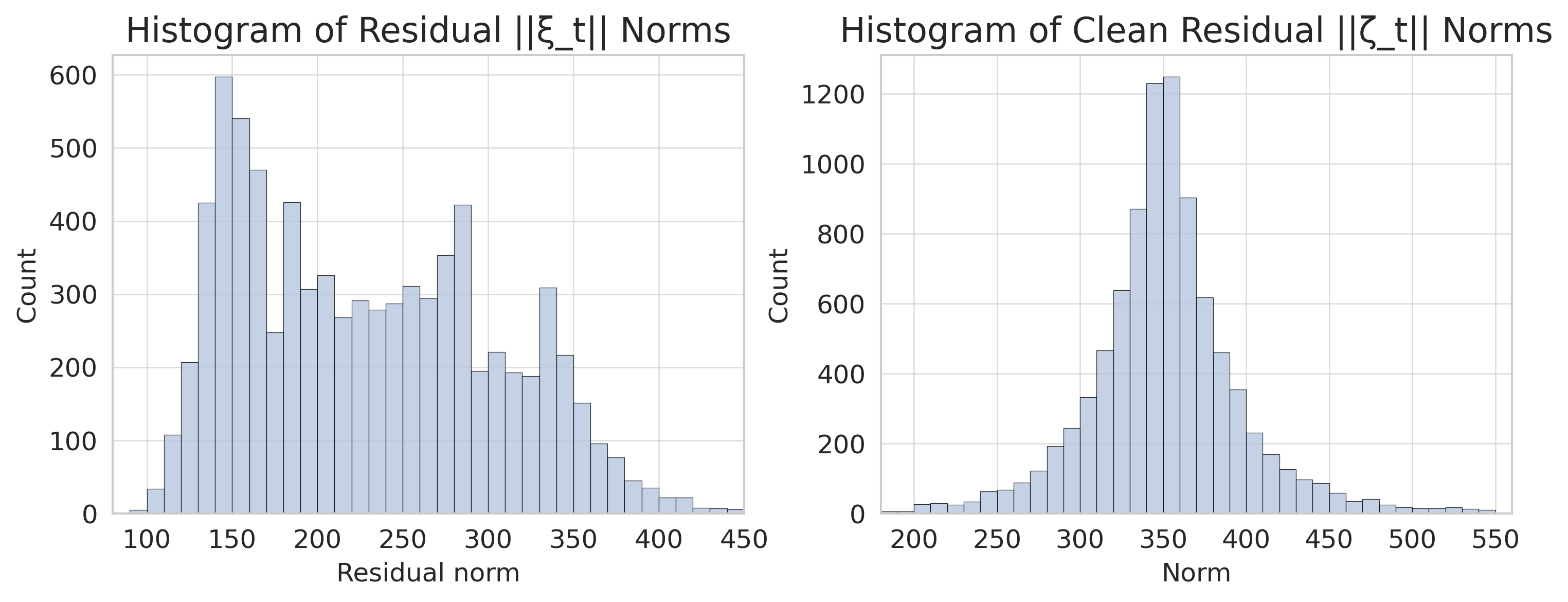
The image displays two side-by-side histograms comparing the distribution of residual norms before and after a cleaning or processing step. The left histogram shows the distribution of raw residual norms (||ξ_t||), while the right histogram shows the distribution of "clean" residual norms (||ζ_t||). Both charts share a similar visual style with light blue bars and a grid background.
### Components/Axes
**Left Histogram:**
* **Title:** "Histogram of Residual ||ξ_t|| Norms"
* **Y-axis Label:** "Count"
* **Y-axis Scale:** Linear, ranging from 0 to 600, with major ticks at intervals of 100.
* **X-axis Label:** "Residual norm"
* **X-axis Scale:** Linear, ranging from approximately 100 to 450, with major ticks labeled at 100, 150, 200, 250, 300, 350, 400, and 450.
**Right Histogram:**
* **Title:** "Histogram of Clean Residual ||ζ_t|| Norms"
* **Y-axis Label:** "Count"
* **Y-axis Scale:** Linear, ranging from 0 to 1200, with major ticks at intervals of 200.
* **X-axis Label:** "Norm"
* **X-axis Scale:** Linear, ranging from approximately 200 to 550, with major ticks labeled at 200, 250, 300, 350, 400, 450, 500, and 550.
**Legend/Color:** No explicit legend is present. All bars in both histograms are filled with the same light blue color and have a dark outline.
### Detailed Analysis
**Left Histogram (Residual ||ξ_t|| Norms):**
* **Distribution Shape:** The distribution is right-skewed (positively skewed). It has a long tail extending towards higher norm values.
* **Peak (Mode):** The highest bar is located in the bin corresponding to a residual norm of approximately **150-160**. The count at this peak is approximately **600**.
* **Range:** The data spans from a minimum norm of just above **100** to a maximum of approximately **450**.
* **Key Data Points (Approximate):**
* Norm ~150-160: Count ~600 (Peak)
* Norm ~140-150: Count ~540
* Norm ~160-170: Count ~470
* Norm ~180-190: Count ~420
* Norm ~280-290: Count ~420 (Secondary local peak)
* Norm ~330-340: Count ~310
* Norm ~400: Count ~50
* **Trend:** The frequency of counts generally decreases as the residual norm increases, but with notable local peaks and valleys, indicating a multi-modal or irregular underlying distribution.
**Right Histogram (Clean Residual ||ζ_t|| Norms):**
* **Distribution Shape:** The distribution is approximately symmetric and bell-shaped, closely resembling a normal (Gaussian) distribution.
* **Peak (Mode):** The highest bar is located in the bin corresponding to a norm of approximately **350-360**. The count at this peak is approximately **1250**.
* **Range:** The data spans from a minimum norm of approximately **200** to a maximum of approximately **550**.
* **Key Data Points (Approximate):**
* Norm ~350-360: Count ~1250 (Peak)
* Norm ~340-350: Count ~1220
* Norm ~360-370: Count ~900
* Norm ~330-340: Count ~870
* Norm ~320-330: Count ~640
* Norm ~370-380: Count ~610
* Norm ~300: Count ~200
* Norm ~400: Count ~220
* **Trend:** The counts rise smoothly to a central peak and then fall symmetrically, with the majority of the data concentrated between norms of 300 and 400.
### Key Observations
1. **Distribution Transformation:** The cleaning process has fundamentally changed the distribution of the residuals from a right-skewed, irregular shape to a symmetric, normal-like shape.
2. **Shift in Central Tendency:** The central value (mean/median/mode) has shifted significantly to the right, from approximately **150-160** in the raw residuals to approximately **350-360** in the clean residuals.
3. **Change in Spread:** While the raw residuals have a wide range (100-450), the clean residuals are more concentrated around their mean, though their absolute range (200-550) is similar. The clean data has a higher peak density (max count ~1250 vs. ~600).
4. **Reduction of Irregularities:** The secondary peaks and irregularities present in the left histogram (e.g., around norms 280 and 330) are absent in the right histogram, which shows a smooth, unimodal curve.
### Interpretation
This pair of histograms visually demonstrates the effect of a data cleaning or signal processing algorithm on a set of residual errors (ξ_t). The raw residuals (||ξ_t||) are not normally distributed; their right skew suggests the presence of outliers or a process that generates occasional large errors. The irregular, multi-modal shape might indicate different underlying error sources or regimes.
The "clean" residuals (||ζ_t||) show a classic normal distribution centered at a higher norm value. This transformation is significant for several reasons:
* **Statistical Validity:** Many statistical models and inference techniques assume normally distributed errors. The cleaning process appears to have produced residuals that better meet this assumption.
* **Process Understanding:** The shift to a higher central norm is intriguing. It suggests the cleaning algorithm didn't simply shrink all residuals uniformly. Instead, it may have removed specific noise components (e.g., high-frequency noise, outliers) that were suppressing the underlying signal's norm, or it may have re-scaled the residuals. The higher, stable norm in the clean data could represent the inherent, irreducible error of the core model after confounding factors are removed.
* **Algorithm Efficacy:** The smoothing of the distribution into a unimodal, symmetric shape indicates the algorithm successfully homogenized the error structure, making the residuals more predictable and easier to model statistically.
In essence, the image provides strong visual evidence that the applied cleaning process successfully transformed noisy, irregularly distributed residuals into a well-behaved, normally distributed set of errors, which is a desirable outcome in many modeling and estimation tasks.